



Tamarindus indica L. (Tamarind)
Description
Tamarindus indica (family Fabaceae, subfamily Caesalpinioideae) is a large, long-lived evergreen tropical tree native to eastern Africa and now widely cultivated across South Asia, Central America, and other tropical regions.
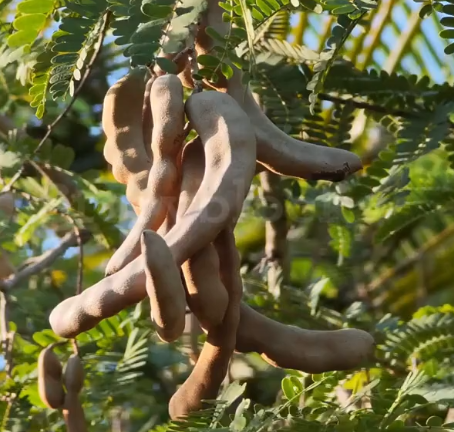
It produces long, brown, woody pods containing a sticky, reddish-brown pulp with a sweet-and-sour taste, highly valued in both cuisine and traditional medicine. Tamarind is well known for its digestive, laxative, antioxidant, and refreshing properties, largely due to its organic acids, sugars, and polyphenols.
Botanical classification (APG IV system)
Kingdom: Plantae
Clade: Angiosperms → Eudicots → Rosids → Fabids
Order: Fabales
Family: Fabaceae
Genus: Tamarindus
Species: Tamarindus indica L.
Tamarind is therefore a legume (Fabaceae), not a citrus-type fruit.
Indicative nutritional values per 100 g (tamarind pulp, raw)
| Component | Approx. value per 100 g |
|---|---|
| Energy | ~ 239 kcal |
| Total carbohydrates | ~ 62.5 g |
| — of which sugars | ~ 38.8–57.4 g (depending on maturation/variety) |
| Dietary fibre | ~ 5.1 g |
| Proteins | ~ 2.8 g |
| Total fats | ~ 0.6 g |
| — of which saturated fatty acids (SFA) | ~ 0.27 g |
| — monounsaturated | ~ 0.18 g |
| — polyunsaturated | ~ 0.06 g |
| Sodium | ~ 28 mg |
| Potassium | ~ 628 mg |
| Calcium | ~ 74 mg |
| Magnesium | ~ 92 mg |
| Phosphorus | ~ 113 mg |
| Iron | ~ 2.8 mg |
| Some vitamins / micronutrients* | Vitamin C ~ 3.5 mg; Thiamine (B1) ~ 0.428 mg; Niacin (B3) ~ 1.94 mg; Vitamin B6 ~ 0.066 mg; Folates ~ 14 µg; Vitamin E ~ 0.10 mg; Vitamin A ~ 30 IU |
* Vitamin and mineral values may vary depending on cultivar, maturation level and growth conditions.
Plant characteristics
Habit: Evergreen tree 10–25 m tall, with a broad, dense canopy and a thick, gray-brown trunk.
Leaves: Alternate, paripinnate, with 10–20 pairs of small, elliptical leaflets, light green in color.
Flowers: Small, yellowish with red or orange streaks, arranged in axillary racemes; hermaphroditic and nectar-rich.
Fruits: Pendulous pods (10–20 cm long), brown, containing a dense, fibrous pulp that surrounds hard, shiny seeds.
Seeds: Flattened, reddish-brown, very hard and durable.
Roots: Deep and robust, allowing the tree to withstand prolonged droughts.
Chemical composition (main constituents of pulp and seeds)
Organic acids: tartaric (dominant), citric, malic, and succinic acids — responsible for the characteristic sour taste.
Sugars: glucose, fructose, and sucrose (30–50% of pulp).
Polyphenols: tannins, catechins, and ferulic acid — with antioxidant properties.
Vitamins: B1, B2, B3, C, and small amounts of provitamin A.
Minerals: calcium, magnesium, phosphorus, iron, potassium, and zinc.
Dietary fiber: abundant in the pulp (5–10%).
Seeds: contain polysaccharides (pectins, xyloglucans), proteins (10–15%), and small amounts of oil.
Cultivation and growing conditions
Climate: Tropical or subtropical, hot and dry; highly drought-tolerant.
Exposure: Full sun.
Soil: Deep, well-drained, sandy or loamy, tolerates slightly alkaline pH; avoid heavy clay soils.
Irrigation: Moderate; tolerates low moisture but not waterlogging.
Propagation: By seed or grafting; seeds retain viability for many months.
Flowering and fruiting: In spring–summer; pods mature after 8–10 months.
Harvesting: When pods turn brown and pulp becomes dense and sticky.
Uses and benefits (traditional and supported by preliminary scientific evidence)
Digestive and mild laxative: tartaric acid and fiber gently stimulate intestinal motility.
Antioxidant and cell-protective: polyphenols help neutralize free radicals.
Febrifuge and refreshing: traditional ingredient in cooling beverages in tropical climates.
Cardioprotective and hypocholesterolemic: preliminary research suggests benefits on lipid metabolism.
Antibacterial and antifungal: pulp and seed extracts exhibit antimicrobial activity.
Modern studies confirm the nutritional and antioxidant value of tamarind, though further clinical trials are needed to validate its therapeutic uses.
Applications
Food: Used in sauces (e.g., tamarind sauce, chutney), beverages, syrups, candies, and desserts.
Herbal medicine: dried or extracted pulp used as a natural digestive and mild laxative.
Phytotherapy: included in detoxifying and antioxidant supplements.
Cosmetics: extracts used in hydrating and brightening skin products due to tartaric acid.
Industrial: seed-derived polysaccharides serve as natural thickeners and stabilizers.
Harvesting and processing
Harvesting: Ripe pods collected manually.
Drying: Natural or controlled drying until
Cleaning: Removal of the outer shell and separation of the seeds from the pulp.
Storage: The dried pulp is pressed and packaged into blocks or paste, stored in cool and dry conditions.
Extraction: The pulp is processed to obtain concentrated or dry extracts used in food, beverages, and herbal preparations.
Environmental considerations
Tamarindus indica is a highly sustainable species, well adapted to hot and dry climates. It plays an important ecological role in soil conservation and reforestation programs in arid and semi-arid regions.
The tree provides shade, improves soil fertility through leaf litter, and supports pollinators and wildlife. Its long lifespan and consistent fruit production make it an excellent agroforestry species.
Safety, contraindications, interactions
Generally recognized as safe when consumed in normal dietary amounts.
Side effects: Excessive intake may have a mild laxative effect due to organic acids and fibers.
Interactions: May enhance the effects of anticoagulant or hypoglycemic medications.
Pregnancy and lactation: Moderate dietary use considered safe.
Allergies: Rare but possible.
Common preparations (general, non-therapeutic use)
Tamarind pulp: Dissolved in water to prepare sauces, beverages, or condiments.
Digestive infusion: 10–15 g of pulp infused in 250 ml of hot water, strained and served warm.
Refreshing syrup: Boiled pulp with sugar and water, used as a cooling drink or sweet sauce.
Tamarind paste: Used in marinades, ethnic dishes, or sweet-and-sour desserts.
References__________________________________________________________________________
Escalona-Arranz JC, Garcia-Diaz J, Perez-Rosés R, De la Vega J, Rodríguez-Amado J, Morris-Quevedo HJ. Effect of Tamarindus indica L. leaves' fluid extract on human blood cells. Nat Prod Res. 2014;28(18):1485-8. doi: 10.1080/14786419.2014.911296.
Abstract. Tamarind leaves are edible; however, their saponin content could be toxic to human blood cells. In this article, the effect of tamarind leaf fluid extract (TFE) on human blood cells was evaluated by using several tests. Results revealed that TFE did not cause significant haemolysis on human red blood cells even at the lowest evaluated concentration (20 mg/mL). Blood protein denaturalisation ratio was consistently lower than in control at TFE concentrations greater than 40 mg/mL. Erythrocyte membrane damage caused by the action of oxidative H2O2 displayed a steady reduction with increasing TFE concentrations. In the reactive oxygen species (ROS) measurement by using flow cytometry assay, leucocyte viability was over 95% at tested concentrations, and a high ROS inhibition was also recorded. Protective behaviour found in TFE should be attributed to its polyphenol content. Thus, tamarind leaves can be regarded as a potential source of interesting phytochemicals.
Amado J, Morris-Quevedo HJ, Mwasi LB, Cabrera-Sotomayor O, Machado-García R, Fong-Lórez O, Alfonso-Castillo A, Puente-Zapata E. Antioxidant and toxicological evaluation of a Tamarindus indica L. leaf fluid extract. Nat Prod Res. 2016;30(4):456-9. doi: 10.1080/14786419.2015.1019350.
Abstract. In the scientific community, there is a growing interest in Tamarindus indica L. leaves, both as a valuable nutrient and as a functional food. This paper focuses on exploring its safety and antioxidant properties. A tamarind leaf fluid extract (TFE) wholly characterised was evaluated for its anti-DPPH activity (IC50 = 44.36 μg/mL) and its reducing power activity (IC50 = 60.87 μg/mL). TFE also exhibited a high ferrous ion-chelating capacity, with an estimated binding constant of 1.085 mol L(-1) while its influence over nitric oxide production in human leucocytes was irregular. At low concentrations, TFE stimulated NO output, but it significantly inhibited it when there was an increase in concentration. TFE was also classified as a non-toxic substance in two toxicity tests: the acute oral toxicity test and the oral mucous irritability test. Further toxicological assays are needed, although results so far suggest that TFE might become a functional dietary supplement.
Komakech R, Kim YG, Matsabisa GM, Kang Y. Anti-inflammatory and analgesic potential of Tamarindus indica Linn. (Fabaceae): a narrative review. Integr Med Res. 2019 Sep;8(3):181-186. doi: 10.1016/j.imr.2019.07.002.
Abstract. Chronic inflammation is one of the causes of a number of non-infectious diseases in the world. Over the years, Tamarindus indica has played fundamental roles in traditional medicine as an anti-inflammatory and analgesic drug. It is a commercialized biocompatible medicinal plant species with a wide range of therapeutic window and with suggested LD50 greater than 5000 mg kg-1 body weight when administered to the Wistar rats. This review examined the anti-inflammatory and analgesic potential and mechanism of various extracts from T. indica pulp, leaves, seeds, stem bark, and roots. The preclinical studies provided strong pharmacological evidence for the anti-inflammatory and analgesic activities of the different parts of T. indica and this may be attributed to the various bioactive compounds in it including alkaloids, flavonoids, tannins, phenols, saponins, and steroids. The anti-inflammatory and analgesic effects of the extracts from the different parts of T. indica may be due to its ability to inhibit a number of biological processes including cyclooxygenase-2 (COX-2) expression, inducible nitric oxide synthase (iNOS), 5-lipoxygenase biosynthesis, and tumor necrosis factor-α. The analgesic activity of T. indica may also be through the activation of the opioidergic mechanism at both the peripheral and central levels. Although further pre-clinical studies still need to be conducted, these results demonstrated that T. indica has potent anti-inflammatory and analgesic activities and hence provides justification for its use in traditional medicine to treat body pain and other inflammatory related diseases including arthritis and offers a basis for future clinical studies and possible drug development.
Bhadoriya SS, Ganeshpurkar A, Narwaria J, Rai G, Jain AP. Tamarindus indica: Extent of explored potential. Pharmacogn Rev. 2011 Jan;5(9):73-81. doi: 10.4103/0973-7847.79102.
Abstract. Tamarindus is a monotypic genus and belongs to the subfamily Caesalpinioideae of the family Leguminosae (Fabaceae), Tamarindus indica L., commonly known as Tamarind tree is one of the most important multipurpose tropical fruit tree species in the Indian subcontinent. Tamarind fruit was at first thought to be produced by an Indian palm, as the name Tamarind comes from a Persian word "Tamar-I-hind," meaning date of India. Its name "Amlika" in Sanskrit indicates its ancient presence in the country. T.indica is used as traditional medicine in India, Africa, Pakistan, Bangladesh, Nigeria,and most of the tropical countries. It is used traditionally in abdominal pain, diarrhea and dysentery, helminthes infections, wound healing, malaria and fever, constipation, inflammation, cell cytotoxicity, gonorrhea, and eye diseases. It has numerous chemical values and is rich in phytochemicals, and hence the plant is reported to possess antidiabetic activity, antimicrobial activity, antivenomic activity, antioxidant activity, antimalarial activity, hepatoprotective activity, antiasthmatic activity, laxative activity, and anti-hyperlipidemic activity. Every part of the plant from root to leaf tips is useful for human needs. Thus the aim of the present review is to describe its morphology, and explore the phytochemical constituents, commercial utilization of the parts of the plant, and medicinal and pharmacologic activities so that T. indica's potential as multipurpose tree species can be understood.
Ghaly MF, Albalawi MA, Bendary MM, Shahin A, Shaheen MA, Abu Eleneen AF, Ghoneim MM, Elmaaty AA, Elrefai MFM, Zaitone SA, Abousaty AI. Tamarindus indica Extract as a Promising Antimicrobial and Antivirulence Therapy. Antibiotics (Basel). 2023 Feb 24;12(3):464. doi: 10.3390/antibiotics12030464.
Abstract. The worldwide crises from multi-drug-resistant (MDR) bacterial infections are pushing us to search for new alternative therapies. The renewed interest in medicinal plants has gained the attention of our research group. Tamarindus indica L. (T. indica) is one of the traditional medicines used for a wide range of diseases. Therefore, we evaluated the antimicrobial activities of ethanolic extract of T. indica. The inhibitions zones, minimum inhibitory concentration (MIC), minimum bactericidal concentration (MBC), and fractional inhibitor concentration indices (FICI) against Gram+ve and -ve pathogens were detected. The bioactive compounds from T. indica extract were identified by mass spectroscopy, thin-layer chromatography, and bio-autographic assay. We performed scanning electron microscopy (SEM) and molecular docking studies to confirm possible mechanisms of actions and antivirulence activities, respectively. We found more promising antimicrobial activities against MDR pathogens with MIC and MBC values for Staphylococcus aureus (S. aureus) and Pseudomonas aeruginosa (P. aeruginosa), i.e., (0.78, 3.12 mg/mL) and (1.56, 3.12 mg/mL), respectively. The antimicrobial activities of this extract were attributed to its capability to impair cell membrane permeability, inducing bacterial cell lysis, which was confirmed by the morphological changes observed under SEM. The synergistic interactions between this extract and commonly used antibiotics were confirmed (FICI values < 0.5). The bioactive compounds of this extract were bis (2-ethylhexyl)phthalate, phenol, 2,4-bis(1,1-dimethylethyl), 1,2-benzenedicarboxylic acid, and bis(8-methylnonyl) ester. Additionally, this extract showed antivirulence activities, especially against the S. aureus protease and P. aeruginosa elastase. In conclusion, we hope that pharmaceutical companies can utilize our findings to produce a new formulation of T. indica ethanolic extract with other antibiotics.

