



Shiraz grape extract (Vitis vinifera L.)
Shiraz grape extract is an ingredient obtained mainly from the skins and seeds of Vitis vinifera grapes, Shiraz/Syrah variety, belonging to the botanical family Vitaceae. The extraction process (usually hydroalcoholic or aqueous) concentrates the phenolic substances present in the grape, such as anthocyanins, tannins and other polyphenols, which give a dark violet color and a marked antioxidant potential.
As a food ingredient, Shiraz grape extract is used in small amounts in beverages, supplements and sometimes in baked goods or culinary preparations, to add fruity, slightly tannic notes and to contribute to the overall content of antioxidant compounds. It can also be used to enhance the sensory profile of products inspired by Shiraz red wines, adding hints of dark fruits and spices.
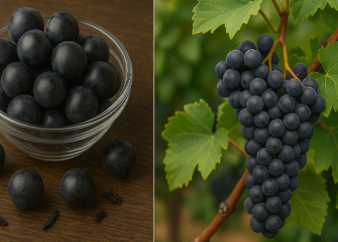
Common name: Shiraz grape (Syrah)
Parent plant: Vitis vinifera L.
Kingdom: Plantae
Clade: Angiosperms
Clade: Eudicots
Order: Vitales
Family: Vitaceae
Genus: Vitis
Species: Vitis vinifera L.
Note: “Shiraz” and “Syrah” refer to the same grape variety. The name “Syrah” is mainly used in France and much of Europe, while “Shiraz” is common in Australia and some New World regions, often associated with a riper, more opulent style of wine.
Cultivation and growth conditions
Climate
Shiraz/Syrah adapts well to warm and temperate climates, but can also perform nicely in cooler regions.
Optimal temperatures: 20–30 °C during the growing season.
Good tolerance to heat, but sensitive to extreme drought.
In cool climates: more peppery, spicy, and floral aromas, higher acidity.
In warm/hot climates: riper fruit (plum, blackberry), softer tannins, higher alcohol.
Requires stable spring conditions; late frosts can damage young shoots.
Sun exposure
Shiraz prefers full sun exposure:
enhances phenolic ripening,
increases skin color intensity,
improves sugar accumulation and aromatic complexity.
In very hot regions, a bit of natural shading from leaves can help prevent berry sunburn.
Soil
Shiraz is fairly adaptable, but gives its best on soils that are:
well drained,
from medium to low fertility,
often rich in stones or gravel (good heat retention and drainage),
with pH from slightly acidic to slightly alkaline.
Very fertile soils → excessive vegetative growth and less concentrated grapes.
Excellent results are obtained on limestone, volcanic, schist, or well-structured loam soils.
Irrigation
Water requirement is moderate, with good tolerance to controlled water stress:
Supplemental irrigation can be useful in critical periods to avoid growth stops and shrivel.
Excess water near veraison and ripening can dilute sugars and phenolics.
In quality-oriented vineyards, a mild, controlled water deficit is often sought to enhance berry concentration and tannin structure.
Temperature
Budbreak: around 10–12 °C
Optimal vegetative growth: 20–28 °C
Veraison and ripening: 25–32 °C desirable
Above 35–38 °C, especially with strong sun, berries are at risk of sunburn and desiccation.
In cooler climates, ripening is slower, often resulting in more peppery, fresh, and elegant wines.
Fertilization
Nitrogen: moderate; excess nitrogen leads to high vigor, shading, and delayed ripening.
Phosphorus: important for root development and fruit set.
Potassium: very important for sugar accumulation and color development.
Organic matter (compost, manure) improves soil structure and microbial activity but should be applied with moderation to avoid over-fertility.
Shiraz generally responds well to moderately poor soils, where vine vigor is naturally controlled.
Crop care
Winter pruning (Guyot, cordon, etc.) to control vigor and regulate yield.
Canopy management (leaf removal, shoot positioning) to:
improve air flow,
optimize sunlight on clusters,
reduce disease pressure.
Main diseases and pests:
powdery mildew (to which Syrah can be relatively sensitive),
downy mildew,
botrytis in humid seasons,
grape moths and leafhoppers.
Trellis systems such as vertical shoot positioning (VSP) with Guyot or spur-pruned cordon are common.
Harvest
Harvest timing depends heavily on climate and desired wine style:
Temperate regions: late summer to early autumn.
Warmer regions: sometimes mid to late summer.
Ideal maturity targets:
high but balanced sugar content (for structured wines),
fully ripe, supple tannins,
intense skin color.
For top-quality wines, hand harvesting is often preferred to select only healthy, fully ripe clusters.
Propagation
Shiraz is propagated by:
Grafting onto phylloxera-resistant rootstocks (e.g. 1103 Paulsen, 140 Ruggeri, SO4, Kober 5BB), chosen according to soil type, vigor control, and climatic conditions.
Hardwood cuttings used in nurseries to produce rootstock and scion material, then grafted.
Vines generally begin producing useful yields after 3–4 years, reaching full production around 5–7 years.
Caloric value (per 100 g of product)
Hydroalcoholic extract: approximately 50–150 kcal/100 g (depends on solids and residual EtOH).
Glyceric/glycolic extract: approximately 150–300 kcal/100 g.
Standardized dry extract (powder): approximately 250–350 kcal/100 g.
At typical use levels in foods, the energy contribution is modest.
Key constituents
Polyphenols: anthocyanins (malvidin-3-glucoside and congeners), proanthocyanidins/condensed tannins (often seed-derived), flavonols (quercetin), phenolic acids (gallic, caffeic).
Organic acids: tartaric (predominant) and malic, influencing pH and color stability.
Minor components: residual sugars (variable °Brix), nitrogenous compounds, trace volatiles; skin-derived extracts may carry norisoprenoids and, in traces, rotundone.
Analytical markers: total phenolic content (TPC, Folin–Ciocalteu, expressed as gallic-acid equivalents) and monomeric anthocyanins profiled by HPLC.
Production process
Raw materials: Selected skins/pulp (optionally seeds) from fresh shiraz grapes or suitable winery by-products.
Extraction: Maceration in water/EtOH at controlled pH, or in glycerol/glycols; alternatively, membrane or resin processes to enrich color (anthocyanins).
Clarification and concentration: Filtration, selective cleanup where needed, low-temperature concentration, and standardization to TPC and/or anthocyanin targets.
Quality control: HPLC profiling (anthocyanins/markers), physicochemical parameters (°Brix, pH), residual EtOH (if relevant), metals/pesticides, and microbiology.
Packing: Light/oxygen-barrier containers under GMP/HACCP with defined CCPs for hygiene and traceability.
Sensory and technological properties
Aroma/color: Dark fruit and vinous notes; anthocyanin fractions yield purple-red hues. Color is pH-dependent (bright red in acidic media; shifts toward violet/blue at higher pH).
Functionality: Antioxidant activity of polyphenols; possible astringent/structuring effect; capacity to mask mild oxidative notes.
Compatibility: Polyphenol–protein interactions may cause haze or precipitation in protein-rich matrices.
Food applications
Soft drinks and acidulated beverages, syrups, confectionery, toppings and sauces, bakery and fillings, chocolate and desserts. For color applications, skin fractions may align with E163 anthocyanins in the EU context. Typical use levels: 0.05–0.30% in liquids, or according to color/flavor targets validated in pilot trials.
Nutrition and health
The extract supplies polyphenols with in-vitro antioxidant capacity; in foods, no health claims should be implied without specific authorization. Residual EtOH in hydroalcoholic extracts and any sulfites must be considered for labeling.
Quality and specification themes
Title in TPC (Folin–Ciocalteu) and anthocyanin HPLC profile; color (absorbance at ~520 nm), °Brix, pH.
Residual EtOH where applicable; metals/pesticides within limits; compliant microbiology.
Absence of off-flavors and light/oxygen stability; full traceability under GMP/HACCP.
Storage and shelf life
Store cool and dark in well-closed, low-permeability containers; minimize DO in solutions and headspace oxygen in packs.
Control RH and aw for powders; avoid heat cycling that accelerates color loss.
Apply FIFO rotation.
Allergens and safety
Grape is not a major listed allergen; extracts sourced from winery streams may contain sulfites. Local labeling requirements and limits on EtOH must be observed for sensitive categories.
Cosmetic (INCI) functions
Common listings include Vitis Vinifera (Grape) Fruit Extract and Vitis Vinifera (Grape) Skin Extract. Reported roles: antioxidant, skin conditioning, mild astringent, masking. Glyceric grades may contribute light humectancy.
Troubleshooting
Color fade: Elevated pH, light, or oxygen → Acidify within product constraints, protect from light/DO, and consider suitable antioxidants.
Haze/precipitate: Polyphenol–protein or metal complexation → Clarify, use mild chelators, and apply fine filtration.
Excess astringency: High dose or tannin-rich grade → Reduce inclusion or select softer fractions.
Lot-to-lot variability: Raw-material or extraction shifts → Standardize to TPC/anthocyanins with tight specifications.
Sustainability and supply chain
Upcycling skins/seeds, energy recovery, and effluent management against BOD/COD targets reduce footprint. Recyclable packaging and temperature-controlled logistics support stability and environmental performance.
Conclusion
Shiraz grape extract combines color, dark-fruit notes, and polyphenolic functionality. Application success depends on raw-material quality, pH profile, protection from light/oxygen, and robust standardization; with these controls, stable and repeatable products are achievable.
Mini-glossary
EtOH — Ethanol; common hydroalcoholic co-solvent and a labeling consideration when residual.
°Brix — Percent soluble solids (sugars) in solution; proxy for extract solids.
pH — Measure of acidity/alkalinity; governs anthocyanin hue and stability.
TPC — Total phenolic content (Folin–Ciocalteu); aggregate polyphenol measure as gallic-acid equivalents.
HPLC — High-performance liquid chromatography; quantifies anthocyanins and other nonvolatile markers.
E163 — Anthocyanins; EU class of plant-derived food colorants.
SO₂/sulfites — Sulfur dioxide/sulfites; antioxidants/preservatives requiring declaration when present.
DO — Dissolved oxygen; reducing DO limits oxidation and color fade.
RH — Relative humidity; high RH promotes caking and degradation in powders.
aw — Water activity; “free” water fraction guiding stability and microbiology.
GMP — Good manufacturing practice; process/hygiene standards for consistency and traceability.
HACCP — Hazard analysis and critical control points; preventive safety system with defined CCPs.
CCP — Critical control point; a step where control prevents, eliminates, or reduces a hazard.
FIFO — First in, first out; inventory rotation principle—use the oldest compliant lots first.

