



Lupine or Lupin ( Lupinus albus L.) is a plant belonging to the Fabaceae family which grows in the Mediterranean regions. The genus Lupinus includes about 200 species, but the most known species are
- Lupinus albus L.
- Lupinus angustifolius L.
Lupin (Lupine) (Lupinus spp.)
The Term “lupin” covers several cultivated species for food, chiefly Lupinus albus (white lupin), L. angustifolius (blue/australian lupin), and L. luteus (yellow lupin). Commercial forms include dry seeds for soaking and cooking, brined ready-to-eat seeds, flours and protein concentrates, flakes or grits for bakery and snacks, and functional ingredients for plant-based products.
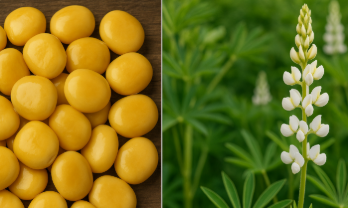
Common name: Lupin seeds (white lupin)
Parent plant: Lupinus albus L.
Kingdom: Plantae
Clade: Angiosperms
Clade: Eudicots
Order: Fabales
Family: Fabaceae
Genus: Lupinus
Species: Lupinus albus L.
Cultivation and growth conditions
Climate:
White lupin is well suited to temperate and cool climates.
It tolerates moderate cold.
It does not withstand very high temperatures during flowering.
It prefers mild springs and summers that are not excessively dry.
It also adapts well to coastal areas thanks to its good tolerance to salinity.
Sun exposure:
Requires full sun, which is essential for:
uniform growth,
proper pod development,
high protein content in the seeds.
Soil:
White lupin prefers soils that are:
acidic to slightly acidic (pH 5.5–7.0),
light or medium-textured,
well drained,
low to moderately fertile.
It is valuable for improving poor soils because it fixes atmospheric nitrogen through symbiosis with Rhizobium.
Calcareous or highly alkaline soils cause chlorosis and low yields.
Irrigation:
It has moderate water requirements.
The soil should remain slightly moist during germination and flowering.
The crop generally needs little irrigation due to its deep root system.
Excess water must be avoided to prevent root rot.
Temperature:
Germination: 5–15 °C
Vegetative growth: 15–25 °C
Temperatures above 32–35 °C reduce fruit set and yield.
Fertilization:
Lupin is not demanding in terms of fertilization:
Nitrogen: usually unnecessary due to nitrogen fixation.
Phosphorus and potassium: beneficial in poor soils to support roots, flowering, and seed formation.
Organic amendments improve soil structure and moisture retention.
Crop care:
Light hoeing in early growth stages to control weeds.
Crop rotation with cereals reduces soil-borne diseases.
Monitoring of pests such as aphids and cutworms.
Fungal diseases (especially Fusarium) must be controlled in heavy or waterlogged soils.
Harvest:
Harvest takes place when the pods turn yellow and begin to dry.
Signs of maturity include:
straw-yellow pods,
hard, fully developed seeds,
dry pods ready for threshing.
After harvest, seeds are dried further to reduce moisture and improve storage stability.
Propagation:
White lupin is propagated by seed.
Sowing occurs in spring in cold regions, or late winter/early spring in temperate areas.
Seeds are typically sown 3–5 cm deep.
Specific Rhizobium inoculation is often used to improve nodulation and yield.
Caloric value (seeds, dry)
About 350–400 kcal per 100 g (typical ≈ 371 kcal/100 g; varies with species, moisture, dehulling, and debittering).
Average composition (dry seeds, per 100 g)
Protein: ~36–40 g with a favorable essential amino acid profile, sometimes limiting in methionine and cysteine.
Fat: ~6–12 g, predominantly MUFA and PUFA.
Available carbohydrates: generally ≤10 g, very low starch with non-starch polysaccharides prevailing.
Total fiber: ~25–35 g with high water-holding capacity.
Minerals: K, Mg, P, Fe, Zn, Mn; Se may vary by soil and species.
Vitamins: B-group (thiamine, riboflavin, niacin, folates) depending on variety and processing.
Phytochemicals and antinutrients: quinolizidine alkaloids (for example lupanine), phytates, protease inhibitors, and raffinose–stachyose family oligosaccharides.
Fatty acid profile (lupin oil, % of total fat)
MUFA (generally favorable): oleic ~40–55%.
PUFA (beneficial yet to be balanced): linoleic ~25–40%, with smaller ALA.
SFA (to moderate): palmitic + stearic ~8–12%.
The Presence of tocopherols and phytosterols, together with moderate PUFA, supports fair oxidative stability versus many other legumes.
Sensory and technological properties
Flavor Is mild with legume and occasional grassy notes; persistent bitterness indicates insufficient alkaloid reduction.
Lupin Proteins exhibit useful emulsifying, foaming, and water/fat-binding properties for sauces, spreads, and bakery.
Flour Can improve water retention and softness in bakery, though high inclusion may weaken gluten networks in wheat doughs.
Light Roasting or controlled lactic fermentations can reduce oligosaccharides and “beany” notes, improving digestibility and acceptance.
Debittering, alkaloid safety, and process aspects
Quinolizidine Alkaloids drive bitterness and, at high levels, adverse effects; food supply chains favor “sweet” low-alkaloid varieties plus soaking, repeated washings, and cooking to reduce them to safe levels.
Brined Snack Lupins often carry higher sodium due to the brine and call for moderation in sensitive individuals.
Effective Debittering depends on pH, time, temperature, and water exchange, while limiting nutrient losses.
Food applications
Lupin Flour And intermediates serve as protein- and fiber-rich ingredients in breads, bakery, enriched dry pasta, bars, and extruded snacks.
Protein Concentrates/isolates support emulsions and aerated structures, enabling partial substitution of eggs or dairy in vegan formulations.
Cooked Or Brined Seeds are consumed as snacks or added to salads and cold dishes; their firm texture suits ready-to-eat uses.
Plant-Based Applications leverage protein functionality for burgers, patties, and dairy/meat analogues.
Nutrition and health
Lupin Is naturally gluten-free and pairs high protein density with abundant fiber, aiding satiety and glycemic management.
MUFA/PUFA Provide a favorable lipid profile within balanced diets, with modest SFA.
Oligosaccharides May cause bloating in sensitive individuals; soaking, cooking, and fermentation reduce their impact.
Cross-Reactivity Can occur in people allergic to peanut or other legumes; cautious introduction is advisable in at-risk profiles.
Typical Serving: ~30–50 g drained brined seeds as a snack, or ~10–30 g of flour in home recipes.
Allergens and safety
Lupin Is a regulated allergen in the European Union and several other jurisdictions, with documented IgE-mediated reactions potentially severe.
Risk Management includes varietal selection, validated debittering, prevention of cross-contact in facilities processing other legumes, and clear labeling of intentional or incidental presence.
Gluten-Free Status does not remove other allergy risks; products should carry required advisories.
Quality and specifications (typical topics)
Dry Seeds: controlled moisture, absence of bitter/defective seeds, compliant microbiology, alkaloids within internal safety targets.
Flours And Proteins: moisture typically ≤10%, defined protein yield and solubility index, controlled protease inhibitor activity, clean color/aroma without oxidative notes.
Oil And Lipids: low peroxide and anisidine indices, compliant FA profile, tocopherols and phytosterols as quality markers.
Residues And Contaminants: pesticides and heavy metals within legal limits; mycotoxins mitigated via proper drying and storage.
Storage and shelf life
Dry Seeds: cool, dry, dark, airtight to limit oxidation and infestation; barrier packaging extends life.
Flours And Concentrates: low humidity, protective atmosphere, moderate temperatures; lipids, though modest, can oxidize over time.
Brined Seeds: keep covered by brine; refrigerate after opening and consume within the indicated period.
Troubleshooting
Persistent Bitterness: indicates insufficient debittering; repeat soaking and water exchange or blend with certified sweet batches.
Dense Or Crumbly Doughs: suggest excessive lupin flour or inadequate hydration; increase water, add a natural emulsifier, or reduce inclusion.
Pronounced Beany Notes: mitigate via light roasting, controlled fermentation, and label-coherent natural flavoring.
Emulsion Break: improve soluble protein fraction, optimize pH and ionic strength, or apply mild heat treatment.
Sustainability and supply chain
Lupin Is an N-fixing legume that improves soil fertility and reduces nitrogen fertilizer needs, supporting positive crop rotations.
Traceable Chains—especially low-alkaloid varieties—deliver consistent quality and lower waste; organic options are available in many growing regions.
Industrial Demand Is growing in Europe and Oceania due to high protein yield and technological versatility.
Conclusion
Lupin Combines high-quality protein, abundant fiber, and valuable techno-functionality, offering concrete opportunities in bakery, snacks, and plant-based categories. Rigorous alkaloid management, allergen prevention, and tight process control allow producers to realize its nutritional and sensory potential while upholding safety and quality.
Mini-glossary of lipid acronyms (English)
MUFA — MonoUnsaturated Fatty Acids: Generally favorable for cardiometabolic profile (e.g., oleic acid).
PUFA — PolyUnsaturated Fatty Acids: Include omega-3 and omega-6; beneficial, but keep a balanced omega-6:omega-3 ratio.
SFA — Saturated Fatty Acids: To moderate; impact depends on overall diet and the replacement nutrient.
ALA/EPA/DHA (omega-3) — Alpha-linolenic acid / Eicosapentaenoic acid / Docosahexaenoic acid: Support heart and brain health, with stronger evidence for EPA/DHA.
TFA — Trans Fatty Acids: To avoid; associated with increased cardiovascular risk.
MCT — Medium-Chain Triglycerides: Rapidly absorbed; useful in specific contexts, but still count toward total calories.
Studies
Its seeds have high protein content, are used in food, cosmetics and pharmaceuticals, contain 36-52% protein, 30-40% fiber and 5-20% essential oils, as well as oleic and linoleic acids, isoflavonoids, zeaxanthin, thiamin, riboflavin and niacin (1),
Data from this study demonstrate that a plant-based vaccine from a genetically engineered plant, the narrow-leafed lupin (Lupinus angustifolius L.), can promote a protective immune response and attenuate experimental asthma, suggesting that plant-based vaccines may be potentially therapeutic for protection against allergic diseases (2).
Lupine seeds are very low in isoflavones, and lupine protein isolates are essentially free of isoflavones and may provide a useful alternative for people wishing to replace animal with plant-based protein for cardiovascular disease prevention. This initial study indicates that lupin, although lacking isoflavones, has cholesterol-lowering activity similar to that of other leguminous proteins in an established animal model. Furthermore, cholesterol reduction appears to be associated with stimulation of LDL receptors by a well-defined protein component of lupin seeds, as demonstrated by in vitro studies (3).
In a study on the effect of lupin protein on circulating cholesterol in plasma and lipoproteins of hypercholesterolemic subjects, a slight lowering of LDL cholesterol concentration was found in hypercholesterolemic subjects, without alteration of HDL cholesterol. No effects or minor effects of lupin protein on circulating glucose, homocysteine, and plasma amino acids were observed (4).

