



Pea Protein
Synonyms/labeling: pea protein isolate; pea protein concentrate; pea protein flour
Botanical source: Pisum sativum L. (yellow/green dry peas), endosperm and seed protein fraction
Definition
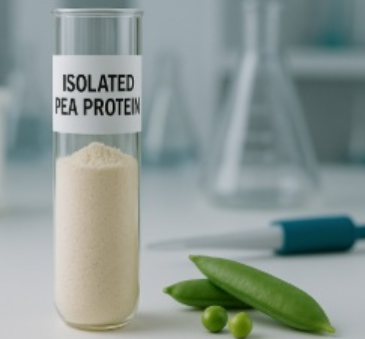
Protein ingredient produced from dry peas via milling, separation of starch/fiber, and protein fractionation. Supplied as an ivory to pale-yellow powder with a mildly leguminous taste. Available as concentrate (~55–70% protein), isolate (~80–90% protein), and textured pea protein (TPP/TVP) for “meat analog” applications.
Caloric value
Isolate: ~360–400 kcal per 100 g
Concentrate: ~350–380 kcal per 100 g
(Depends on moisture and residual carbohydrate/fat.)
Indicative composition (isolate, per 100 g)
Protein: ~80–90 g (globulins legumin/vicilin, albumins)
Carbohydrates: ~1–7 g
Dietary fiber: ~0–5 g (process-dependent)
Fat: ~1–3 g
Moisture: ~5–8%
Ash (minerals): ~3–6 g (K, Mg, Fe, Zn vary)
Amino-acid quality
Complete in essentials; lysine rich; methionine + cysteine relatively limiting.
Useful BCAA levels for muscle protein synthesis.
Typical PDCAAS ~0.8–0.9; DIAAS ~0.7–0.9 (processing-dependent). Pairing with cereals (methionine-richer) improves overall score.
Manufacturing overview
Dry peas → cleaning/dehulling → milling → separation of starch/fiber (air classification or wet) →
Concentrate: dry fractionation (air classification).
Isolate: alkaline extraction (pH ~8–9) → separation → isoelectric precipitation (pH ~4.5) → washing → neutralization → spray drying.
Texturization: extrusion (low/high moisture) to create fibrous structures.
Enzymatic or fermentation steps may reduce off-flavors and antinutrients.
Techno-functional properties
Solubility: moderate, pH/ionic-strength dependent; best away from pI (good at pH >6 or <3).
Emulsification: good emulsifying and emulsion-stabilizing capacity (O/W).
Gelling: forms thermo-gels with elastic texture—useful in desserts and meat analogs.
Foaming: fair (below whey/egg).
Water/oil binding: high → boosts juiciness and yield.
Viscosity: tunable via denaturation/hydrolysis.
Applications
Beverages & shakes (prefer isolates for solubility).
Meat alternatives (burgers, sausages, mince): TPP/TVP with fibers/oils.
Bakery (breads, cookies, pancakes) for protein enrichment and structure.
Plant-based dairy (yogurts, frozen desserts, creamers) leveraging emulsifying/gel properties.
Sauces/dips as a clean-label emulsifier/stabilizer.
Pasta/extruded snacks for protein boost and bite.
Formulation guidance (indicative)
Beverages: 5–10% protein; set pH 6.8–7.2 or acidic <4 to reduce chalkiness; apply homogenization and consider chelators for mineral control.
Bars: 20–35% of dry phase; combine with syrups/fibers for plasticity and shelf life.
Bakery: 5–15% on flour; increase water +2–6%; balance with starches and fats to avoid toughness.
Alt-meat (TPP): 15–30% of formula with binders (HPMC/methylcellulose, alginates, psyllium/citrus fibers) and structured oils; salt/Ca can modulate gelation.
Emulsions: 1–3% protein with 10–30% oil; introduce under high shear for fine droplets.
Digestibility, tolerance, antinutrients
Generally hypoallergenic vs major allergens (free of gluten, dairy, egg, soy); rare legume allergies exist.
Antinutrients (phytates, trypsin inhibitors, saponins) reduced by heat, fermentation, enzymes, or germination.
FODMAPs typically low in isolates; higher in concentrates/flours.
Sensory & off-flavor mitigation
“Beany/green” notes (lipoxygenase-derived aldehydes) can be reduced via:
gentle thermal steps and deaeration,
light acidification (citric/lactic) and natural maskers,
lactic fermentation or partial enzymatic hydrolysis,
seasoning and lipid addition in savory formats.
Safety, allergens, regulatory
Not among the EU “top-14” allergens; still label as pea (Pisum sativum) and manage cross-contact.
Naturally gluten-free; maintain ≤20 ppm for GF claims.
Isolates/concentrates widely accepted; check local requirements for TPP and added flavors.
Quality & specifications (typical)
Declared protein (e.g., ≥80% for isolates); moisture ≤8%; microbiology within spec; heavy metals/pesticides compliant.
Solubility vs pH curve, emulsifying/gel indices, particle-size distribution.
Controlled off-flavor (sensory; TBARS/aldehydes for oxidation).
Storage & shelf life
Store dry, airtight, away from heat/light/odors; oxygen-barrier packaging preferred.
Typical shelf life: 18–24 months sealed; reseal promptly after opening.
Nutrition & positioning
High-quality plant protein with good digestibility and lysine-rich profile.
Sustainability: peas are nitrogen-fixing, generally lower-input than many animal proteins.
Combine with cereals (e.g., oats/rice) or oilseeds to optimize amino-acid balance and texture.
Conclusion
Pea protein offers a strong technical and nutritional proposition: solid emulsification/gelation, water/oil binding, good digestibility, and relative hypoallergenicity. By optimizing pH, hydration, and off-flavor control, and by using amino-acid complementation where needed, formulators can deliver stable, palatable, high-protein foods across beverages, bakery, plant-based dairy, and meat analogs.
Studies
In a controlled diet, daily consumption of whole and fractionated yellow pea meal at doses equivalent to half a cup of yellow peas reduced insulin resistance in hypercholesterolaemic, while whole pea meal reduced android adiposity in women (1).
Purified peptides extracted from Pisum sativum have demonstrated a broad spectrum of antibacterial activity that can be used as a selective agent against infections and bacteria (2).
This study informs us that as the skin ages, impairment of extracellular matrix protein synthesis and increased action of degradative enzymes manifest as atrophy, wrinkles, and laxity. There is growing evidence for the functional role of exogenous peptides in many areas, including in offsetting the effects of skin aging. Here, using an artificial intelligence approach, RTE62G, a natural and unmodified peptide with extracellular matrix stimulatory properties, was identified. The predicted anti-aging properties of RTE62G peptide were then validated through in vitro, ex vivo, and proof-of-concept clinical trials (3).

