Hello, Guest!


  Objects Tiiips Categories
Hydroxy-citronellal
"Descrizione"
by Al222 (23420 pt)
2025-Jul-26 16:43

Definizione
L’Hydroxycitronellal è un composto chimico aromatico sintetico, appartenente alla famiglia delle aldeidi terpeniche. È ampiamente utilizzato in profumeria e cosmetica per la sua fragranza dolce, floreale e fresca, simile al mughetto (Lily of the Valley).

Non è naturalmente presente in forma pura in natura ma è ottenuto per sintesi da precursori terpenici.


1. Struttura chimica

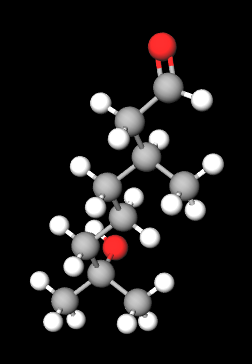
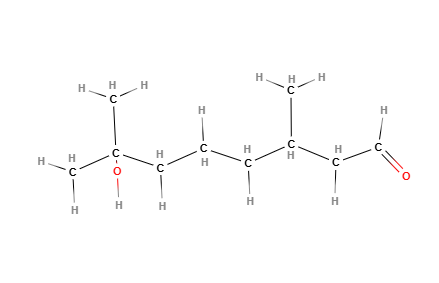
  • Nome IUPAC: 7-idrossi-3,7-dimetilottanale

  • Formula molecolare: C₁₀H₂₀O₂

  • Massa molare: 172,26 g/mol

  • Classe chimica: aldeide alifatica ossigenata

  • Gruppi funzionali: gruppo aldeidico (-CHO) e gruppo ossidrilico (-OH)

  • Aspetto: liquido limpido, incolore o giallo pallido

  • Odore: floreale, fresco, simile al mughetto

  • Punto di ebollizione: circa 250 °C

  • Solubilità: poco solubile in acqua, molto solubile in alcoli e oli


2. Principali sostanze contenute

Poiché l’Hydroxycitronellal è una sostanza pura, non contiene a sua volta altre sostanze. Tuttavia, nei prodotti commerciali può essere presente in miscele aromatiche insieme a:

  • Alcol benzilico

  • Linalolo

  • Citronellolo

  • Geraniolo

  • Composti terpenici minori

Queste sostanze possono essere coformulanti nelle composizioni profumate o presenti in tracce a seconda della purezza.


3. Metodo di lavorazione o estrazione

L’Hydroxycitronellal è prodotto esclusivamente per via sintetica. Il processo industriale più comune prevede:

  • Punto di partenza: citronellale (ottenuto da distillazione dell’olio essenziale di citronella o da sintesi)

  • Reazione chimica:

    • idratazione catalitica del doppio legame del citronellale → formazione di un gruppo ossidrilico

    • ossidazione parziale in condizioni controllate

  • Purificazione: tramite distillazione frazionata o cristallizzazione selettiva

Il prodotto finale è generalmente una miscela in cui predomina la forma desiderata (isomero lineare con attività olfattiva).


4. Proprietà olfattive

  • Nota dominante: floreale, fresca, dolce

  • Riferimento olfattivo: mughetto

  • Famiglia: aldeidica-floreale

  • Persistenza: media

  • Tipo di nota: nota di cuore (mid note)


5. Applicazioni principali

Cosmetica e profumeria

  • Profumi (soprattutto floreali e primaverili)

  • Saponi e detergenti per il corpo

  • Deodoranti e creme

  • Shampoo e balsami

  • Ammorbidenti e profumatori per ambienti

Funzioni INCI

Profumo. A differenza della fragranza che può contenere anche odori leggermente meno gradevoli o caratteristici, la dizione profumo indica soltanto le profumazioni molto gradevoli. Utilizzato per profumi e materie prime aromatiche.

Sicurezza cosmetica

Ingrediente cosmetico soggetto a restrizioni III/72  come Voce pertinente negli allegati del regolamento europeo sui cosmetici n. (EU) 2023/1545. Sostanza o ingrediente segnalato: Hydroxycitronellal

Tipo di prodotto, parti del corpo    a) Prodotti per la somministrazione orale b) Altri prodotti

Massima concentrazione nella preparazione pronta all'uso    b) 1,0 %

Altro    (a) (b) La presenza della sostanza deve essere indicata nell'elenco degli ingredienti di cui all'articolo 19, paragrafo 1, lettera g), quando la sua concentrazione supera: — 0,001 % nei prodotti da non sciacquare — 0,01 % nei prodotti da sciacquare

CAS    107-75-5    EC number    203-518-7

Industria aromatica

  • Componente chiave per ricostruire l’aroma del mughetto, che non può essere estratto in forma naturale

  • Utilizzato in fragranze verdi e floreali sintetiche


6. Sicurezza e regolamentazione

  • IFRA (International Fragrance Association): impone limiti d’uso precisi nei prodotti cosmetici

  • Regolamento UE 1223/2009 – allegato III: obbligo di etichettatura se la concentrazione è superiore a:

    • 0,001% nei leave-on (non risciacquati)

    • 0,01% nei rinse-off (risciacquati)

  • Può provocare reazioni allergiche o dermatiti da contatto in soggetti sensibili

  • Non mutageno, non cancerogeno, non tossico per la riproduzione

  • Il patch test lo identifica tra gli allergeni da contatto più comuni tra le aldeidi profumate


7. Conclusione

L’Hydroxycitronellal è una materia prima profumata di sintesi estremamente diffusa per il suo aroma dolce e floreale, ideale per ricreare fragranze leggere e femminili. È apprezzato per la sua stabilità e versatilità, ma necessita di attenzione nella formulazione a causa del potenziale allergenico.

Il suo uso è strettamente regolamentato per garantire sicurezza dermatologica, pur restando uno degli ingredienti aromatici più iconici dell’industria profumiera moderna.

Confronto: Hydroxycitronellal / Lyral / Lilial

CaratteristicaHydroxycitronellalLyral (Hydroxyisohexyl 3-Cyclohexene Carboxaldehyde)Lilial (Butylphenyl Methylpropional)
Numero CAS107-75-531906-04-480-54-6
Formula molecolareC₁₀H₂₀O₂C₁₃H₂₂O₂C₁₄H₂₀O
Profilo olfattivoFloreale, fresco, mughettoFloreale, dolce, tipo mughettoFloreale, aldeidico, dolce, mughetto
OrigineSintetico (derivato dal citronellale)Sintetico puroSintetico puro
Uso principaleProfumeria, cosmeticaProfumeria (ampiamente usato in passato)Profumeria (fragranze bianche e fiorite)
Status come allergenePotenziale sensibilizzante – limitatoSensibilizzante noto – vietato in UEClassificato come tossico per la riproduzione – vietato in UE
Stato UEConsentito con restrizioni (Allegato III)Vietato (Allegato II, voce 1666)Vietato (Allegato II, voce 1669)
Stato IFRAConsentito con limiti per categoria d’usoProibito (Amendment 49 – 2017)Proibito (standard IFRA dal 2021)


Regolamento (CE) n. 1223/2009 – Allegato III

  • Elenca 26 allergeni del profumo (in espansione a oltre 80 secondo le ultime revisioni)

  • Questi devono essere dichiarati in etichetta se presenti in concentrazioni superiori a:

    • 0,001% nei prodotti leave-on (non risciacquati)

    • 0,01% nei prodotti rinse-off (risciacquati)

  • Esempi inclusi:

    • Hydroxycitronellal, Linalool, Eugenol, Geraniol, Citral, Coumarin, Isoeugenol

Allegato II – Sostanze vietate

  • Sostanze vietate nei cosmetici a causa di rischi significativi per la salute (mutageni, cancerogeni, tossici per la riproduzione):

    • Lyral – vietato come forte allergene cutaneo (voce 1666)

    • Lilial – vietato dal 1° marzo 2022 in quanto classificato CMR 1B (tossico per la riproduzione) – voce 1669

Standard IFRA (International Fragrance Association)

  • Stabilisce limiti massimi o divieti completi per alcune sostanze profumate in base a valutazioni tossicologiche:

    • Hydroxycitronellal: consentito ma con limiti in base alla categoria del prodotto

    • Lyral: proibito in tutti i prodotti profumati dal 2017

    • Lilial: proibito negli standard IFRA e bandito dalla normativa UE

Bibliografia__________________________________________________________________________

Svedman C, Bruze M, Johansen JD, Andersen KE, Goossens A, Frosch PJ, Lepoittevin JP, Rastogi S, White IR, Menné T. Deodorants: an experimental provocation study with hydroxycitronellal. Contact Dermatitis. 2003 Apr;48(4):217-23. doi: 10.1034/j.1600-0536.2003.00094.x. 

Abstract. Axillary dermatitis is a common problem, particularly in individuals with contact allergy to fragrances. Many individuals suspect their deodorant to be the causal product of their fragrance allergy. It has been shown that deodorants containing cinnamic aldehyde (cinnamal) can elicit axillary dermatitis in patients sensitized to this substance. The aim of the present investigation was to evaluate the importance of hydroxycitronellal used in deodorants for the development of axillary dermatitis, when applied by individuals with and without contact allergy to this fragrance chemical. Patch tests with deodorants and ethanolic solutions containing hydroxycitronellal, as well as repeated open application tests (ROAT) with roll-on deodorants with and without hydroxycitronellal at different concentrations, were performed in 14 dermatitis patients, 7 with and 7 without contact allergy to hydroxycitronellal. A positive ROAT was noted only in the patients hypersensitive to hydroxycitronellal (P < 0.001) and only in the axilla to which the deodorants containing hydroxycitronellal had been applied (P < 0.001). Deodorants containing hydroxycitronellal in the concentration range of 0.032-0.32% used twice daily on healthy skin in individuals hypersensitive to hydroxycitronellal can elicit axillary dermatitis in a few weeks.

Heydorn S, Andersen KE, Johansen JD, Menné T. A stronger patch test elicitation reaction to the allergen hydroxycitronellal plus the irritant sodium lauryl sulfate. Contact Dermatitis. 2003 Sep;49(3):133-9. doi: 10.1111/j.0105-1873.2003.00175.x.

Abstract. Household and cleaning products often contain both allergens and irritants. The aim of this double-blinded, randomized, paired study was to determine whether patch testing with an allergen (hydroxycitronellal) combined with an irritant [sodium lauryl sulfate (SLS)] cause a stronger patch test elicitation reaction than patch testing with the allergen (hydroxycitronellal) alone, in patients previously patch tested positive to hydroxycitronellal. A stronger patch test elicitation reaction was defined as at least 1 day of patch test reading showing more positive patch tests (+, ++ or +++) on the forearm patch tested with 6 concentrations of SLS plus hydroxycitronellal than on the forearm tested with 6 concentrations of hydroxycitronellal alone and no day of patch test readings showing more positive tests on the hydroxycitronellal forearm. 15/20 (75%) had at least 1 day of patch test reading with more positive patch tests on the forearm patch tested with SLS plus hydroxycitronellal and no day of patch test readings with more positive patch tests on the forearm tested with hydroxycitronellal (P = 0.0253). Estimation of the blood flow with laser Doppler supported these findings.

Ford RA, Api AM, Suskind RR. Allergic contact sensitization potential of hydroxycitronellal in humans. Food Chem Toxicol. 1988 Nov-Dec;26(11-12):921-6.

Abstract. Hydroxycitronellal, an important ingredient in fragrances, was studied for its sensitizing potential in human skin. Fifteen human maximization tests were conducted with hydroxycitronellal obtained from four different sources at induction concentrations from 5 to 12%. No reactions were induced at 5% in two separate panels while 10% sensitized 2/25 panelists in one test but none in a second. Induction at 12% produced sensitization in 8 of 11 tests. Impurities do not appear to be a sensitizing factor. There is some evidence that the l-stereoisomer is a less potent sensitizer than the d-stereoisomer. In an initial modified human repeat-insult patch-test two positive reactions to challenge were observed among 197 panelists, one at a concentration of 5% and the other at 7.5%. When 100 of the non-reacting panelists were re-exposed in the same way, allergic sensitization reactions appeared during the induction period with concentrations as low as 2.5%. When 28 sensitized panelists were exposed to 1% concentrations in a simulated use test, there were three reactors. A no-effect level for sensitization has not been determined although the lowest concentrations tested were in the product usage range.

Rastogi SC, Johansen JD, Menné T. Natural ingredients based cosmetics. Content of selected fragrance sensitizers. Contact Dermatitis. 1996 Jun;34(6):423-6. doi: 10.1111/j.1600-0536.1996.tb02246.x. 

Abstract. In the present study, we have investigated 42 cosmetic products based on natural ingredients for content of 11 fragrance substances: geraniol, hydroxycitronellal, eugenol, isoeugenol, cinnamic aldehyde, cinnamic alcohol, alpha-amylcinnamic aldehyde, citral, coumarin, dihydrocoumarin and alpha-hexylcinnamic aldehyde. The study revealed that the 91% (20/22) of the natural ingredients based perfumes contained 0.027%-7.706% of 1 to 7 of the target fragrances. Between 1 and 5 of the chemically defined synthetic constituents of fragrance mix were found in 82% (18/22) of the perfumes. 35% (7/20) of the other cosmetic products (shampoos, creams, tonics, etc) were found to contain 0.0003-0.0820% of 1 to 3 of the target fragrances. Relatively high concentrations of hydroxycitronellal, coumarin, cinnamic alcohol and alpha-amyl cinnamic aldehyde were found in some of the investigated products. The detection of hydroxycitronellal and alpha-hexylcinnamic aldehyde in some of the products demonstrates that artificial fragrances, i.e., compounds not yet regarded as natural substances, may be present in products claimed to be based on natural ingredients.

Andrade JC, Monteiro ÁB, Andrade HHN, Gonzaga TKSN, Silva PR, Alves DN, Castro RD, Maia MS, Scotti MT, Sousa DP, Almeida RN. Involvement of GABAA Receptors in the Anxiolytic-Like Effect of Hydroxycitronellal. Biomed Res Int. 2021 Jun 16;2021:9929805. doi: 10.1155/2021/9929805. PMID: 34222487; PMCID: PMC8225436.

Evaluate