



Volkswagen Tiguan costs, pros, cons and common fixes
Country of Manufacture
The Volkswagen Tiguan is built in Wolfsburg, Germany, and Puebla, Mexico, on the MQB platform.
Quick Overview
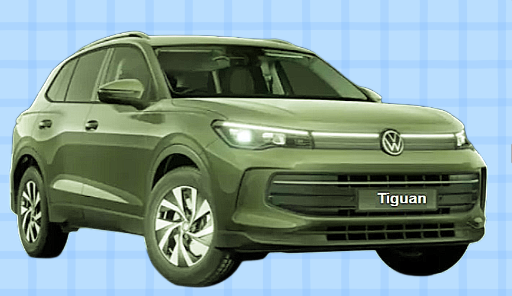
The Tiguan is a compact five-door SUV with sculpted lines, a bold front fascia, and optional IQ.LIGHT Matrix LED headlights on higher trims. Inside, it offers high-quality materials, a configurable 10.25″ Digital Cockpit, an 8″ or 9.2″ touchscreen, and dual-zone climate control for a premium, versatile experience.
Powertrain & Performance
| Engine | Power & Torque | 0–100 km/h | Top Speed | WLTP Consumption |
|---|---|---|---|---|
| 1.5 TSI eTSI MHEV (110 kW / 150 hp) | 150 hp / 250 Nm | 9.2 s | 210 km/h | 6.5–7.0 L/100 km |
| 2.0 TSI (140 kW / 190 hp) 4MOTION | 190 hp / 320 Nm | 7.5 s | 225 km/h | 7.2–7.8 L/100 km |
| 2.0 TDI (85 kW / 115 hp) | 115 hp / 300 Nm | 11.5 s | 195 km/h | 5.0–5.4 L/100 km |
| 2.0 TDI (110 kW / 150 hp) 4MOTION | 150 hp / 360 Nm | 9.5 s | 210 km/h | 5.4–5.8 L/100 km |
All engines are paired with a 6-speed manual or 7-speed DSG; 4MOTION AWD is available on more powerful variants.
Dimensions & Capacity
| Specification | Measurement |
|---|---|
| Length | 4,494 mm |
| Width | 1,839 mm (excl. mirrors) |
| Height | 1,667 mm |
| Wheelbase | 2,681 mm |
| Curb Weight | 1,465–1,700 kg |
| Cargo Volume | 520 L / 1,655 L |
| Ground Clearance | 200 mm |
| Turning Circle | 11.4 m |
Trim Levels & Pricing
| Trim | Price (€) |
|---|---|
| Life | 36,500 |
| Style | 39,500 |
| R-Line | 42,500 |
| Elegance | 45,500 |
| R-Line Black | 47,500 |
(On-the-road price; VAT included, incentives and delivery fees excluded.)
Maintenance & First Services (Indicative Costs)
| Service | Avg. Cost (€) |
|---|---|
| 1st Service (1 yr or 15,000 km) | 220–260 |
| 2nd Service (2 yrs or 30,000 km) | 240–280 |
| Front Brake Pads Replacement | 220–260 |
| Front Discs + Pads Replacement | 600–700 |
| Cabin & Engine Air Filter Replacement | 130–160 |
| 12 V Auxiliary Battery Replacement | 150–180 |
| Tire Replacement (each) | 160–200 |
Pros
Spacious & Flexible: 520 L of cargo and sliding rear seats
Advanced Tech: Digital Cockpit and available Matrix IQ.LIGHT headlights
AWD Capability: 4MOTION enhances traction in all conditions
Efficient Engine Range: mild-hybrid, petrol, and diesel options
Comfortable Ride: balanced suspension and effective noise insulation
Cons
Fuel Consumption climbs on the 4MOTION and higher-output TSI models
Premium Pricing for top trims and options
Hefty Weight affects handling and efficiency
Rear Visibility restricted by wide C-pillars and high spoiler
In Summary
The Volkswagen Tiguan 2025 is a premium compact SUV that blends comfort, technology, and versatility. With mild-hybrid, petrol, and diesel powertrains—plus optional AWD—it suits families and adventurers alike, though top trims demand a significant investment and trade some efficiency for performance.
Verdict — Volkswagen Tiguan (Model Year 2025)
Compact Mild-Hybrid SUV · 1.5 L TSI 4-cyl 150 hp + 48 V Mild-Hybrid · FWD (4Motion AWD optional) · 6-spd Manual or 7-spd DSG · 0–100 km/h in 8.4 s · WLTP 6.0–6.5 L/100 km · 137–149 g/km CO₂ · 190 mm Ground Clearance
The 2025 Tiguan remains a best-seller in the compact SUV segment, combining sculpted lines and a bold front end—honeycomb grille, Matrix LED headlights, pronounced wheel arches, and a subtly sloping roof. At 4.49 m long with a 2.68 m wheelbase, it strikes the ideal balance between city‐friendly dimensions and roomy interior. 18″ “Mistral” wheels blend style with efficiency, and available 4Motion all-wheel drive enhances capability on any terrain.
Inside, the “Urban Lounge” cabin focuses on comfort and tech: a horizontal dash featuring a 10″ touchscreen for infotainment and climate, a 10.25″ “Digital Cockpit” behind the wheel, and optional head-up display. Ergonomic ArtVelours seats, soft-touch surfaces, and ambient lighting create a welcoming environment. A 520 L boot (1,650 L with rear seats folded) delivers family-friendly versatility. Wireless App-Connect, over-the-air updates, and a full Travel Assist suite complete the package.
| Category | Strengths | Performs Well | Limitations |
|---|---|---|---|
| Design & Image | Robust modern styling; Matrix LED headlights | Balanced proportions | Less sporty than coupe-style SUVs |
| Comfort & Packaging | Quiet, refined cabin; supportive ArtVelours seats | Generous space for five adults | Center tunnel intrudes on foot space |
| Efficiency & Economy | Mild-hybrid reduces urban fuel use | Effective energy recuperation | No full-electric driving mode |
| Driving Dynamics | Precise steering; composed handling | Balanced comfort and control | Ride can feel firm over very rough surfaces |
| Practicality | 520 L boot (+1,650 L folded); low loading sill | Multiple clever storage bins | No front trunk (“frunk”) |
| Infotainment & Connect. | 10″ touchscreen & Digital Cockpit; OTA updates | Wireless App-Connect; intuitive interface | Built-in navigation requires optional upgrade |
| Safety & ADAS | Travel Assist & Emergency Assist standard | Reliable adaptive cruise and lane-keep assist | No fully hands-free highway driving |
| Running Costs | Low maintenance; modest fuel consumption | Mild-hybrid incentives where available | Mild-hybrid service network still expanding |
| Depreciation | Strong residuals in compact SUV class | Consistent used-car demand | Growing competition from electric SUVs and PHEVs |
Who It’s For
Families and professionals seeking a versatile compact SUV with spacious interior, advanced tech, and efficient mild-hybrid performance—ideal for daily commutes and weekend adventures.
Who Should Look Elsewhere
If you want standard AWD or full-EV driving, consider the Toyota RAV4 Hybrid, Ford Kuga PHEV, or Volkswagen ID.4.
Recommended Configuration
Style Business trim with 7-spd DSG, 4Motion AWD, 19″ “Mistral” wheels, Comfort & Lighting pack (heated seats, head-up display), and Travel Assist Plus—for the best blend of space, comfort, and safety.

