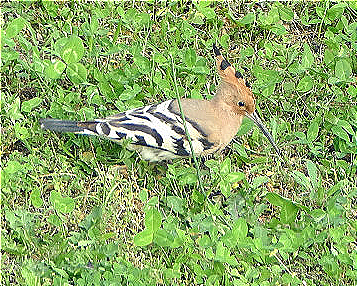
La famiglia Upupidae è un gruppo di uccelli appartenente all'ordine Coraciiformes, che comprende una singola specie, Upupa epops, comunemente nota come upupa comune o upupa europea. Questo uccello è noto per il suo piumaggio distintivo, la cresta erettile e il comportamento curioso. Sebbene la famiglia sia rappresentata da una sola specie, l'upupa comune è ampiamente distribuita in Eurasia e Nordafrica, ed è riconoscibile per il suo comportamento unico e la sua estetica affascinante.
Classificazione scientifica
Regno: Animalia
Phylum: Chordata
Classe: Aves
Ordine: Coraciiformes
Famiglia: Upupidae
Genere: Upupa
Specie: Upupa epops
Caratteristiche Morfologiche
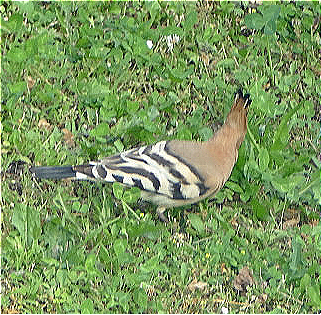
L'upupa comune è un uccello di dimensioni medio-piccole, con una lunghezza che varia dai 25 ai 32 cm. È facilmente riconoscibile per la sua cresta erettile che, quando alzata, è una delle sue caratteristiche distintive più evidenti. Il piumaggio dell'upupa è generalmente di colore marrone chiaro con striature nere, con toni più vivaci sulla testa e sulla coda. Il suo becco è lungo, sottile e ricurvo, adattato per scavare nel terreno alla ricerca di insetti e invertebrati. Le sue ali sono lunghe e arrotondate, e la coda è relativamente lunga e appuntita.
Il piumaggio della cresta è composto da piume lunghe e sottili, che l'uccello può sollevare in un elegante ciuffo quando è eccitato o durante il corteggiamento. I colori del piumaggio possono variare leggermente a seconda della stagione e della geografia, ma generalmente sono tonificati in beige, marrone e bianco, con striature nere sulle ali e sulla testa.
Comportamento e Abitudini Alimentari
L'upupa comune è un uccello principalmente insettivoro, che si nutre di una varietà di insetti, tra cui formiche, coleotteri, scarafaggi e altri piccoli invertebrati. Il suo becco lungo e ricurvo gli permette di forare il terreno e la corteccia degli alberi alla ricerca di cibo. Nonostante sia un uccello terrestre, l'upupa è anche un abile volatore e si sposta rapidamente da un luogo all'altro quando cerca cibo o durante la migrazione.
L'upupa è noto per il suo comportamento di foraggiamento solitario, che include la ricerca di insetti nel terreno, sotto la corteccia o in cespugli e piante basse. Può anche essere visto sollevare la cresta come parte del suo comportamento di corteggiamento o durante le interazioni con altri uccelli.
Habitat e Distribuzione
L'upupa comune è diffuso principalmente in Europa, Asia e Nordafrica, ma può essere trovato anche in alcune zone del Medio Oriente e in alcune isole dell'oceano Indiano. Il suo habitat ideale include terreni aperti, giardini, prati, boschi radicati e terreni agricoli. L'upupa è spesso visto in ambienti agricoli, dove può foraggiarsi tra le coltivazioni o in giardini e parchi urbani.
Durante la stagione invernale, molte popolazioni migrano verso sud, in particolare verso l'Africa, per evitare i rigori invernali delle regioni più fredde dell'Eurasia. Alcune popolazioni, tuttavia, sono stanziali in regioni più temperate, specialmente nelle aree meridionali del loro areale.
Riproduzione
La stagione riproduttiva dell'upupa comune si svolge principalmente in primavera e estate. I maschi corteggiano le femmine attraverso il comportamento di sollevare la cresta e il canto melodioso, che è uno degli aspetti distintivi di questa specie. Una volta accoppiatisi, i piccioni costruiscono il loro nido in cavità degli alberi, in buchi nel terreno o in muri rovinati. La femmina depone generalmente da 4 a 7 uova, che vengono incubate da entrambi i genitori per circa 15 giorni.
I genitori si prendono cura dei piccoli, alimentandoli principalmente con insetti e altri piccoli invertebrati fino a quando non sono abbastanza grandi per volare e foraggiarsi autonomamente. La cura parentale è molto forte, con entrambi i genitori che partecipano attivamente nel nutrire e proteggere i piccoli.
Conservazione
L'upupa comune è generalmente considerata una specie a bassa preoccupazione in termini di conservazione, ma alcune popolazioni locali sono minacciate dalla perdita di habitat, dalla deforestazione e dall'uso di pesticidi che riducono la disponibilità di cibo. La distruzione di terreni agricoli e l'urbanizzazione delle aree naturali minacciano l'habitat dell'upupa, anche se la specie è ancora relativamente abbondante in molte regioni.
La protezione degli habitat naturali e la conservazione delle aree agricole tradizionali sono essenziali per garantire che l'upupa comune continui a prosperare, specialmente nelle aree in cui le popolazioni sono più vulnerabili.
Conclusione
La famiglia Upupidae, rappresentata principalmente dall'upupa comune (Upupa epops), è un esempio straordinario di adattamento agli ambienti aperti e alla ricerca di cibo tra il terreno e le piante basse. Con il suo piumaggio distintivo, la cresta erettile e il comportamento solitario e insettivoro, l'upupa continua a essere una specie affascinante e facilmente riconoscibile. Sebbene non sia considerata minacciata in modo globale, la conservazione del suo habitat naturale è essenziale per garantire la sua sopravvivenza a lungo termine in molte aree.
Bibliografia__________________________________________________________________________
Díaz-Lora S, Pérez-Contreras T, Azcárate-García M, Peralta-Sánchez JM, Martínez-Bueno M, José Soler J, Martín-Vivaldi M. Cosmetic coloration of cross-fostered eggs affects paternal investment in the hoopoe (Upupa epops). Proc Biol Sci. 2021 May 12;288(1950):20203174. doi: 10.1098/rspb.2020.3174.
Abstract. The signalling hypothesis suggests that avian eggshell coloration is a sexually selected female signal advertising her quality to its male partner, thereby stimulating his provisioning rate. This hypothesis has been tested for structural eggshell pigments, but not for cosmetic colorations, such as that produced by the uropygial secretion on eggshells. During the breeding season, female hoopoes (Upupa epops) host in their uropygial glands symbiotic bacteria. Females actively smear the eggshells with their secretion, protecting embryos from pathogenic trans-shell infections and changing eggshell coloration. Because the colour of the secretions is related to their antimicrobial potential, cosmetic eggshell coloration may act as a cue or even as a post-mating sexually selected signal if it affects male provisioning rates. To experimentally test this hypothesis, we cross-fostered already-smeared clutches between hoopoe nests, and quantified male feeding behaviour to females before and after the experiment. This approach allows disentanglement of the effects of female quality and of egg coloration on male investment. In accordance with the hypothesis, males adjusted their provisioning rate to the eggshell cosmetic coloration. This is, to our knowledge, the first experimental demonstration that egg colour stained with uropygial secretion could act as a post-mating sexual signal of female quality to males.
Soler JJ, Martín-Vivaldi M, Nuhlíčková S, Ruiz-Castellano C, Mazorra-Alonso M, Martínez-Renau E, Eckenfellner M, Svetlík J, Hoi H. Avian sibling cannibalism: Hoopoe mothers regularly use their last hatched nestlings to feed older siblings. Zool Res. 2022 Mar 18;43(2):265-274. doi: 10.24272/j.issn.2095-8137.2021.434.
Abstract. Sibling cannibalism is relatively common in nature, but its evolution in birds and certain other vertebrates with extended parental care had been discarded. Here, however, we demonstrate its regular occurrence in two European populations of the Eurasian hoopoe (Upupa epops) and explore possible adaptive and non-adaptive explanations. Results showed that sibling cannibalism was more frequently detected in Spain (51.7%) than in Austria (5.9%). In these two populations, the hoopoes laid similar clutch sizes, resulting in similar fledging production, but hatching failures were more frequent in the northern population. Consequently, having more nestlings condemned to die in the southern population may explain the higher incidence of sibling cannibalism. In accordance with this interpretation, hatching span and failure, but not breeding date, explained the probability of sibling cannibalism in the Spanish hoopoes, while all three variables predicted brood reduction intensity. Furthermore, experimental food supply reduced the probability of sibling cannibalism, but not the intensity of brood reduction. Finally, females allocated fewer resources to the smallest nestlings when they were going to starve, but not necessarily when they were going to be used as food for their siblings. These results suggest that hoopoes produce extra eggs that, in the case of reduced hatching failure and food scarcity, produce nestlings that are used to feed older siblings. These findings provide the first evidence that sibling cannibalism occurs regularly in a bird species, thus expanding our evolutionary understanding of clutch size, hatching asynchrony, parent-offspring conflict, infanticide, and sibling cannibalism in the animal kingdom.
Plard F, Arlettaz R, Schaub M. Hoopoe males experience intra-seasonal while females experience inter-seasonal reproductive costs. Oecologia. 2018 Mar;186(3):665-675. doi: 10.1007/s00442-017-4028-8.
Abstract. Reproductive and survival costs due to reproductive investment are a central element for the evolution of life histories. Both intra- (reduction of reproductive performance of second brood due to investment in first brood) and inter-seasonal costs (reduction of reproductive performance or annual survival due to reproductive investment in preceding year) may appear in multiple breeding species. Knowledge about how trade-offs within and between seasons shape individual trajectories and influence fitness are crucial in life-history evolution, yet intra- and inter-seasonal reproductive costs are rarely analysed simultaneously. We investigated sex-specific differences in intra- and inter-seasonal reproductive and survival costs in response to previous reproductive effort in a monogamous, double-brooding bird, the hoopoe (Upupa epops), accounting for heterogeneity in individual and annual quality. Intra-seasonal reproductive costs were detected in males and inter-seasonal reproductive and survival costs were detected in females. In males, the probability of being a successful double breeder was negatively correlated with the number of hatchlings produced in the first brood. In females, the number of fledglings raised in the first brood was negatively correlated with the reproductive effort in the preceding season. Female annual survival was also negatively influenced by the number of broods produced in the previous reproductive season. Most of these reproductive costs were detected only in years with low productivity, suggesting that costs become evident when environmental conditions are harsh. Our results illustrate how different investment in current vs. future reproduction and survival shape different life-history strategies in males and females of a monogamous bird species.
Soler JJ, Martín-Vivaldi M, Peralta-Sánchez JM, Arco L, Juárez-García-Pelayo N. Hoopoes color their eggs with antimicrobial uropygial secretions. Naturwissenschaften. 2014 Sep;101(9):697-705. doi: 10.1007/s00114-014-1201-3.
Abstract. Uropygial gland secretions are used as cosmetics by some species of birds to color and enhance properties of feathers and teguments, which may signal individual quality. Uropygial secretions also reach eggshells during incubation and, therefore, may influence the coloration of birds' eggs, a trait that has attracted the attention of evolutionary biologists for more than one century. The color of hoopoe eggs typically changes along incubation, from bluish-gray to greenish-brown. Here, we test experimentally the hypothesis that dark uropygial secretion of females is responsible for such drastic color change. Moreover, since uropygial secretion of hoopoes has antimicrobial properties, we also explore the association between color and antimicrobial activity of the uropygial secretion of females. We found that eggs stayed bluish-gray in nests where female access to the uropygial secretion was experimentally blocked. Furthermore, experimental eggs that were maintained in incubators and manually smeared with uropygial secretion experienced similar color changes that naturally incubated eggs did, while control eggs that were not in contact with the secretions did not experience such color changes. All these results strongly support the hypothesis that female hoopoes use their uropygial gland secretion to color the eggs. Moreover, saturation of the uropygial secretion was associated with antimicrobial activity against Bacillus licheniformis. Given the known antimicrobial potential of uropygial secretions of birds, this finding opens the possibility that in scenarios of sexual selection, hoopoes in particular and birds in general signal antimicrobial properties of their uropygial secretion by mean of changes in egg coloration along incubation.




