



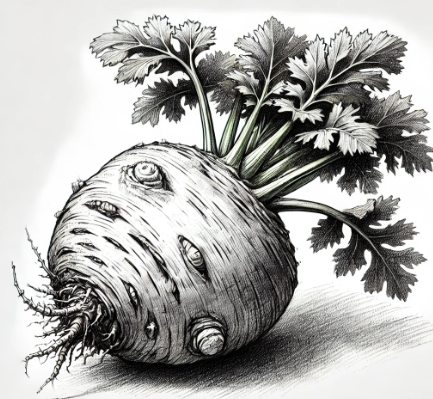
Celeriac (Apium graveolens var. rapaceum) commonly known as celery root, is a variety of celery cultivated for its large, edible tuber. Unlike stalk celery, which is grown for its stems, celeriac produces a knobby root with a mild, nutty flavor and an earthy aroma. It is widely used in European cuisine, particularly in France and Germany, and is gaining popularity worldwide due to its versatility and nutritional benefits. It is a biennial plant but is typically harvested as an annual before flowering.
Botanical Classification
- Kingdom: Plantae
- Clade: Angiosperms
- Class: Eudicots
- Order: Apiales
- Family: Apiaceae
- Genus: Apium
- Species: Apium graveolens
- Variety: rapaceum
Plant Characteristics
- Root: The edible portion is a rough, round, and knobby tuber with a firm white interior.
- Leaves & Stems: Green, celery-like leaves emerge from the root but are not as commonly consumed.
- Flowers: Small, white flowers appear in the second year of growth if the plant is left unharvested.
- Flavor: Earthy, slightly sweet, and similar to celery with a mild nutty undertone.
- Growth Cycle: Slow-growing, requiring 120–150 days to mature.
Nutritional Facts (Per 100g, Raw)
Nutrient | Amount | % Daily Value (DV) |
|---|---|---|
Energy | 42 kcal | 2% |
Carbohydrates | 9.2 g | 3% |
Sugars | 1.6 g | - |
Fiber | 1.8 g | 7% |
Protein | 1.5 g | 3% |
Fat | 0.3 g | <1% |
Vitamin C | 8 mg | 9% |
Vitamin K | 41 µg | 34% |
Folate (B9) | 27 µg | 7% |
Potassium | 300 mg | 9% |
Phosphorus | 90 mg | 7% |
Magnesium | 20 mg | 5% |
(Source: USDA FoodData) |
Celeriac is low in calories but rich in fiber, essential vitamins, and minerals, making it a great addition to a balanced diet.
Chemical Composition
Celeriac contains several bioactive compounds that contribute to its health benefits:
- Flavonoids & Polyphenols: Act as antioxidants with anti-inflammatory properties.
- Phthalides: Volatile compounds contributing to its characteristic aroma.
- Essential Oils: Includes limonene, which has potential antimicrobial effects.
- Dietary Fiber: Supports gut health and digestion.
How to Cultivate Apium graveolens var. rapaceum
- Climate:
- Thrives in cool temperatures (15°C to 20°C).
- Requires a long growing season (4 to 5 months).
- Soil Requirements:
- Prefers deep, rich, well-drained soil with high organic content.
- pH between 6.0 and 7.0 is ideal.
- Planting:
- Best grown from seeds started indoors 10–12 weeks before the last frost.
- Seedlings should be hardened off before transplanting.
- Watering:
- Requires consistent moisture but cannot tolerate waterlogging.
- Fertilization:
- Benefits from nitrogen-rich organic fertilizers to support steady growth.
- Harvesting:
- Ready for harvest when the root reaches 10–15 cm in diameter, usually in late autumn.
- Storage:
- Stores well in cool, humid conditions and can last several months.
Uses and Benefits
Culinary Uses
- Can be eaten raw (e.g., in celeriac remoulade, a French salad).
- Cooked in soups, stews, gratins, and purees.
- Roasted, boiled, mashed, or turned into fries as a low-carb alternative to potatoes.
- Used in vegetable juices and smoothies.
Health Benefits
- Heart Health: High potassium content helps regulate blood pressure.
- Digestive Health: High fiber promotes gut health and regularity.
- Anti-Inflammatory: Antioxidants contribute to reducing inflammation.
- Bone Health: Vitamin K supports calcium absorption and bone strength.
- Low-Calorie & Nutrient-Dense: Supports weight management and overall well-being.
Agricultural & Environmental Benefits
- Can be used in crop rotation to improve soil health.
- Requires less water than traditional root vegetables like potatoes.
Applications
Food Industry:
- Used in processed vegetable blends, soups, and dehydrated vegetable powders.
- Incorporated into plant-based diets.
Medical & Nutritional:
- Studied for its potential role in reducing inflammation and oxidative stress.
- Used in functional foods due to its fiber and antioxidant content.
Agriculture:
- Suitable for organic farming due to its pest-resistant nature.
- Helps improve soil structure in mixed cropping systems.
Environmental and Safety Considerations
Environmental Benefits
- Requires minimal chemical inputs compared to some other crops.
- Can be grown in cooler climates, reducing the need for excessive irrigation.
Safety
- Generally safe for consumption, but individuals allergic to celery should avoid celeriac.
- Some people may experience mild skin irritation when handling raw celeriac due to its natural compounds.
Research and Future Potential
With increasing interest in low-carb, nutrient-rich vegetables, Apium graveolens var. rapaceum is gaining popularity in health-conscious diets. Researchers are exploring its potential benefits for heart health, digestion, and inflammation reduction. The food industry is also investigating new ways to incorporate celeriac into plant-based products and functional foods. In agriculture, efforts are focused on developing more resilient and high-yielding celeriac varieties to promote sustainable cultivation.

