Dicrateria rotunda (Dicrateria rotunda (N. Reynolds) El M. Bendif & I. Probert)
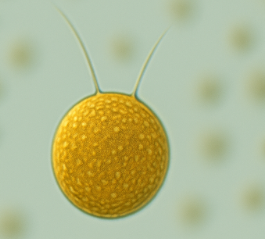
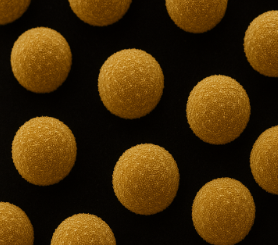
Marine unicellular microalga belonging to the Haptophyta, typical of the marine phytoplankton in temperate and cold waters, including Arctic Ocean environments. Cells are small (typically a few micrometres in diameter), spherical or slightly oval, free-living in the water column and lacking calcified structures. Colour ranges from yellow–golden to brownish–golden due to the presence of photosynthetic plastids.
Morphologically, Dicrateria rotunda forms biflagellate cells, with two flagella of length comparable to the cell diameter, enabling active motility in the water column. The cell body contains parietal chloroplasts of yellow–brown colour, often in variable number depending on the growth stage. Some descriptions report the presence of superficial circular scales arranged radially, observable only under electron microscopy; reserve materials are mainly carbohydrates of the leucosin type and intracellular lipid droplets.
The composition is characterised by a significant fraction of lipids, including saturated hydrocarbons with linear chains (n-alkanes with chain length from C₁₀ to C₃₈), as well as fatty acids, proteins, storage carbohydrates and photosynthetic pigments (chlorophylls and carotenoids. The presence of an extended series of n-alkanes is a distinctive feature of the genus Dicrateria and particularly of D. rotunda, which has attracted interest for potential applications in biofuel and green chemistry fields. The relative amount of hydrocarbons and lipids may increase under stress conditions, for example under darkness or nitrogen limitation, with accumulation of oily droplets in the cytoplasm.
From an ecological standpoint, Dicrateria rotunda functions as a primary producer within marine plankton, contributing to photosynthesis and the carbon cycle in ocean ecosystems. Cells may serve as a food source for higher planktonic organisms (microzooplankton, invertebrate larvae), thus entering the marine food web. Its capacity to synthesise linear hydrocarbons also makes it an interesting model for studying biosynthetic pathways of alkanes in the marine environment.
From an experimental and applied perspective, Dicrateria rotunda is maintained in pure culture strains in microalgal collections and is used in studies of algal physiology, lipid production and n-alkane biosynthesis. Parameters such as growth temperature, nutrient availability and light regime are modulated to evaluate the response in terms of hydrocarbon production and lipid composition. Correct taxonomic identification, control of culture conditions, and analysis of hydrocarbon and pigment profiles are key elements for the use of Dicrateria rotunda as a model of biotechnological and environmental interest.
 |  |
Botanical Classification
- Domain: Eukaryota
- Clade: Haptophyta
- Class: Prymnesiophyceae
- Order: Prymnesiales
- Family: Prymnesiaceae
- Genus: Dicrateria
- Species: Dicrateria rotunda
Cell Characteristics
Dicrateria rotunda is a microalgae species with distinct cellular features:
- Size: Cells typically measure 4–10 µm in diameter.
- Shape: Spherical to slightly elliptical.
- Flagella: Possesses two flagella for motility and a haptonema, which assists in feeding and environmental sensing.
- Chloroplasts: Contains chloroplasts that allow photosynthesis, giving the cells a greenish or golden hue.
- Lipid Production: Known for its high lipid content, including hydrocarbons and fatty acids, which have industrial and biofuel applications.
Chemical Composition
Dicrateria rotunda is rich in various compounds, contributing to its industrial and ecological significance:
- Lipids: High levels of neutral lipids, hydrocarbons, and triglycerides.
- Fatty Acids: Includes omega-3 fatty acids like EPA (eicosapentaenoic acid), beneficial for health and nutrition.
- Proteins: Moderate protein content suitable for nutritional applications.
- Carbohydrates: Present in smaller amounts, primarily as storage polysaccharides.
- Pigments: Contains chlorophylls, carotenoids, and other pigments essential for photosynthesis.
Habitat and Ecology
- Environment: Dicrateria rotunda is found in marine environments, often in nutrient-rich waters.
- Temperature Range: Prefers moderate to warm water temperatures.
- Role in Ecosystem:
- Plays a role in the marine food web as a primary producer.
- Contributes to carbon sequestration through photosynthesis.
- Produces compounds that can affect microbial and planktonic interactions.
Applications
The unique properties of Dicrateria rotunda make it a focus of research and potential commercial applications:
How to Cultivate Dicrateria rotunda
Cultivation of Dicrateria rotunda requires specific conditions to maximize growth and lipid production:
- Growth Medium: Requires seawater or artificial seawater enriched with nutrients such as nitrates, phosphates, and trace metals.
- Light: Requires moderate to high light intensity for photosynthesis. Light-dark cycles are typically maintained to simulate natural conditions.
- Temperature: Thrives in temperatures between 20°C and 30°C.
- Aeration: Requires adequate aeration to maintain oxygen levels and prevent sedimentation.
- Harvesting: Cells are harvested through centrifugation or filtration, depending on the scale of cultivation.
Environmental and Safety Considerations
Environmental Role:
- Contributes to the marine carbon cycle and supports aquatic food webs.
- Potential for large-scale cultivation to sequester carbon dioxide.
Safety:
- Non-toxic and safe for aquaculture and nutritional applications.
- Careful management is needed to prevent unintended ecological impacts in large-scale aquaculture.
Research and Future Potential
The study of Dicrateria rotunda is growing, with ongoing research into its use for sustainable biofuels, nutritional supplements, and marine biotechnology. Its unique ability to produce hydrocarbons positions it as a promising candidate for addressing global energy and environmental challenges.
Bibliografia__________________________________________________________________________
Marlowe, I. T., Green, J. C., Neal, A. C., Brassell, S. C., Eglinton, G., & Course, P. A. (1984). Long chain (n-C37–C39) alkenones in the Prymnesiophyceae. Distribution of alkenones and other lipids and their taxonomic significance. British Phycological Journal, 19(3), 203-216.
Abstract. Long chain (C37–C39) n-alkenones, esters of polyunsaturated n-C36 acids and C27–C29 sterols have been examined in thirteen species from nine genera of algae from the class Prymnesiophyceae and appear to have chemotaxonomic value. The alkenones and esters have been shown to occur in Chrysotila lamellosa and three species of Isochrysis and their presence in Emiliania huxleyi has been confirmed. They were absent from five other members of the order Isochrysidales, and from those representatives of the orders Coccosphaerales, Prymnesiales and Pavlovales examined. This discrimination was reflected in the distribution of the sterols; all five of the above-named species having high concentrations of 24-methylcholesta-5,22E-dien-3β-ol relative to cholest-5-en-3β-ol (cholesterol). In contrast, the former sterol is a minor component in, or is absent from, members of the Prymnesiales and Pavlovales. The sterol distributions suggest that some species at present included in the Isochrysidales (e.g. Ochrosphaera) have closer affinities with species of the Prymnesiales. The Isochrysidales is therefore not a natural taxonomic unit. Pavlova lutheri has sterols and fatty acids in common with members of the Isochrysidales and Prymnesiales, suggesting that the Pavlovales are a relatively ancient group within the Prymnesiophyceae. The distribution of hydrocarbons, fatty acids and carotenoids within the class can provide additional information of taxonomic value in isolated instances.
Bendif, E. M., Probert, I., Schroeder, D. C., & de Vargas, C. (2013). On the description of Tisochrysis lutea gen. nov. sp. nov. and Isochrysis nuda sp. nov. in the Isochrysidales, and the transfer of Dicrateria to the Prymnesiales (Haptophyta). Journal of applied phycology, 25, 1763-1776.
Abstract. The Isochrysidaceae is a family of non-calcifying organisms within the haptophyte order Isochrysidales. Isochrysis galbana, a species widely used as a food source in aquaculture, is the best-known representative of this family that contains three genera but only six described species. We sequenced partial nuclear small subunit (SSU) and large subunit rDNA and mitochondrial cytochrome oxidase 1 genes of 34 isochrysidacean culture strains (including authentic strains when available) and compared molecular phylogenetic inferences with cytological and ultrastructural observations. The isochrysidaceaen culture strain Isochrysis affinis galbana (Tahiti isolate), widely used in aquaculture and commonly known as T-Iso, is clearly genetically distinct from Isochrysis galbana, despite seemingly being morphologically identical. A strain with a similar ultrastructure to that of Isochrysis galbana except for the lack of body scales had sequences that were more similar to but still distinct from those of Isochrysis galbana. Dicrateria inornata, a species that lacks body scales, is classified within the Isochrysidaceae, but the SSU rDNA sequence of the authentic strain of this species matches that of Imantonia rotunda within another haptophye order, the Prymnesiales. D. inornata and Imantonia rotunda have similar ultrastructure except for the respective absence/presence of scales. These results lead us to propose the erection of one new genus (Tisochrysis gen. nov.) and two new species (Tisochrysis lutea sp. nov. and Isochrysis nuda sp. nov.). D. inornata is reclassified within the Prymnesiales, and Imantonia rotunda is transferred to this genus (Dicrateria rotunda comb. nov.).
Green, J. C., & Pienaar, R. N. (1977). The taxonomy of the order Isochrysidales (Prymnesiophyceae) with special reference to the genera Isochrysis Parke, Dicrateria Parke and Imantonia Reynolds. Journal of the Marine Biological Association of the United Kingdom, 57(1), 7-17.
Abstract. The order Isochrysidales was erected by Pascher in 1910 to accommodate chrysomonads with two equal flagella. It was based on the family Hymenomonadaceae (Senn, 1900) and included such genera as Synura Ehrenberg (later shown to be heterokont and therefore incorrectly placed here; Hovasse, 1949; Manton, 1955), Wyssotzkia Lemmermann and Hymenomonas Stein. Papenfuss (1955) used the name in a similar sense but encompassing also the coccolithophorids, while those genera with two equal flagella and a ‘short third flagellum’ ((Prymnesium Massart, Platychrysis N. Carter, Chrysochromulina Lackey) were placed in the order Prymnesiales. Subsequently it was demonstrated that members of the Isochrysidales and Prymnesiales differ from other chrysomonads in that the two true flag-ella are smooth with no coarse hairs (‘mastigonemes’) and that the third appendage found in genera of the latter order is a unique structure, termed the ‘haptonema’ by Parke, Manton & Clarke (1955). On the basis of these observations, Christensen (1962) erected a new class, the Haptophyceae (now referred to by the typified name Prymnesiophyceae; Hibberd, 1976 a), to contain the two orders although Bourrelly (1968) preferred to retain them within the Chrysophyceae whilst recognizing their unique status by the erection of a sub-class, the Isochrysophycidae.




