Artemisia capillaris, comunemente conosciuta come assenzio capillare o "yin chen hao" nella Medicina Tradizionale Cinese (MTC), è un’erba perenne molto apprezzata per le sue foglie sottili e piumate e le sue proprietà aromatiche. Originaria dell’Asia orientale, questa pianta è conosciuta per le sue applicazioni medicinali, in particolare per il supporto alla salute del fegato, la promozione della disintossicazione e la gestione delle condizioni infiammatorie. È un componente nei rimedi erboristici per l’ittero e i disturbi digestivi.
Classificazione Botanica
- Regno: Plantae
- Clade: Tracheophytes
- Classe: Magnoliopsida
- Ordine: Asterales
- Famiglia: Asteraceae
- Genere: Artemisia
- Specie: Artemisia capillaris
Caratteristiche della Pianta
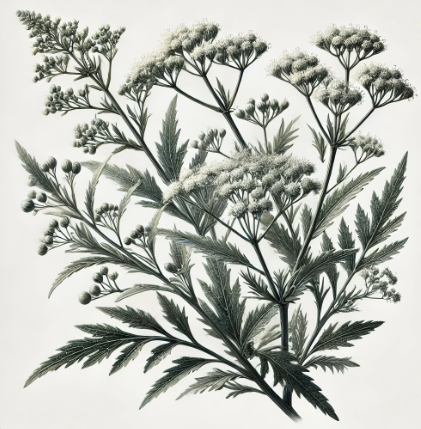
Artemisia capillaris è un’erba perenne resistente che può crescere fino a un’altezza di 30–100 cm. Presenta foglie finemente divise, simili a fili, che le conferiscono un aspetto delicato e piumato. La pianta produce piccoli fiori giallo-verdi che sbocciano in grappoli verso la fine dell’estate e l’autunno. L’aroma caratteristico della pianta la rende facilmente riconoscibile, e cresce in una varietà di ambienti, dai terreni sabbiosi ai pascoli.
Composizione Chimica e Struttura
Le proprietà terapeutiche di Artemisia capillaris sono attribuite ai suoi composti bioattivi, tra cui:
Flavonoidi: Come lo scoparone e l’isoscoparina, noti per i loro effetti antinfiammatori e protettivi per il fegato.
Oli Essenziali: Ricchi di composti come il capillarisina e l’artemisinina, che contribuiscono alle sue proprietà aromatiche e antimicrobiche.
Cumarine: Inclusi esculetina e scoparone, che supportano la funzione epatica e hanno effetti antiossidanti.
Polisaccaridi: Composti che rafforzano il sistema immunitario e contribuiscono alle proprietà disintossicanti della pianta.
Composti Fenolici: Con proprietà antiossidanti, aiutano a combattere lo stress ossidativo e proteggono la salute cellulare.
Come Coltivare Artemisia capillaris
La coltivazione di Artemisia capillaris è relativamente semplice grazie alla sua adattabilità:
Clima: Cresce bene in climi temperati con pieno sole o ombra parziale. È resistente alla siccità e tollerante a diverse condizioni climatiche.
Requisiti del Suolo: Predilige terreni ben drenati, sabbiosi o limosi, con fertilità moderata. È tollerante anche ai suoli più poveri e alcalini.
Propagazione: Si propaga tramite semi o divisioni delle radici. I semi vanno seminati in primavera, mentre le divisioni si effettuano in autunno o all’inizio della primavera.
Annaffiatura e Manutenzione: Richiede poca acqua una volta stabilita. È importante evitare ristagni idrici per prevenire il marciume radicale. La potatura occasionale favorisce una crescita sana e la fioritura.
Raccolta: Le parti aeree della pianta, comprese foglie e steli, vengono raccolte in estate prima della fioritura per uso medicinale. Solitamente, vengono essiccate e lavorate per tè, tinture ed estratti.
Usi e Benefici
Artemisia capillaris è utilizzata nella MTC e in altri sistemi di medicina tradizionale per i suoi numerosi benefici per la salute:
Supporto al Fegato: Nota per le sue proprietà protettive per il fegato, è tradizionalmente utilizzata per trattare condizioni epatiche come l’ittero e l’epatite, favorendo la disintossicazione e la secrezione biliare.
Salute Digestiva: Utilizzata per alleviare problemi digestivi, gonfiore e altri disagi gastrointestinali, migliorando la digestione complessiva.
Effetti Antinfiammatori: I flavonoidi e le cumarine aiutano a ridurre l’infiammazione, in particolare nel fegato e nel tratto digestivo.
Proprietà Antiossidanti: I composti fenolici combattono lo stress ossidativo, supportando la salute cellulare e il benessere generale.
Effetti Antimicrobici e Antivirali: Gli oli essenziali sono stati studiati per il loro potenziale antimicrobico e antivirale, rendendo la pianta utile nella prevenzione delle infezioni.
Applicazioni
Medico: Artemisia capillaris è un pilastro della MTC, spesso inclusa nelle formulazioni per la salute del fegato, la disintossicazione e il trattamento dell’ittero. È comunemente preparata come decotto, tè o estratto.
Cosmetico: Gli estratti della pianta sono occasionalmente utilizzati nei prodotti per la cura della pelle per le loro proprietà antiossidanti e antinfiammatorie, utili per lenire pelle irritata o infiammata.
CAS 223747-93-1
Considerazioni Ambientali e di Sicurezza
Artemisia capillaris è generalmente sicura se utilizzata secondo le pratiche tradizionali. Tuttavia, un uso eccessivo potrebbe causare lievi disagi gastrointestinali a causa dei suoi composti amari. Si raccomandano pratiche di raccolta sostenibile per preservare le popolazioni selvatiche e garantire la disponibilità a lungo termine. La pianta non è invasiva e cresce facilmente in ambienti controllati, rendendola una scelta ecologica per la coltivazione. Come per tutti i prodotti botanici, chi ha allergie o sensibilità dovrebbe testare la tolleranza prima di un uso prolungato.
Bibliografia__________________________________________________________________________
Kim J, Jung KH, Yan HH, Cheon MJ, Kang S, Jin X, Park S, Oh MS, Hong SS. Artemisia Capillaris leaves inhibit cell proliferation and induce apoptosis in hepatocellular carcinoma. BMC Complement Altern Med. 2018 May 8;18(1):147. doi: 10.1186/s12906-018-2217-6.
Abstract. Background: Natural product is one of the most important sources of drugs used in pharmaceutical therapeutics. Artemisia capillaris has been traditionally used as a hepatoprotective and anti-inflammatory agent. In this study, we extracted an ethanol fraction (LAC117) from the dried leaves of Artemisia capillaris and identified its anticancer activity and mechanism of action against hepatocellular carcinoma (HCC). Conclusions: The present study highlights that LAC117 could not only efficiently induce apoptosis, but also inhibit the growth of human HCC cells by blocking the PI3K/AKT signaling pathway, suggesting that LAC117 would be a potentially useful drug candidate against HCC.
dela Peña IJ, Hong E, Kim HJ, de la Peña JB, Woo TS, Lee YS, Cheong JH. Artemisia capillaris Thunberg Produces Sedative-Hypnotic Effects in Mice, Which are Probably Mediated Through Potentiation of the GABAA Receptor. Am J Chin Med. 2015;43(4):667-79. doi: 10.1142/S0192415X1550041X.
Abstract. The Artemisia group of plants has long been used as a traditional remedy for various conditions. The present study assessed the sleep-promoting (sedative-hypnotic) effects of Artemisia capillaris Thunberg (A. capillaris), and elucidated a possible mechanism behind its effect. ICR mice were given A. capillaris extract (oral) at different dosages (50, 100, 200, 300, or 400 mg/kg), distilled water (oral; control), or diazepam (intraperitoneal; reference drug). One hour after administration, locomotion (open-field test) and motor coordination (rota-rod test) were assessed. The extract's effect on pentobarbital-induced sleep was also evaluated. Additionally, electroencephalographic (EEG) recordings were measured in rats. To evaluate a possible mechanism behind its effects, changes in chloride ( Cl (-)) ion influx were measured in human neuroblastoma cells. As compared to the control group, mice treated with A. capillaris demonstrated significantly decreased locomotor activity and impaired motor balance and coordination. The extract also shortened the onset and lengthened the duration of sleep induced by pentobarbital sodium. These effects were comparable to that induced by diazepam. Furthermore, A. capillaris-treated rats showed increased delta and decreased alpha EEG waves; an electroencephalographic pattern indicative of relaxation or sedation. In neuroblastoma cells, the extract dose-dependently increased Cl (-) ion influx, which was blocked by co-administration of bicuculline, a GABAA receptor competitive antagonist, suggesting that its effects are mediated through the GABAA receptor- Cl (-) ion channel complex. Altogether, the results of the present study demonstrate that A. capillaris possesses potent sedative-hypnotic effects, which are probably mediated through potentiation of the GABAA receptor- Cl (-) ion channel complex.
Lee SH, Lee JY, Kwon YI, Jang HD. Anti-Osteoclastic Activity of Artemisia capillaris Thunb. Extract Depends upon Attenuation of Osteoclast Differentiation and Bone Resorption-Associated Acidification Due to Chlorogenic Acid, Hyperoside, and Scoparone. Int J Mol Sci. 2017 Feb 4;18(2):322. doi: 10.3390/ijms18020322.
Abstract. The present study attempts to elucidate the anti-osteoporotic activity of Artemisia capillaris Thunb. in the form of anti-osteoclastic effect and responsible bioactive compounds. The contents of chlorogenic acid, caffeic acid, hyperoside, isoquercitrin, isochlorogenic acid A, and scoparone in Artemisia capillaris hydroethanolic extract (ACHE) were 38.53, 0.52, 4.07, 3.03, 13.90, and 6.59 mg/g, respectively. ACHE diminished osteoclast differentiation and bone resorption due to chlorogenic acid, hyperoside, and scoparone. In addition, ACHE attenuated acidification as well as reducing tumor necrosis factor receptor-associated factor 6 (TRAF6) expression and its association with vacuolar H⁺-adenosine triphosphatase (V-ATPase). Furthermore, chlorogenic acid, hyperoside, and scoparone from A. capillaris abrogated the association of V-ATPase with TRAF6, suggesting that the blockage of bone resorption by A. capillaris was partially mediated by reducing acidification through down-regulating interaction of V-ATPase with TRAF6 due to scoparone as well as chlorogenic acid and hyperoside. These results imply that the anti-osteoclastic effect of A. capillaris through down-regulating osteoclast differentiation and bone resorption may contribute to its anti-osteoporotic effect.
Ha H, Lee H, Seo CS, Lim HS, Lee JK, Lee MY, Shin H. Artemisia capillaris inhibits atopic dermatitis-like skin lesions in Dermatophagoides farinae-sensitized Nc/Nga mice. BMC Complement Altern Med. 2014 Mar 14;14:100. doi: 10.1186/1472-6882-14-100.
Abstract. Background: Artemisia capillaries Thunb. (AC) has been used to treat inflammatory and hepatic disorders such as hepatic injury, hepatic fibrosis and hepatitis. However, the efficacy of AC against atopic dermatitis (AD), an inflammatory disease, has not been examined. In the present study, AC was evaluated for anti-inflammatory and anti-AD effects using both in vitro and in vivo systems.....Conclusions: Our results suggest that AC should be explored as a potential therapeutic agent to treat atopic dermatitis and analysis by HPLC will help to improve the quality of AC.
Ekiert H, Klimek-Szczykutowicz M, Rzepiela A, Klin P, Szopa A. Artemisia Species with High Biological Values as a Potential Source of Medicinal and Cosmetic Raw Materials. Molecules. 2022 Sep 29;27(19):6427. doi: 10.3390/molecules27196427.
Abstract. Artemisia species play a vital role in traditional and contemporary medicine. Among them, Artemisia abrotanum, Artemisia absinthium, Artemisia annua, Artemisia dracunculus, and Artemisia vulgaris are the most popular. The chemical composition and bioactivity of these species have been extensively studied. Studies on these species have confirmed their traditional applications and documented new pharmacological directions and their valuable and potential applications in cosmetology. Artemisia ssp. primarily contain sesquiterpenoid lactones, coumarins, flavonoids, and phenolic acids. Essential oils obtained from these species are of great biological importance. Extracts from Artemisia ssp. have been scientifically proven to exhibit, among others, hepatoprotective, neuroprotective, antidepressant, cytotoxic, and digestion-stimulating activities. In addition, their application in cosmetic products is currently the subject of several studies. Essential oils or extracts from different parts of Artemisia ssp. have been characterized by antibacterial, antifungal, and antioxidant activities. Products with Artemisia extracts, essential oils, or individual compounds can be used on skin, hair, and nails. Artemisia products are also used as ingredients in skincare cosmetics, such as creams, shampoos, essences, serums, masks, lotions, and tonics. This review focuses especially on elucidating the importance of the most popular/important species of the Artemisia genus in the cosmetic industry.
Chen Y, Zhang S, Qu L. The protective effect of Artemisia Capillaris Thunb. Extract against UVB-induced apoptosis and inflammation through inhibiting the cGAS/STING pathway. J Photochem Photobiol B. 2024 Sep;258:112989. doi: 10.1016/j.jphotobiol.2024.112989.




