



Review HT Instruments HT25N
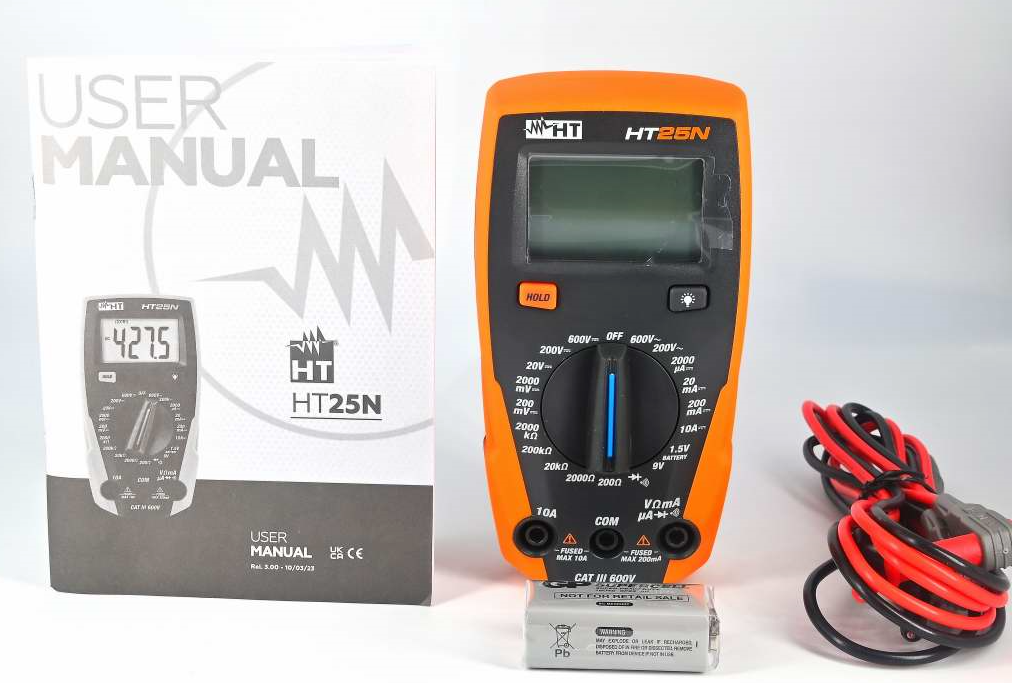
The HT25N is a professional bipole voltage tester designed and manufactured in Italy to detect and measure AC (alternating current) and DC (direct current) voltages in a broad range, typically up to 690 V. It is intended for professional use by electricians, maintenance personnel, and technicians who need to swiftly assess whether a circuit is energized, in compliance with applicable standards.
Key Features
- AC/DC Voltage Measurement: Enables detection of low-voltage (LV) values with clear LED indication.
- Continuity Function: Verifies closed-circuit conditions, providing visual (LED) and/or audible (buzzer) feedback, depending on the model.
- Phase Detection (Single-Pole Test): Many models allow identification of the live conductor using only one test probe, referencing earth potential via the handle or a suspended second probe.
- Polarity Indication: In DC mode, automatically determines positive/negative polarity.
- Compact & Robust Build: The insulated enclosure, often rated IP64, safeguards internal components from dust and water splashes.
2. Technical Specifications (Indicative Values)
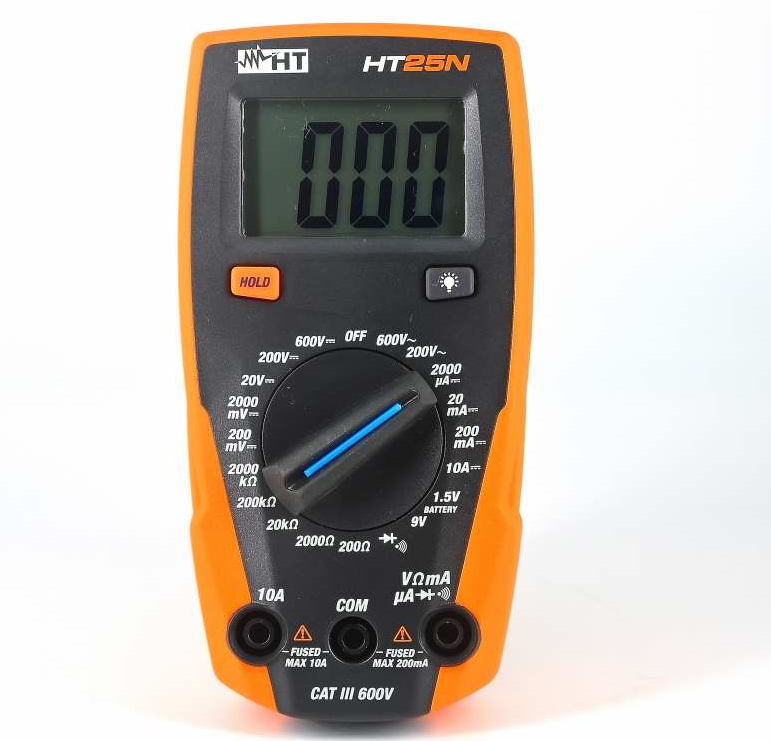
The table below offers approximate technical data; refer to the official manual for final values and tolerances:
- Voltage Measurement Range:
- AC: Approximately 12 V to 690 V (50/60 Hz; consult the manual for tolerance details).
- DC: Approximately 12 V to 690 V.
- LED Indication: Segmented display for typical voltage thresholds (e.g., 12, 24, 50, 120, 230, 400, 690 V).
- Safety Category (CAT): Usually CAT III 690 V (check the instrument labeling for the latest rating).
- IP Protection: Typically IP64 (dustproof and splashproof).
- Frequency (AC): Approx. 0 to 400 Hz (consult manual for exact specs).
- Power Supply: Typically 2 x 1.5 V batteries (AAA or equivalent).
- Continuity Test: LED/buzzer indication for resistance below a specific threshold (e.g., <100 Ω).
- Dimensions & Weight: Compact design, suitable for daily on-site use (values vary by version).
3. Standards and Safety
Applicable Standards:
- EN/IEC 61243-3: Live working – Voltage detectors – Part 3: Two-pole low-voltage type.
- EN/IEC 61010-1: Safety requirements for electrical equipment for measurement, control, and laboratory use.
Measurement Category:
- CAT III: Suitable for measurements on fixed installations, distribution boards, and wiring, up to 690 V, unless otherwise specified.
- Always ensure the category (CAT) and rated voltage match or exceed the system or device under test.
Safety Guidelines:
- Inspect the tester’s enclosure and test leads for any damage prior to each use.
- Wear appropriate personal protective equipment (PPE), such as insulated gloves and safety glasses.
- Do not operate the tester in explosive atmospheres or high-moisture conditions unless explicitly permitted.
- Respect the operating limits set by the manufacturer (max. voltage, measurement category, etc.).
4. Operating Instructions
Pre-use Check
- Install the 9 v battery provided in the package by unscrewing 2 screws in the back of the instrument and removing the black plastic cover.
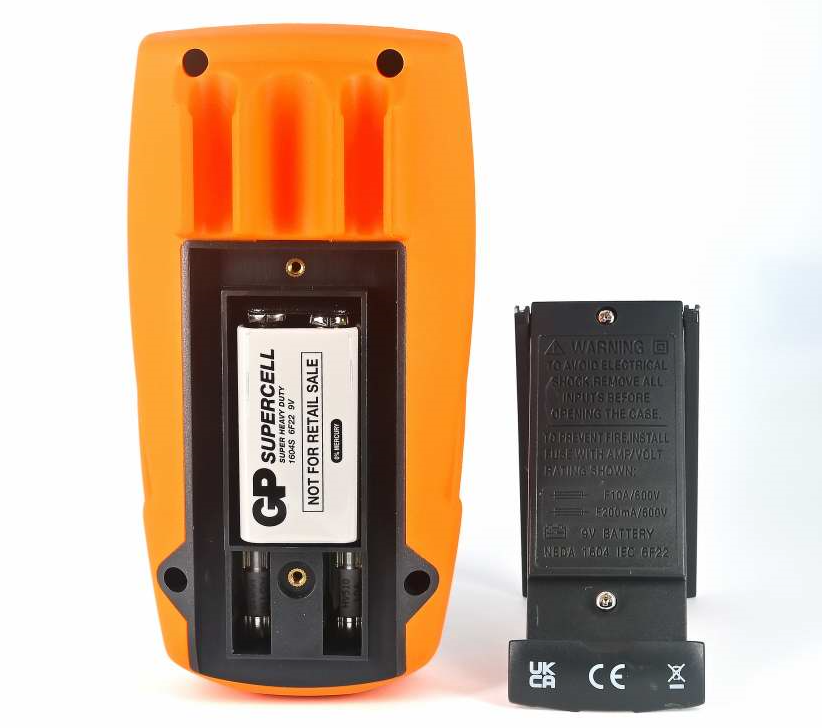
- Verify battery status and confirm that the battery compartment is correctly closed.
- Ensure that the test leads and cables are free from damage or exposed areas.
AC/DC Voltage Measurement
- Apply the two test leads to the conductors or points to be tested (e.g., phase–neutral, phase–earth for AC; positive–negative for DC).
- Observe the illuminated LED segments to determine the approximate voltage level.
- For voltages above 50 V AC/120 V DC, take adequate safety precautions.
Continuity Test
- Short-circuit the test leads or apply them across the conductor/circuit under test.
- If the resistance is below the specified threshold, the tester will activate a visual (LED) and/or audible (buzzer) signal.
Phase Detection (Single-Pole Test)
- Place one test lead on the suspected live conductor.
- Use the other hand or an appropriate reference (as directed in the manual) to ground or hold the second probe in suspension.
- The phase LED illuminates if a voltage potential is detected relative to the reference.
Phase Rotation Check (where available)
- Some HT-Instruments bipole testers support phase-sequence detection (only if mentioned in the manual).
- Connect the leads to two phases of a three-phase system and follow the LED indications to determine the rotation order.
5. Routine Maintenance
- Cleaning: Use a slightly damp cloth without harsh solvents; avoid exposure to excessive heat.
- Battery Replacement: Change the batteries whenever the tester indicates low power or shows irregular behavior.
- Periodic Inspection: Check leads, cables, and the enclosure for wear or damage; a compromised instrument can be hazardous.
- Storage: Store the HT25N in a dry environment, protected from dust and mechanical shocks.
6. Operational Advantages
- Reliability: Meets European standards EN/IEC 61243-3 and is typically rated CAT III 690 V, making it suitable for numerous professional applications.
- Speed of Diagnosis: The LED voltage-scale indication delivers a rapid, clear assessment of whether a circuit is energized.
- Versatility: By combining AC/DC measurement, continuity test, and phase detection, the HT25N covers a wide range of routine electrical checks.
- Portability: Its compact design and battery-powered operation make it ideal for field service and workshop tasks.
7. Conclusion and Official Documentation
The HT25N bipole tester from HT-Instruments S.r.l., Italy is a professional tool designed for voltage measurement and continuity testing in both industrial and domestic settings. To ensure proper and safe operation:
- Refer to the Official Manual: Consult the manufacturer’s documentation for detailed instructions on measurement ranges, tolerances, safety protocols, and any calibration procedures.
- Comply with Standards: Adhere to national and international norms (EN/IEC 61243-3, EN/IEC 61010-1, etc.) when using the instrument.
- Maintain the Instrument: Regular inspections and prompt replacement of worn parts are essential for safety and reliability.
Among the many “reasonably priced” multimeters located in the 30- to 80-euro range on the market of which at least 95 percent are Chinese-made, the HT25N stands at the top of the range in terms of quality, accuracy, and the high level of components used. It is compact, has the right weight, the rotary switch is precise, the brightness can be increased with a button, the leads cables are quite soft, and the display has clearly readable digits.
Excellent product.

