



The Lunenburg lens (also known as Lüneburg lens) is an advanced optical structure with a specific and unique refractive index distribution. It operates fundamentally differently from standard lenses, and its properties allow it to focus or deflect electromagnetic waves—primarily in the radio and microwave frequency ranges—in ways that traditional lenses cannot achieve. Let’s dive deeper into its design, principles, and applications.
1. Design and Structure
The Lüneburg lens is a spherical lens with a specific refractive index profile that decreases radially from the outer surface towards the center. In a traditional lens, the refractive index typically increases or decreases as a function of the distance from the center of the lens. In contrast, the Lüneburg lens has the following characteristics:
Spherical Geometry: It is shaped like a sphere, where the refractive index changes as a function of the radial distance from the center.
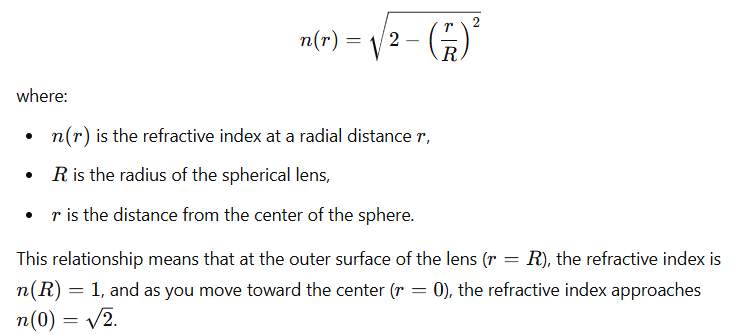
Refractive Index Distribution: The key feature is the radial variation of the refractive index, which is described mathematically as:
2. Principle of Operation
The Lüneburg lens operates on the principle of controlling the speed and direction of electromagnetic waves (such as light, microwaves, or radio waves) by varying the refractive index across the lens. This variation in refractive index affects how waves propagate through the material.
Wave Propagation:
Electromagnetic Wave Focusing: Due to the way the refractive index decreases from the edges toward the center, the waves bend towards the center as they travel through the lens. The lens focuses parallel waves to a point at the opposite side of the sphere, making it a perfect focusing lens for certain frequencies of electromagnetic waves.
Ray Optics and Refraction: The refraction at each point on the surface of the lens depends on the local refractive index, directing the rays of light or waves toward a common focal point. Unlike regular lenses where curvature alone dictates refraction, the Lüneburg lens controls refraction via both geometry (spherical shape) and the varying refractive index.
Focusing Characteristics:
The spherical symmetry of the lens leads to its ability to focus incoming waves from any direction to a single focal point. This is in stark contrast to traditional lenses that require specific curvature and material properties for focused light.
Ideal for Wavefront Shaping: The Lüneburg lens can focus incoming plane waves into a single point, which is ideal for applications where wavefronts need to be manipulated with high precision.
3. Mathematical Explanation
The refractive index profile is based on a spherical coordinate system, and the mathematical derivation behind it is rooted in ray optics and Snell's law (the law of refraction). The formulation

comes from solving the wave equation under boundary conditions that would focus incoming plane waves to a single focal point on the other side of the sphere.
This refractive index profile ensures that:
- The wave’s direction is controlled as it travels through the lens,
- The lens can focus waves from an arbitrary direction,
- The behavior is consistent with the principles of geometrical optics but differs due to the unusual index distribution.
4. Applications of the Lüneburg Lens
While Lüneburg lenses were initially a theoretical development, they have found practical applications, particularly in fields that rely on microwave and radio frequency (RF) technology. Some key applications include:
A. Antenna and Radar Systems
Microwave and Radio Frequency: In radar and communication systems, the Lüneburg lens is used to focus and direct electromagnetic waves (such as microwaves or radio signals) more efficiently than conventional systems.
Radar Antennas: The Lüneburg lens can be used in radar systems to create beamforming mechanisms, where electromagnetic waves are focused or steered. This is especially important for directing signals without mechanical moving parts.
Wide-Angle Radar: In radar applications, the Lüneburg lens can help in creating wide-angle beams or highly focused beams. It is especially useful in multi-beam systems, where the goal is to focus energy across a broad area without distortion.
Antenna Design: Lüneburg lenses are sometimes incorporated into antenna designs to enhance the focusing of waves from an antenna, improving the overall efficiency of the transmission and reception of signals.
B. Optical Applications (Theoretical and Experimental)
While most common applications of the Lüneburg lens are in radio and microwave frequencies, there have been theoretical proposals and experimental efforts to adapt the principles of the lens to optical wavelengths. The challenge is the manufacturing of materials with the required refractive index profiles at these smaller wavelengths.
Photonics: In the field of photonics, researchers have looked at the potential of Lüneburg lenses for manipulating light at optical wavelengths (e.g., in laser systems or optical communication systems). However, the material and precision challenges are significant.
Plasmonics and Metamaterials: Some experimental research explores the possibility of creating Lüneburg-like lenses using metamaterials that are engineered to have specific refractive properties at optical frequencies.
C. Signal Processing and Wave Manipulation
The Lüneburg lens’s ability to control the direction and focusing of electromagnetic waves makes it useful in advanced signal processing systems, including waveguide designs and beam-steering technologies.
Optical and Microwave Imaging: The lens may be applied in systems requiring wavefront shaping, where the goal is to create images or direct waves with high precision.
5. Advantages and Challenges
Advantages:
- Compactness: The Lüneburg lens is a single, spherical piece, making it a compact solution compared to traditional optical systems with complex arrangements of lenses and mirrors.
- Wide-Angle Focusing: It can focus waves from all directions, offering an advantage in systems that need a wide field of view or flexible focusing.
Challenges:
- Manufacturing Complexity: Creating a material with the precise radial refractive index profile, especially at optical wavelengths, is technically challenging.
- Material Limitations: For optical wavelengths, suitable materials with the required refractive properties are not readily available.
6. Conclusion
The Lüneburg lens is a fascinating and powerful optical device that differs from conventional lenses in its spherical design and radially varying refractive index. It has found success primarily in microwave and radio frequency applications, especially in radar and antenna systems. While challenges remain in applying it to optical frequencies, the Lüneburg lens remains a promising concept for future developments in optical and electromagnetic wave manipulation.

