Il Codirosso o Codirosso spazzacamino (Phoenicurus ochruros) è un piccolo passeriforme noto per la sua coda vivacemente colorata, che è un arancio-rossastro acceso. Il maschio ha un piumaggio scuro, con il dorso nero o grigio scuro e una caratteristica macchia bianca sulle ali. Le femmine e i giovani sono generalmente più sobri, con un piumaggio bruno-grigiastro, ma anch'essi presentano la coda rossastra. Questo uccello è noto per il suo comportamento vivace e la sua tendenza a saltellare sui rami o sulle rocce, muovendo costantemente la coda. Il canto del codirosso spazzacamino è melodico e spesso punteggiato da suoni aspri e metallici.
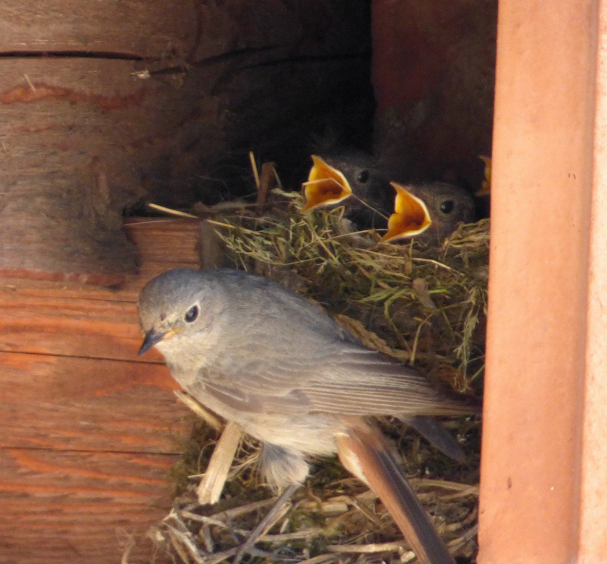
Classificazione scientifica:
- Regno: Animalia
- Phylum: Chordata
- Classe: Aves
- Ordine: Passeriformes
- Famiglia: Muscicapidae
- Genere: Phoenicurus
- Specie: Phoenicurus ochruros
Dimensioni e Peso: Il codirosso spazzacamino misura tra i 13 e i 15 cm di lunghezza, con un'apertura alare che va dai 23 ai 26 cm. Il peso di un adulto varia dai 12 ai 20 grammi. Le dimensioni ridotte e il corpo snello conferiscono a questo uccello una grande agilità, soprattutto durante il volo.
Habitat: Questo uccello è estremamente adattabile e si trova in una vasta gamma di habitat. Tradizionalmente legato ad ambienti rocciosi e montuosi, si è anche adattato a vivere in ambienti urbani, nidificando tra edifici, muri e vecchie strutture. È comune nei giardini, nei parchi e nelle aree rurali. In Italia e in Europa, lo si può trovare sia in alta montagna che a quote più basse, mentre in inverno tende a migrare verso aree più temperate.
Comportamento e Abitudini: Il codirosso spazzacamino è noto per la sua vivacità e il suo comportamento territoriale. I maschi difendono aggressivamente il loro territorio, esibendosi in canti complessi e vivaci. Durante la stagione riproduttiva, che va da aprile a luglio, la femmina costruisce un nido in cavità di alberi, rocce o edifici, dove depone da 4 a 6 uova. Entrambi i genitori partecipano all'allevamento dei piccoli, che lasciano il nido dopo circa due settimane dalla schiusa. Il codirosso è insettivoro, nutrendosi principalmente di insetti e larve, ma in autunno integra la dieta con frutti e bacche.
Pericoli, Nemici e Minacce: I principali predatori del codirosso spazzacamino includono rapaci, serpenti e piccoli mammiferi carnivori che possono attaccare il nido. Tuttavia, l'influenza umana, come l'uso di pesticidi, la perdita di habitat e la diminuzione delle aree naturali di nidificazione, rappresentano le principali minacce per questa specie. Anche i cambiamenti climatici possono influire sulla sua distribuzione, alterando la disponibilità di cibo e le condizioni migratorie.
Specie Protetta o Minacciata: Il codirosso spazzacamino non è considerato una specie in pericolo a livello globale, ma in alcune regioni europee è soggetto a monitoraggio e protezione per preservare i suoi habitat naturali. Grazie alla sua capacità di adattarsi agli ambienti urbani, la popolazione del codirosso spazzacamino è generalmente stabile, ma l'eccessiva urbanizzazione e l'uso di pesticidi potrebbero rappresentare una minaccia futura.
Bibliografia__________________________________________________________________________
Villavicencio CP, Windley H, D'Amelio PB, Gahr M, Goymann W, Quispe R. Neuroendocrine patterns underlying seasonal song and year-round territoriality in male black redstarts. Front Zool. 2021 Feb 24;18(1):8. doi: 10.1186/s12983-021-00389-x.
Abstract. Background: The connection between testosterone and territoriality in free-living songbirds has been well studied in a reproductive context, but less so outside the breeding season. To assess the effects of seasonal androgenic action on territorial behavior, we analyzed vocal and non-vocal territorial behavior in response to simulated territorial intrusions (STIs) during three life-cycle stages in free-living male black redstarts: breeding, molt and nonbreeding. Concurrently, we measured changes in circulating testosterone levels, as well as the mRNA expression of androgen and estrogen receptors and aromatase in the preoptic, hypothalamic and song control brain areas that are associated with social and vocal behaviors. Results: Territorial behavior and estrogen receptor expression in hypothalamic areas did not differ between stages. But plasma testosterone was higher during breeding than during the other stages, similar to androgen receptor and aromatase expression in the preoptic area. The expression of androgen receptors in the song control nucleus HVC was lower during molt when birds do not sing or sing rarely, but similar between the breeding and the nonbreeding stage. Nevertheless, some song spectral features and the song repertoire differed between breeding and nonbreeding. Territorial behavior and song rate correlated with the expression of steroid receptors in hypothalamic areas, and in the song control nucleus lMAN. Conclusions: Our results demonstrate seasonal modulation of song, circulating testosterone levels, and brain sensitivity to androgens, but a year-round persistency of territorial behavior and estrogen receptor expression in all life-cycle stages. This suggests that seasonal variations in circulating testosterone concentrations and brain sensitivity to androgens is widely uncoupled from territorial behavior and song activity but might still affect song pattern. Our study contributes to the understanding of the complex comparative neuroendocrinology of song birds in the wild.
Apfelbeck B, Mortega KG, Kiefer S, Kipper S, Goymann W. Life-history and hormonal control of aggression in black redstarts: Blocking testosterone does not decrease territorial aggression, but changes the emphasis of vocal behaviours during simulated territorial intrusions. Front Zool. 2013 Feb 21;10(1):8. doi: 10.1186/1742-9994-10-8.
Abstract. Introduction: Many studies in behavioural endocrinology attempt to link territorial aggression with testosterone, but the exact relationship between testosterone and territorial behaviour is still unclear and may depend on the ecology of a species. The degree to which testosterone facilitates territorial behaviour is particularly little understood in species that defend territories during breeding and outside the breeding season, when plasma levels of testosterone are low. Here we suggest that species that defend territories in contexts other than reproduction may have lost the direct regulation of territorial behaviour by androgens even during the breeding season. In such species, only those components of breeding territoriality that function simultaneously as sexually selected signals may be under control of sex steroids. Results: We investigated black redstarts (Phoenicurus ochruros), a species that shows periods of territoriality within and outside of the breeding season. We treated territorial males with an anti-androgen and an aromatase inhibitor during the breeding season to block both the direct and indirect effects of testosterone. Three and ten days after the treatment, implanted males were challenged with a simulated territorial intrusion. The treatment did not reduce the overall territorial response, but it changed the emphasis of territoriality: experimental males invested more in behaviours addressed directly towards the intruder, whereas placebo-treated males put most effort into their vocal response, a component of territoriality that may be primarily directed towards their mating partner rather than the male opponent. Conclusions: In combination with previous findings, these data suggest that overall territoriality may be decoupled from testosterone in male black redstarts. However, high levels of testosterone during breeding may facilitate-context dependent changes in song.




