



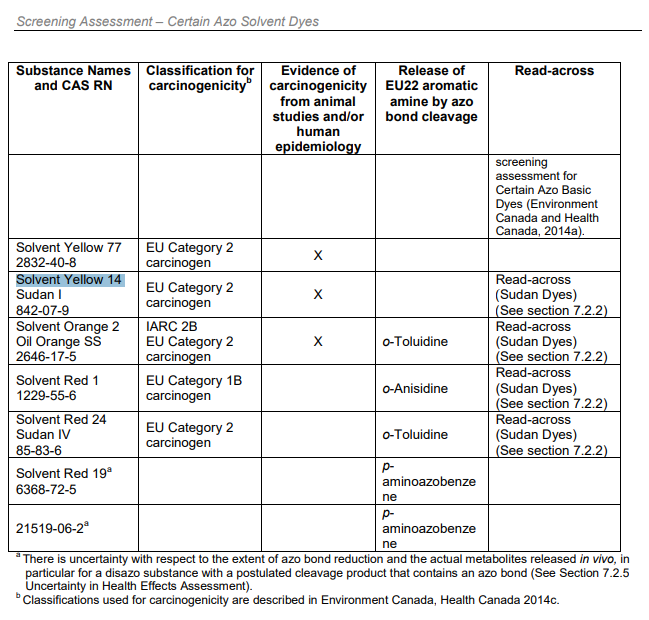
Solvent Yellow 14, also known as Sudan I, is a synthetic azo dye with the chemical formula C16H12N2O. It is primarily used for coloring industrial materials such as plastics, waxes, and occasionally for coloring oils and solvent-based products. Sudan I is classified in Category 2 for carcinogenicity by the European Union, meaning it is suspected of being carcinogenic to humans. The evidence for its carcinogenicity comes from animal studies and, in some cases, from human epidemiological studies. Sudan I belongs to a group of aromatic azo dyes that are linked to carcinogenic aromatic amines, as highlighted in the Screening Assessment for Aromatic Azo and Benzidine-based Substance Grouping Certain Azo Solvent Dyes (see Section 7.2.2 in the report by Environment Canada).
Chemical Composition and Structure
Solvent Yellow 14 is an azo dye made up of an azo bond (-N=N-) linking two aromatic rings, with a hydroxyl group (-OH) attached to one of the rings. Its chemical formula is C16H12N2O. The azo bond provides the characteristic bright yellow-orange color of Sudan I but also raises concerns due to the potential degradation of the dye into aromatic amines, which are known carcinogens.
Physical Properties
It typically appears as a yellow-orange crystalline powder. It is insoluble in water but highly soluble in organic solvents such as oils and hydrocarbons. It has good light and heat stability, making it suitable for industrial products that require resistance to harsh environmental conditions.
Production Process
Solvent Yellow 14 is produced through an azo coupling process, where aromatic amines are diazotized and then coupled to form the azo bond. The production and handling of this dye require careful control due to the potential release of harmful aromatic amines during manufacturing, which pose health risks.
Applications
- Industrial Use: Solvent Yellow 14 is mainly used for coloring:
- Plastics: It is used to color plastics and polymers where chemical stability and light resistance are crucial.
- Waxes and Oils: It is employed as a colorant in waxes, lubricants, and oils due to its high solubility in organic solvents.
- Inks and Coatings: In some industrial applications, Sudan I is used as a colorant in inks and coatings.
Health and Safety Concerns
Carcinogenicity
Solvent Yellow 14 is classified as Category 2 for carcinogenicity by the European Union, meaning there is strong suspicion that it may cause cancer in humans. The evidence comes primarily from animal studies that have shown tumor development following exposure to Sudan I. The primary concern stems from its potential degradation into aromatic amines, which are recognized carcinogens, particularly in the development of bladder cancer.
Toxicity
Solvent Yellow 14 can cause acute toxicity if ingested, inhaled, or absorbed through the skin. Prolonged exposure can lead to skin and respiratory irritation and increase the risk of cancer. For these reasons, the use of Sudan I is heavily regulated, with restrictions on its use in consumer products and close monitoring in industrial settings.
Environmental and Safety Considerations
It is not biodegradable and can accumulate in the environment, particularly in aquatic ecosystems. Uncontrolled release of Sudan I or its by-products can pose a significant environmental hazard. Regulatory frameworks enforce strict waste management and disposal protocols to prevent environmental contamination. Industries using Solvent Yellow 14 must adhere to stringent regulations to minimize environmental impact and ensure worker safety.
Regulatory Status
Due to its classification as a possible carcinogen, Solvent Yellow 14 is subject to stringent regulations in the European Union and other countries. The use of Sudan I is banned in cosmetics, food products, and textiles intended for consumer use. However, it continues to be used in some industrial applications where strict safety measures are in place to reduce the risk of exposure.
Applications Under Strict Control
- Manufacturing: Solvent Yellow 14 is still used in specific industrial sectors where its coloring properties are needed, such as in plastics and synthetic materials.
- Research: It is used in controlled research environments, mainly for analytical studies or limited applications.
Safety
The problem with azo dyes (monoazo or diazo) is photocatalytic degradation leading to oxidation and the subsequent formation of impurities such as aromatic amines, some of which have carcinogenic activity. (Chung KT, Stevens SE Jr, Cerniglia CE. The reduction of azo dyes by the intestinal microflora. Crit Rev Microbiol. 1992;18(3):175-90. doi: 10.3109/10408419209114557. )
The study cited in Bibliography finds that: Overall, under the conditions of the NTP cancer bioassays, Sudan I was carcinogenic in rats but not in mice of either sex. Sudan I exhibited some genotoxicity and induced hematological effects in experimental animals. It caused chromosomal and DNA damages in vivo and in vitro and induced gene mutations in mammalian cells and in bacteria in vitro. It induced neoplastic changes in rat liver via oral administration. It exhibited tumour promotion activity and induced mammalian cell transformation. Reactive metabolites of Sudan I bound to DNA and formed DNA adducts in rat liver, which could lead to gene mutation and subsequent tumour formation. In addition, a Sudan I metabolite, 1-amino-2-naphthol, has shown potent cytotoxicity, which could also contribute to the Sudan I–induced tumour formation.
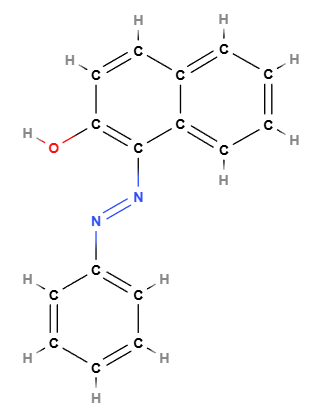 | 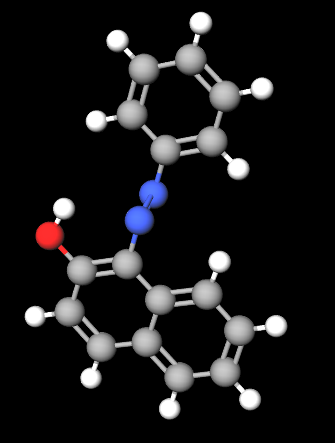 |
Molecular Formula C16H12N2O
Molecular Weight 248.28 g/mol
CAS 842-07-9
UNII 48I7IBB68J
EC Number 212-668-2
CHEMBL1397023
DTXSID4021135
Synonyms:
1-Phenylazo-2-naphthol
Solvent Yellow 14
Sudan I

