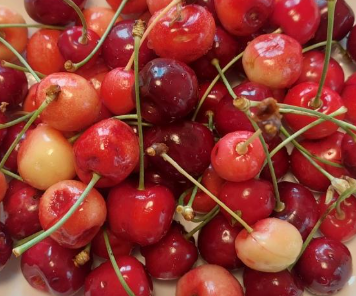
Cherry puree is a smooth, thick liquid made from fresh cherries (Prunus avium for sweet cherries and Prunus cerasus for sour cherries) that have been pitted, cooked, and blended. This puree captures the rich, sweet, and tart flavors of cherries, making it a popular ingredient in various culinary applications. It is often used in desserts, sauces, beverages, and as a natural flavoring agent.
Nutrition Facts
- Calories per 100g: Approximately 50–60 kcal
- Fat: 0g
- Carbohydrates: 13–15g (of which sugars: 10–12g)
- Protein: 1g
- Fiber: 1–2g
- Vitamin C: Approximately 7 mg (about 8% of the Daily Value)
- Potassium: Approximately 250 mg
Nutritional values can vary based on the type of cherries used and any additional ingredients.
Chemical Composition and Structure
Cherry puree is primarily composed of:
- Water: Approximately 85% of the puree.
- Carbohydrates: Mainly sugars such as glucose and fructose, which provide sweetness.
- Organic Acids: Such as citric acid and malic acid, contributing to the tart flavor.
- Vitamins: Rich in vitamin C and various B vitamins, which are important for immune function and energy metabolism.
- Minerals: Includes potassium, magnesium, and small amounts of iron and calcium.
- Antioxidants: Contains phenolic compounds, including anthocyanins, which give cherries their red color and have potential health benefits.
The puree has a vibrant red to deep burgundy color, smooth texture, and thick consistency.
Physical Properties
- Appearance: Thick, smooth liquid, typically red to deep burgundy.
- Taste: Sweet with a tart finish, varying in intensity depending on the cherry variety used.
- Viscosity: Moderately thick, allowing it to coat and blend well with other ingredients.
- Solubility: Soluble in water, forming a homogeneous mixture.
Production Process
- Selection: High-quality, ripe cherries are selected for processing.
- Washing: The cherries are thoroughly washed to remove dirt and pesticides.
- Pitting: Cherries are pitted to remove the seeds, which can be bitter.
- Cooking: The pitted cherries are cooked briefly to soften them and enhance their flavor.
- Blending: The cooked cherries are blended into a smooth puree using a food processor or blender.
- Straining (optional): The puree may be strained to remove any remaining solids or skins for a smoother texture.
- Packaging: The puree is packaged in airtight containers or frozen to preserve freshness.
Applications
- Culinary Uses:
- Desserts: Used in cakes, tarts, mousses, and ice creams to enhance flavor and add color.
- Sauces: Commonly used in sauces for meats and desserts, such as cherry sauce for duck or cheesecake.
- Beverages: Added to cocktails, smoothies, and juices for a fruity flavor.
- Baby Food: A popular choice for homemade baby food due to its natural sweetness and nutritional benefits.
Environmental and Safety Considerations
Cherry puree is generally considered safe for consumption.
However, it is important to source cherries from sustainable farms to reduce environmental impact, including the use of pesticides and water resources. Individuals with cherry allergies should avoid this product. When purchasing cherry puree, look for options that do not contain added sugars or preservatives for a healthier choice.
Studies
Sour cherry (Prunus cerasus L.) among the cherries is the fruit that has the most attention for its content (1): anthocyanins, phenolic acids (hydrocinnamic acid, chlorogenic acid), flavonoids (catechin, epicatechin, epigallocatechin, gallocatechin, ursolic acis, oleanoic acid). All phenolic compounds have demonstrated antioxidant activity and curative effects on gastrointestinal tract, cancer, cardiovascular disease (1).
In a study on the possibility of Prunus avium extract to counteract the progression of cancer cells in prostate cancer, researchers found that the extract decreased the viability of neoplastic and non-neoplastic cells, while it increased apoptosis in neoplastic cells of the human prostate. These results broadened our knowledge of the mechanisms by which this extract modulates cell physiology, demonstrating a broad action on the characteristics of cancer (2).
Accumulation of uric acid (hyperuricemia) can cause inflammatory arthritis and gout especially in overweight or obese people. The daily intake of 240ml of tart cherry juice for 4 weeks has significantly reduced the accumulation of uric acid and may eliminate pro-inflammatory markers in individuals at risk (3). Fennel can therefore be attributed to the tart cherry, with anti-inflammatory, antiperuricemic and antiarthritic potential (3).
In a study of 22 participants, tart cherries intake significantly reduced post-prandial triglyceride levels (4).
The ability of tart cherry juice to reduce systolic blood pressure and LDL cholesterol in elderly people has also been confirmed. This may be partly due to its antioxidant and anti-inflammatory properties (5).
Cherry studies
References_______________________________________________________________
(1) Biro A, Markovich A, Homoki JR, Szőllősi E, Hegedűs C, Tarapcsák S, Lukács J, Stündl L, Remenyik J. Anthocyanin-Rich Sour Cherry Extract Attenuates the Lipopolysaccharide-Induced Endothelial Inflammatory Response. Molecules. 2019 Sep 21;24(19). pii: E3427. doi: 10.3390/molecules24193427.
Abstract. The anthocyanin content of Hungarian sour cherry is remarkable based on our preliminary investigations. Nutraceutical and pharmaceutical effects of anthocyanins have been extensively studied. The objective of this work was to investigate the the effect of purified sour cherry extract using human umbilical cord vein endothelial cells (HUVECs) as the inflammatory model. HUVECs were isolated by enzymatic digestion and characterized by flow cytometry. The optimal concentration range of sour cherry extract was selected based on MTT, apoptosis, and necrosis assays. Cells were divided into three groups, incubating with M199 medium as control, or with lipopolysaccharide (LPS) or with LPS plus anthocyanin extract (ACE). The effect of sour cherry extract on oxidative stress, pro-inflammatory factors, and arachidonic pathway was investigated. An amount of 50 μg/mL ACE (ACE50) was able to increase the level of glutathione and decrease the ROS, thereby improving the unbalanced redox status in inflammation. ACE50 lowered pro-inflammatory cytokine levels including Interleukin-6 (IL-6), regulated on activation, normal T cell expressed and secreted (RANTES), granulocyte-macrophage colony-stimulating factor (GM-CSF), and tumor necrosis factor alpha (TNF-α). ACE50 affected the arachidonic acid pathway by reducing the LPS-induced enzyme expression (cyclooxygenase-1, cyclooxygenase-2, and prostacyclin synthase). The extract under investigation seems to have a pleiotropic effect including anti-oxidative, anti-inflammatory, hemostatic, and vasoactive effects. Our results indicate that purified sour cherry extract could reduce the LPS-induced inflammatory response, thereby improving endothelial dysfunction.
(2) Silva GR, Vaz CV, Catalão B, Ferreira S, Cardoso HJ, Duarte AP, Socorro S. Sweet Cherry Extract Targets the Hallmarks of Cancer in Prostate Cells: Diminished Viability, Increased Apoptosis and Suppressed Glycolytic Metabolism. Nutr Cancer. 2019 Sep 11:1-15. doi: 10.1080/01635581.2019.1661502.
Abstract. The present work evaluated the anticancer properties of sweet cherry (Prunus avium) extract on human prostate cells. Several sweet cherry cultivars from Fundão (Portugal) were methanol-extracted and their phytochemical composition characterized. The Saco "late harvest" extract was highly-enriched in anthocyanins and selected for use in biological assays. Non-neoplastic (PNT1A) and neoplastic (LNCaP and PC3) human prostate cells were treated with 0-2,000 μg/ml of extract for 48-96 h. Cell viability was evaluated by the MTT assay. Apoptosis, oxidative stress, and glycolytic metabolism were assessed by Western blotting and enzymatic assays. Glucose consumption and lactate production were measured spectrophotometrically. Saco cherry extract diminished the viability of neoplastic and non-neoplastic cells, whereas enhancing apoptosis in LNCaP. Cherry extract-treatment also diminished oxidative damage and suppressed glycolytic metabolism in LNCaP cells. These findings widened the knowledge on the mechanisms by which cherry extract modulate cell physiology, demonstrating their broad action over the hallmarks of cancer.
(3) Martin KR, Coles KM. Consumption of 100% Tart Cherry Juice Reduces Serum Urate in Overweight and Obese Adults Curr Dev Nutr. 2019 Feb 25;3(5):nzz011. doi: 10.1093/cdn/nzz011.
Abstract. Background: Gout is a frequently occurring, complex rheumatologic form of inflammatory arthritis caused by the accumulation of serum uric acid (sUA) and deposition of uric acid crystals in the joints and tissues of the body. Hyperuricemia is also a significant independent risk factor for all-cause and cardiovascular morbidity and mortality and is associated with hypertension, diabetes, obesity, and osteoarthritis. However, patient adherence to prescribed urate-lowering therapies ranges from 20% to 70%, suggesting that other additional strategies, such as dietary intervention with specific, efficacious foods or beverages, may be necessary to mitigate the risk of arthritis, as well as other comorbidities. Tart cherry juice (TCJ) has been used for decades by some for gout based largely on anecdotal evidence of its efficacy and its antioxidant and anti-inflammatory properties. Objectives: We designed this study to test the effect of TCJ on uricemia, lipidemia, glycemia, and inflammation in at-risk overweight and obese humans with a specific hypothesis that TCJ consumption would reduce sUA concentrations. Methods: In this randomized, placebo-controlled crossover study, we recruited overweight and obese participants with body mass index (BMI) >25.0 kg/m2 (n = 26, 18 women/8 men, 41 ±11 y; BMI 31.3 ± 6.0; 12 obese, 14 overweight) to consume 240 mL/d (8 oz/d) of either TCJ or placebo beverage, for 4 wk each with a 4-wk intervening washout period followed by 4 wk of the alternate beverage. Results: TCJ significantly reduced sUA concentration by 19.2% (P < 0.05) and reduced by 19.4% (P = 0.09) and 6.3% (P = 0.08) proinflammatory high-sensitivity C-reactive protein and monocyte chemoattractant protein-1, respectively. The participants in this study displayed risk ratios indicating increased cardiovascular disease risk and insulin resistance but no differences in the pre- and postintervention groups of either placebo or TCJ groups. Conclusion: Collectively, the data suggest that 100% TCJ reduces sUA concentrations, mitigating hyperuricemia associated with gouty arthritis. This trial was registered at clinicaltrials.gov as NCT03636529.
(4) Polley KR, Oswell NJ, Pegg RB, Cooper JA. Tart Cherry Consumption With or Without Prior Exercise Increases Antioxidant Capacity and Decreases Triglyceride Levels Following A High-Fat Meal. Appl Physiol Nutr Metab. 2019 Mar 27. doi: 10.1139/apnm-2018-0535.
Abstract. Exercise and high-phytonutrient foods may lower oxidative stress and increase antioxidant levels, which could combat the negative effects associated with a high-fat (HF) meal. The objective of this study is to test the effects of Montmorency tart cherry (Prunus cerasus L.) consumption, with or without aerobic exercise, on antioxidant responses to an HF meal. Twelve normal-weight men (aged 22 ± 3 years), participated in a randomized crossover design comprising 4 trials: (i) HF meal with Montmorency tart cherry consumption (MC), (ii) HF meal with placebo (P), (iii) exercise prior to HF meal with MC (E+MC), and (iv) exercise prior to HF meal with P (E+P). The HF meal contained 60 g of fat and was consumed with MC or P. For exercise trials, a 30-min bout of submaximal treadmill exercise was performed the afternoon prior to HF meal consumption. Antioxidant capacity and triglycerides (TG) levels were measured at baseline and at 1, 2, and 3 h postprandially. Postprandial antioxidant capacity as assessed by oxygen radical absorbance capacity was significantly higher after MC and E+MC compared with E+P (incremental area under the curve (iAUC): 2.95 ± 2.19 and 4.87 ± 1.45 vs. -1.02 ± 1.72 mmol Trolox equivalents/L for MC and E+MC vs. E+P, respectively; p < 0.01). Postprandial TG levels were significantly lower after E+MC compared with P (iAUC: 58.99 ± 19.46 vs. 107.46 ± 22.66 mmol Trolox equivalents/L for E+MC vs. P, respectively; p < 0.05). These results indicate that MC consumption alone, and in combination with prior exercise, leads to greater antioxidant capacity following an HF meal compared with prior exercise with placebo. Further, MC consumption with prior exercise led to more favorable postprandial TG levels compared with placebo.
(5) Chai SC, Davis K, Zhang Z, Zha L, Kirschner KF. Effects of Tart Cherry Juice on Biomarkers of Inflammation and Oxidative Stress in Older Adults Nutrients. 2019 Jan 22;11(2). pii: E228. doi: 10.3390/nu11020228.
Abstract. Inflammation and oxidative stress are important factors in the development of cardiovascular disease and atherosclerosis. The findings of our previous study suggest that 12 weeks consumption of tart cherry juice lowers the levels of systolic blood pressure (BP) and low-density lipoprotein (LDL) cholesterol in older adults. The present study investigated the effects of tart cherry juice on blood biomarkers of inflammation and oxidative stress. In this randomized-controlled clinical trial, a total of 37 men and women between the ages of 65⁻80 were randomly assigned to consume 480 mL of tart cherry juice or control drink daily for 12 weeks. Several blood biomarkers of inflammation and oxidative stress were assessed at baseline and after 12 weeks intervention. After the 12 weeks intervention, tart cherry juice significantly increased the plasma levels of DNA repair activity of 8-oxoguanine glycosylase (p < 0.0001) and lowered (p = 0.03) the mean c-reactive protein (CRP) level compared to the control group. There was a significant group effect observed for plasma CRP (p = 0.03) and malondialdehyde (MDA) (p = 0.03), and a borderline significant group effect observed for plasma oxidized low-density lipoprotein (OxLDL) (p = 0.07). Within group analysis showed that the plasma levels of CRP, MDA, and OxLDL decreased numerically by 25%, 3%, and 11%, respectively after 12 weeks of tart cherry juice consumption compared with corresponding baseline values. The present study suggests that the ability of tart cherry juice to reduce systolic BP and LDL cholesterol, in part, may be due to its anti-oxidative and anti-inflammatory properties. Larger and longer follow-up studies are needed to confirm these findings.




