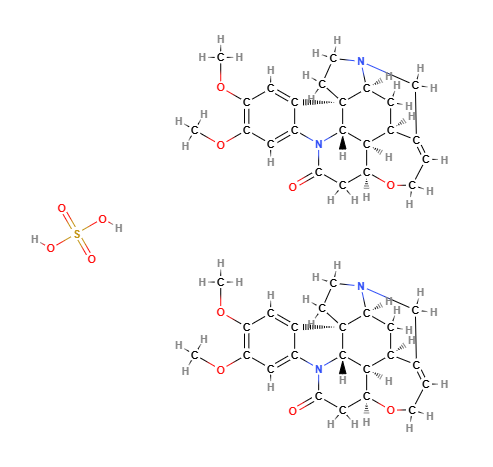
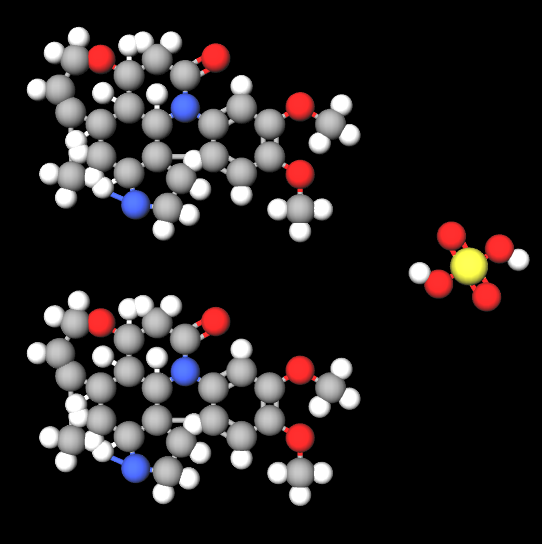
Il solfato di brucina è un sale formato dalla brucina e dall'acido solforico. Derivato dai semi dell'albero Strychnos nux-vomica, è conosciuto per il suo sapore amaro. Nella medicina erboristica, il solfato di brucina è stato utilizzato per le sue potenziali proprietà stimolanti e digestive. Nelle formulazioni cosmetiche, può offrire effetti astringenti, rendendolo utile per tonificare e rassodare la pelle.
Composizione Chimica e Struttura
La composizione chimica del solfato di brucina include:
- Brucina: Un alcaloide con la formula molecolare C23H26N2O4.
- Gruppo Solfato: Un gruppo solfato (SO₄²⁻) è aggiunto per formare il solfato di brucina.
Strutturalmente, il solfato di brucina consiste nell'alcaloide di brucina legato all'ione solfato, il che può influenzare la sua solubilità e biodisponibilità rispetto alla brucina da sola.
Proprietà Fisiche
Aspetto: Tipicamente una polvere cristallina bianca o giallo pallido.
Solubilità: Solubile in acqua e alcol; la forma solfato aumenta la sua solubilità rispetto alla brucina.
pH: Leggermente acido in soluzione.
Odore: Inodore, rendendolo adatto a varie formulazioni.
Stabilità: Stabile in condizioni normali di conservazione; tuttavia, deve essere protetto dalla luce e dall'umidità.
Processo di Produzione
Estrazione: Il solfato di brucina è derivato dai semi di Strychnos nux-vomica, con la brucina estratta tramite macerazione o estrazione con solvente.
Solfatazione: La brucina estratta viene poi trattata con acido solforico per formare il solfato di brucina attraverso una reazione di neutralizzazione.
Purificazione: Il solfato di brucina risultante viene purificato per rimuovere impurità e garantire un'alta qualità.
Formulazione: Il solfato di brucina purificato è incorporato in vari prodotti erboristici e cosmetici.
Applicazioni
Medico: Utilizzato nella medicina tradizionale per le sue proprietà stimolanti, in particolare per la salute digestiva, come tonico e batteriostatico (1).
Cosmetici: Incluso in prodotti per la cura della pelle come denaturante.. Può anche migliorare l'assorbimento di altri ingredienti attivi.
Funzioni INCI:
Denaturante. Rende i cosmetici poco gradevoli. Viene a volte aggiunto ai cosmetici contenenti alcol etilico per renderlo inadatto all'ingestione. Le molecole ioniche o polari di questo ingrediente inserite in formulazioni che interagiscono con i gruppi proteici, modulano le proprietà della soluzione in modo da modificarla per esigenze specifiche.
Alimentare: Non utilizzato nei prodotti alimentari a causa della sua potenziale tossicità.
Usi Industriali: Occasionalmente impiegato in formulazioni per il controllo dei parassiti come insetticida naturale.
Considerazioni Ambientali e di Sicurezza
Il gruppo di esperti scientifici ha riconosciuto che i dati disponibili non erano sufficienti per supportare la sicurezza di Quassina, Brucina e Brucina solfato, Alcohol denaturato con tali denaturanti, o SD Alcohol 39 e SD Alcohol 40 e affinché il gruppo di esperti possa giungere a una conclusione per questi denaturanti, sono necessari ulteriori dati. (2).
La Brucina può essere tossica in certe dosi, portando a potenziali effetti collaterali come nausea o sintomi neurologici. Può anche causare irritazioni cutanee in individui sensibili. Pratiche di approvvigionamento e formulazione responsabili sono cruciali per garantire che l'ingrediente sia prodotto in modo sostenibile e privo di contaminanti nocivi. Gli utenti dovrebbero essere informati sulla sua potenza e sui potenziali effetti collaterali, anche nelle applicazioni cosmetiche.
Molecular Formula C46H54N4O12S
Molecular Weight 887.0 g/mol
CAS 4845-99-2
UNII KY7O12XPOQ
EC Number 225-432-9
DTXSID5052123
Bibliografia__________________________________________________________________________
(1) Li J, Hu S, Feng P, Xia Y, Pei Z, Tian J, Jiang K, Liu L, Cai X, Wu P. Brucine Sulfate, a Novel Bacteriostatic Agent in 3D Printed Bone Scaffold Systems. Polymers (Basel). 2024 May 17;16(10):1428. doi: 10.3390/polym16101428. PMID: 38794621; PMCID: PMC11124991.
Abstract. Bacterial infection is a common complication in bone defect surgery, in which infection by clinically resistant bacteria has been a challenge for the medical community. Given this emerging problem, the discovery of novel natural-type inhibitors of drug-resistant bacteria has become imperative. Brucine, present in the traditional Chinese herb Strychnine semen, is reported to exert analgesic and anti-inflammatory effects. Brucine's clinical application was limited because of its water solubility. We extracted high-purity BS by employing reflux extraction and crystallization, greatly improved its solubility, and evaluated its antimicrobial activity against E. coli and S. aureus. Importantly, we found that BS inhibited the drug-resistant strains significantly better than standard strains and achieved sterilization by disrupting the bacterial cell wall. Considering the safety concerns associated with the narrow therapeutic window of BS, a 3D BS-PLLA/PGA bone scaffold system was constructed with SLS technology and tested for its performance, bacteriostatic behaviors, and biocompatibility. The results have shown that the drug-loaded bone scaffolds had not only long-term, slow-controlled release with good cytocompatibility but also demonstrated significant antimicrobial activity in antimicrobial testing. The above results indicated that BS may be a potential drug candidate for the treatment of antibiotic-resistant bacterial infections and that scaffolds with enhanced antibacterial activity and mechanical properties may have potential applications in bone tissue engineering.
(2) Cosmetic Ingredient Review Expert Panel. Final report of the safety assessment of Alcohol Denat., including SD Alcohol 3-A, SD Alcohol 30, SD Alcohol 39, SD Alcohol 39-B, SD Alcohol 39-C, SD Alcohol 40, SD Alcohol 40-B, and SD Alcohol 40-C, and the denaturants, Quassin, Brucine Sulfate/Brucine, and Denatonium Benzoate. Int J Toxicol. 2008;27 Suppl 1:1-43. doi: 10.1080/10915810802032388.
Abstract. Alcohol Denat. is the generic term used by the cosmetics industry to describe denatured alcohol. Alcohol Denat. and various specially denatured (SD) alcohols are used as cosmetic ingredients in a wide variety of products. Many denaturants have been previously considered, on an individual basis, as cosmetic ingredients by the Cosmetic Ingredient Review (CIR) Expert Panel, whereas others, including Brucine and Brucine Sulfate, Denatonium Benzoate, and Quassin, have not previously been evaluated. Quassin is a bitter alkaloid obtained from the wood of Quassia amara. Quassin has been used as an insect antifeedant and insecticide and several studies demonstrate its effectiveness. At oral doses up to 1000 mg/kg using rats, Quassin was not toxic in acute and short-term tests, but some reversible piloerection, decrease in motor activity, and a partial loss of righting reflex were found in mice at 500 mg/kg. At 1000 mg/kg given intraperitoneally (i.p.), all mice died within 24 h of receiving treatment. In a cytotoxicity test with brine shrimp, 1 mg/ml of Quassin did not possess any cytotoxic or antiplasmodial activity. Quassin administered to rat Leydig cells in vitro at concentrations of 5-25 ng/ml inhibited both the basal and luteinizing hormone (LH)-stimulated testosterone secretion in a dose-related fashion. Quassin at doses up to 2.0 g/kg in drinking water using rats produced no significant effect on the body weights, but the mean weights of the testes, seminal vesicles, and epididymides were significantly reduced, and the weights of the anterior pituitary glands were significantly increased. The sperm counts and levels of LH, follicle-stimulating hormone (FSH), and testosterone were significantly lower in groups treated with Quassin. Brucine is a derivative of 2-hydroxystrychnine. Swiss-Webster mice given Brucine base, 30 ml/kg, had an acute oral LD(50) of 150 mg/kg, with central nervous system depression followed by convulsions and seizures in some cases. In those animals that died, respiratory arrest was the cause. The acute i.p. LD(50) for 15 ml/kg of Brucine base was 62.0 mg/kg, with central nervous system depression prior to the onset of convulsions, just as with oral Brucine. The acute intravenous (i.v.) LD(50) was 12.0 mg/kg. Brucine was nonmutagenic in an Ames assay at levels up to 6666 mu g/plate, with and without metabolic activation. In a repeat-insult patch test, for a hair care product containing 47% SD Alcohol 40 (95%), it was reported that Brucine Sulfate may be considered a nonprimary irritant and a nonprimary sensitizer. Three different sunscreen products (35% SD Alcohol 40-B, 72.4% SD Alcohol 40, and 74.5% SD Alcohol 40) did not show any signs of photoallergy in human subjects. Also, these three formulas did not exhibit any evidence of phototoxicity in humans. Denatonium Benzoate is a bitter substance detectable at a concentration of 10 ppb, discernibly bitter at 50 ppb, and unpleasantly bitter at 10 ppm. The distribution of topically applied lidocaine, a topical anesthetic chemically related to Denatonium Benzoate demonstrated that virtually no lidocaine appears in the plasma, suggesting that the larger Denatonium Benzoate molecule also would have little or no systemic exposure. Denatonium Benzoate (0.1%) did not show adverse effects in 10 rats in an acute inhalation toxicity test and 0.005% to 0.05% was nonirritating to ocular mucosa in 6 albino rabbits. The acute oral LD(50) for the male rats was 640 mg/kg and for females, 584 mg/kg. The LD(50) for the male rabbits was 508 mg/kg and for the female rabbits, 640 mg/kg. In two chronic toxicity studies, Denatonium Benzoate was administered (by gavage) at 1.6, 8, and 16 mg/kg/day, one using cynomologus monkeys and the other rats, resulted in no compound-related toxicity. The toxicity of SD Alcohols has also been tested, with implications for the particular denaturant used. An irritation test of 55.65% SD Alcohol 40-B denatured with Denatonium Benzoate using rabbits produced minimal effects. A spray formula containing 12% SD Alcohol 40-B was found to be nonirritating when evaluated for vaginal mucosal irritation in New Zealand white rabbits. Cosmetic formulations containing SD Alcohol 40-B (denatured with Denatonium Benzoate) were not sensitizers in repeated insult patch tests. A gel formula containing 29% SD Alcohol 40-B and a spray liquid containing 12% SD Alcohol 40-B did not induce photoallergy, dermal sensitization, or phototoxic response in human subjects. Although the absorption of ethanol (aka Alcohol for purposes of cosmetic ingredient labeling) occurs through skin, ethanol does not appear to affect the integrity of the skin barrier nor reach a very high systemic concentration following dermal exposure. Ethanol may be found in the bloodstream as a result of inhalation exposure and ingestion. Topically applied, ethanol can act as a penetration enhancer. Most of the systemic toxicity of ethanol appears to be associated with chronic abuse of alcohol. Although ethanol is denatured to make it unfit for consumption, there have been reports of intentional and unintentional consumption of products containing denatured alcohol. Ethanol is a reproductive and developmental toxicant. Ethanol is genotoxic in some test systems and it has been proposed that the genotoxic effects of ethanol are mediated via its metabolite, acetaldehyde. A brief summary is provided of the effects of chronic ingestion of alcohol including intoxication, liver damage, brain damage, and possible carcinogenicity. The CIR Expert Panel recognizes that certain ingredients in this group are reportedly used in a given product category, but the concentration of use is not available. Because dermal application or inhalation of cosmetic products containing these ingredients will not produce significant systemic exposure to ethanol, the CIR Expert Panel concluded that safety of the ingredients should be predicated on the safety of the denaturants used. The Panel considered that the adverse effects known to be associated with Alcohol ingestion included in this safety assessment do not suggest a concern for Alcohol Denat. or SD Alcohols because of the presence of the denaturants, which are added for the express purpose of making the Alcohol unpotable. The CIR Expert Panel has previously conducted safety assessments of t-Butyl Alcohol, Diethyl Phthalate, Methyl Alcohol, Salicylic Acid, Sodium Salicylate, and Methyl Salicylate, in which each was affirmed safe or safe with qualifications. Given their use as denaturants are at low concentrations of use in Alcohol, the CIR Expert Panel determined that Alcohol Denat. denatured with t-Butyl Alcohol, Diethyl Phthalate, Methyl Alcohol, Salicylic Acid, Sodium Salicylate, and Methyl Salicylate is safe as used in cosmetic formulations with no qualifications. Likewise, because they are denatured with either t-Butyl Alcohol, Diethyl Phthalate, or Methyl Alcohol, SD Alcohols 3-A, 30, 39-B, 39-C, and 40-C all are considered safe as used. The Panel considered the available data for Denatonium Benzoate and SD Alcohol 40-B to be sufficient to support the safety of these ingredients in cosmetics. Denatonium Benzoate is sufficiently bitter that it is an effective denaturant at only 0.0006%. The Panel recognized that data on dermal penetration of Denatonium Benzoate were not available, but considered that the available data on lidocaine, a smaller structurally related chemical, indicates that dermal exposure does not result in measurable systemic exposure. The available data, however, were not sufficient to support the safety of Quassin, Brucine, and Brucine Sulfate, Alcohol Denat. denatured with those denaturants, or SD Alcohol 39 and SD Alcohol 40 (SD Alcohols denatured with Quassin, Brucine, and/or Brucine Sulfate), and in order for the Expert Panel to reach a conclusion for these denaturants, additional data are needed