



Acer saccharum extract: properties, uses, pros, cons, safety
Description
Acer saccharum (Sugar Maple) extract is obtained from the leaves or bark of the sugar maple tree (Acer saccharum). It is primarily used in cosmetics for potential skin benefits, notably antioxidant and anti-inflammatory activity, with possible support for improving skin texture and overall comfort.
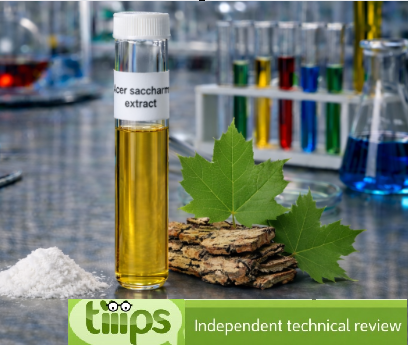
Chemical composition and structure
The extract contains a range of bioactive compounds, including:
Polyphenols: such as flavonoids and phenolic acids, associated with antioxidant properties.
Triterpenoids: contributing to anti-inflammatory effects.
Sugars: including sucrose and glucose, potentially relevant for moisturizing support (water retention).
Vitamins: such as vitamin C and the B-vitamin complex, supporting overall skin health.
The chemical structure is complex due to the coexistence of multiple molecular classes; a significant fraction consists of polyphenolic compounds associated with the plant material’s cellular matrix.
| Compound class | Examples | Functional role |
|---|---|---|
| Polyphenols | Flavonoids, phenolic acids | Antioxidant |
| Triterpenoids | Various | Anti-inflammatory |
| Sugars | Sucrose, glucose | Hydration support |
| Vitamins | Vitamin C, B-complex | Skin support |
Physical properties
Appearance: typically a dark brown/amber liquid or a powder.
Odor: slightly herbal or woody.
pH: generally around 5.0–6.0.
Solubility: water-soluble and soluble in most solvents commonly used in cosmetic formulations.
| Parameter | Indicative value |
|---|---|
| Appearance | Dark/amber liquid or powder |
| Odor | Herbal/woody |
| pH | 5.0–6.0 |
| Solubility | Water and common cosmetic solvents |
Production process
Harvesting: leaves or bark from Acer saccharum.
Extraction: treatment with water or solvents to isolate compounds of interest.
Filtration: removal of solid residues.
Concentration: optional step to increase the level of active constituents.
Packaging: final extract packed for use in cosmetics or skincare products.
| Step | Objective |
|---|---|
| Extraction | Recovery of bioactive compounds |
| Filtration | Extract clarification |
| Concentration | Increase functional strength |
| Packaging | Stability and industrial handling |
Applications
Medical
Potential use in therapeutic contexts due to anti-inflammatory and antioxidant properties, although this remains secondary to cosmetic use.
Cosmetic
Used in serums, creams, and lotions.
Main functional contributions: antioxidant protection, support in reducing inflammatory phenomena, and possible improvement of skin texture.
INCI Functions:
Skin conditioning agent. It is the mainstay of topical skin treatment as it has the function of restoring, increasing or improving skin tolerance to external factors, including melanocyte tolerance. The most important function of the conditioning agent is to prevent skin dehydration, but the subject is rather complex and involves emollients and humectants that can be added in the formulation.
CAS: 91770-22-8 EC number 294-807-7
Food
Limited use; mainly found as a flavoring or natural colorant in specialty foods.
| Field | Application |
|---|---|
| Cosmetic | Serums, creams, lotions |
| Medical | Potential, secondary use |
| Food | Flavoring/colorant (limited) |
INCI functions
Skin conditioning agent
Supports skin tolerance to external factors and contributes to preventing dehydration; overall performance depends on the formulation and synergy with emollients and humectants.
CAS: 91770-22-8
EC number: 294-807-7
Environmental and safety considerations
Generally considered suitable for use in cosmetics and, where applicable, in specific food uses. It is important to adopt sustainable harvesting practices to reduce environmental impacts and preserve plant resources, and to ensure appropriate quality and control standards throughout the supply chain.

