



Pyrus malus peel extract: properties, uses, pros, cons, safety
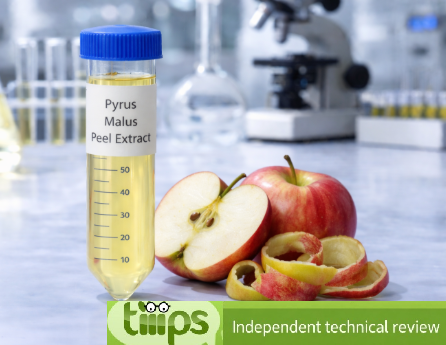
Pyrus malus peel extract is an extract obtained from the peel of the apple fruit, commonly referenced in the cosmetic field as an apple-derived ingredient (the cultivated species is often indicated as Malus domestica; the name Pyrus malus is a historical/alternative denomination). In cosmetics it is used mainly for a combined functional profile: gentle exfoliation, antioxidant support, and contribution to hydration/skin conditioning, with typical applications in face and body products designed to improve radiance and skin texture.
Definition
It is not a single molecule: it is a complex mixture of bioactive compounds extracted from the peel. From a formulation standpoint, the extract can be interpreted as a plant “matrix” combining:
an acid component (organic acids, with a mild exfoliating/keratolytic role),
a polyphenolic component (flavonoids and phenolics, with an antioxidant role),
a vitamin component (notably vitamin C, variable depending on process and standardization),
a fraction of sugars and minor components that can contribute to sensory feel and conditioning.
Main uses
Cosmetics
Primary use in skincare and bodycare products targeting surface renewal, protection from oxidative stress, and improvement of softness: gentle exfoliants, serums, creams, masks, cleansers, and “glow” products. Use levels are typically calibrated to obtain a progressive effect without excessive aggressiveness, especially when the extract is standardized in terms of fruit acids or polyphenols.
INCI functions
Antioxidant agent. Ingredient that counteracts oxidative stress and helps prevent cellular damage. Free radicals, pathological inflammatory processes, reactive nitrogen species, and reactive oxygen species are responsible for the aging process and for many oxidation-related diseases.
Industrial use
Beyond cosmetics, extracts from apple processing by-products (including peel/pomace) are often valorized as “upcycling” ingredients to support claims of naturality and by-product recovery, when consistent with product positioning and when raw-material quality and batch consistency are adequately controlled.
Key constituents
The typical profile includes (with variability linked to cultivar, season, and process):
Organic acids, especially malic acid (reference formula: C4H6O5), associated with gentle surface exfoliation and contribution to hydration maintenance.
Flavonoids, including quercetin (reference formula: C15H10O7) and kaempferol, with antioxidant activity.
Polyphenols such as chlorogenic acid, providing additional antioxidant support.
Vitamins, in particular vitamin C, relevant for radiance and overall skin appearance (content is variable and depends on stability/process).
Frequent functional groups within constituents: hydroxyl and carbonyl groups, associated with antioxidant reactivity and interactions with the stratum corneum.
Identification data and specifications
| Characteristic | Value | Note |
|---|---|---|
| INCI name | Pyrus Malus Peel Extract | Cosmetic denomination |
| Botanical source | Malus domestica (syn. Pyrus malus) (family Rosaceae) | Nomenclature may vary |
| Preparation type | extract (solvent extract) | Depends on manufacturer |
| CAS number | 85251-63-4 | Commonly reported identifier |
| EC number (EINECS) | 286-475-7 | EU identifier |
| Molecular formula | not applicable (mixture) | Botanical extract |
| Molecular weight | not applicable (mixture) | Not a single value |
| Main use | antioxidant, exfoliation support, hydrating/conditioning support | Skincare and bodycare |
Chemical-physical properties (indicative)
| Characteristic | Indicative value | Note |
|---|---|---|
| Appearance | clear liquid or light brown powder | Depending on extraction/concentration |
| Water solubility | good | Typical for hydrophilic-balanced extracts |
| Solubility in organic solvents | variable | Depends on polyphenols/sugars balance |
| Odor | fruity | Variable with peel quality and process |
| Stability | sensitive to oxygen/light | Critical for polyphenols/vitamin C fraction |
| Color change in finished product | may darken over time | Possible polyphenol oxidation |
Functional role and mechanism of action
The cosmetic effect mainly arises from three contributions:
Gentle exfoliation: the organic acid fraction can promote progressive shedding of superficial corneocytes, improving smoothness and radiance.
Antioxidant protection: polyphenols and flavonoids help reduce the impact of oxidative stress on the skin surface and, to a limited extent, on the product itself (by counteracting oxidation phenomena).
Hydration/conditioning: hydrophilic fractions and minor components can support a softer, more conditioned skin feel, especially in well-balanced formulas with humectants and lipids.
Formulation compatibility
In general it is easy to incorporate into aqueous or hydroalcoholic systems and emulsions, but typical critical points are:
pH: both perceived exfoliating effect and stability can depend on overall pH; excessively high pH may reduce the acid-related effect and accelerate degradation of some fractions.
Color/oxidation: polyphenols can darken; antioxidant strategy, packaging, and air/headspace management are often useful.
Interactions with electrolytes and polymers: some thickeners/polymers can change haze or viscosity; it is advisable to verify hot/cold stability and long-term behavior.
Production process
A typical industrial process can be traced back to operational phases, with manufacturer-dependent variants:
Collection and preparation: selected peels, cleaned and sometimes dried or stabilized to reduce microbial load and variability.
Extraction: use of water and/or suitable solvents to isolate organic acids and polyphenolic fractions (yield and profile depend on time, temperature, and solid/solvent ratio).
Purification and concentration: filtration and clarification (also via centrifugation) to remove particulates and concentrate target components, with possible standardization.
Formulation/carriering: incorporation into a carrier base (e.g., glycolic, glyceric, or hydroalcoholic) to improve handling and batch-to-batch reproducibility.
Safety, regulatory, and environmental aspects
As a botanical extract, it is generally manageable from a safety standpoint when used within appropriate formulation ranges, but variability and the presence of potentially irritating constituents in predisposed individuals must be considered (especially in leave-on products and for reactive skin).
Allergen.
It is not typically classified as a single “fragrance allergen,” but like all botanical extracts it can contribute to individual reactions; practical management relies on quality control, batch specifications, and evaluation of the finished product.
Contraindications (brief).
Use caution on very reactive or compromised skin and in formulas that already contain strong exfoliating actives (AHA/BHA/retinoids), to avoid additive irritation. For new products or higher concentrations, a finished-product safety and tolerability assessment is recommended.
Environmental impact.
It is often considered favorable because it valorizes a by-product (peels) that would otherwise be discarded, consistent with by-product recovery approaches when traceability and quality standards are solid.
Formulation troubleshooting
Darkening over time.
Action: optimize packaging (light/air barrier), reduce headspace, evaluate compatible antioxidants, and control batch quality/oxidation.
Irritation or stinging in leave-on products.
Action: reduce dosage, adjust pH and combinations with other exfoliating actives, increase soothing/barrier-support components, and repeat tolerability evaluations.
Haze in aqueous systems.
Action: check compatibility with polymers/thickeners and electrolytes; evaluate a different extract grade (carrier/standardization) or a more effective pre-solubilization approach.
Conclusion
Pyrus malus peel extract is an apple peel extract with a functional profile oriented to antioxidation, gentle surface renewal, and support for hydration/conditioning feel. Its technical value depends mainly on supplier quality and standardization, and on good formulation control of pH, oxidative stability, and compatibility with other actives, to achieve consistent performance and adequate tolerability.
Mini-glossary
UVCB. Mixture with unknown or variable composition; for botanical extracts this means there is no single representative molecular formula or molecular weight.
Malic acid. An organic acid typical of fruit; in cosmetics it is associated with surface exfoliation and support to hydration maintenance.
Polyphenols. A family of plant compounds with antioxidant activity; they can also contribute to color changes over time through oxidation.
Flavonoids. A subclass of polyphenols (e.g., quercetin) with antioxidant activity and a protective role against oxidative stress.

