Burdock (Arctium lappa): properties, uses, pros, cons, safety
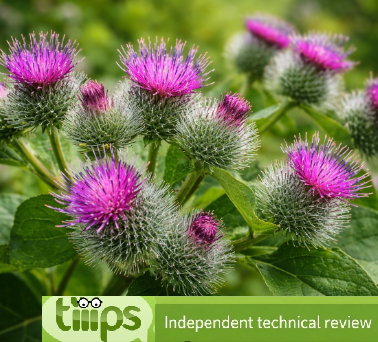
Arctium lappa (burdock, family Asteraceae) is a biennial herbaceous plant native to Europe and Asia and now cultivated in other temperate areas. It is easily recognized by its burr-like seed heads which, at maturity, form “burs” with hooked bracts that readily adhere to fabrics and animal fur. Practical interest mainly concerns the root (food and traditional uses) and, in cosmetics, plant extracts used to support skin conditioning.
Definition
It is a botanical species from which different raw materials can be obtained (fresh/dried root, powders, hydroalcoholic/glyceric extracts, etc.). The real performance of “burdock” therefore depends on the plant part used and on the process (for extracts), rather than on the common name.
Plant characteristics
In the first year the plant grows primarily as a basal rosette; in the second year it produces a flowering stem that can reach about 1–2 m. Leaves are broad and heart-shaped, with the underside often lighter and tomentose. Violet/pink flower heads mature into burrs with hooks. The root is a taproot, cylindrical, often long and fibrous, and is the most widely used edible part.
Main uses
Food.
The root is eaten as a vegetable (especially in Asia, where it is known as “gobo” in Japanese tradition). It is used in cooked dishes (stews, soups, stir-fries), usually after thorough washing and, if needed, brief soaking to reduce astringent notes and limit surface oxidation.
Cosmetics.
In skincare and scalp-care formulations, interest is linked to burdock extracts used to support a more “comfortable” skin feel and improved film manageability, with a rationale connected to the polyphenolic fraction. Performance depends on extract type, dose, vehicle, and formulation synergies.
INCI functions.
Skin conditioning agent. It represents the cornerstone of topical skin treatment as it has the function of restoring, increasing or improving skin tolerance to external factors, including melanocyte tolerance. The most important function of a conditioning agent is to prevent skin dehydration, but the topic is rather complex and involves emollients and humectants that can be added to the formulation.
Medicine.
In traditional herbal medicine the root has been used in “depurative” preparations and as digestive support. From a modern perspective, caution is required when translating this into claims: dose, form of use, and raw-material quality matter.
Pharmaceutical.
Possible use as a herbal drug/extract in phytotherapeutic products or as a component in supplements, subject to quality standards and finished-product evaluations.
Industrial use.
Botanical ingredient for standardized extracts intended for cosmetics and, in some cases, the nutraceutical sector.
Key constituents
Burdock root is known for a reserve-carbohydrate fraction and a profile of plant secondary metabolites that may include:
Inulin-type fructans and other polysaccharide fractions, of nutritional/technological interest as fiber and for prebiotic effects.
Lignans (e.g., arctiin and arctigenin), frequently discussed for biological activities in preclinical literature.
Phenolic acids and other phenolics contributing to the overall antioxidant profile of the matrix.
Flavonoids (e.g., quercetin and kaempferol) reported within the Arctium genus.
Practical note: composition can vary significantly with cultivar, maturity, soil, and post-harvest handling.
Nutritional use note and bioactive compounds
As a food, the root functions mainly as a fiber-rich vegetable (including fructans). Bioactive compounds (phenolics and lignans) are present variably and their real “weight” depends on portion, cooking, and consumption frequency. In cosmetics, bioactives are relevant at the extract level and with supplier standardization, not for the root “in general”.
Calories (energy value)
As a vegetable, energy intake is generally moderate and driven mainly by carbohydrates and fiber in the root; actual value depends on preparation and serving size. In a cosmetic context, this parameter is not applicable.
Identification data and specifications
| Characteristic | Value |
|---|
| Common name | Burdock |
| Botanical name | Arctium lappa |
| Botanical family | Asteraceae |
| Type | biennial plant |
| Parts of interest | root (food/tradition); extracts (cosmetics) |
| Variability | depends on origin, plant part, and standardization (for extracts) |
Physico-chemical properties (indicative)
| Characteristic | Indicative value | Note |
|---|
| Root (fresh) | crunchy/fibrous texture | maturity dependent |
| Odor/taste (root) | earthy, slightly sweet, sometimes astringent | often reduced by cooking/soaking |
| Cosmetic extracts | liquids or powders | depends on solvent and carrier |
| Color (extracts) | yellow-amber → brown | phenolics/tannins may intensify color |
| Stability (extracts) | sensitive to light/air/temperature | possible color/odor drift |
Cultivation
Burdock prefers deep, well-drained soils rich in organic matter. In temperate climates it grows well in full sun or partial shade. For root production, agronomic management aims to avoid soil compaction and control weeds; harvesting is typically done when the root is well developed, before the plant completes the second year with flowering and excessive lignification.
Safety, regulation, and environment
As a food, the root is generally consumed without particular concerns in populations where it is traditionally used. In herbal use, a precautionary approach is advisable during pregnancy/breastfeeding due to limited robust data and in individuals with specific sensitivities.
Allergen.
It is not typically classified as a “major” food allergen, but as an Asteraceae it is rational to consider possible cross-reactivity in individuals sensitive to plants of the same family.
Contraindications (brief).
Use caution during pregnancy/breastfeeding and in case of known Asteraceae allergies. For use as a supplement or herbal preparation, carefully consider interactions and individual conditions, since form and dose differ substantially from culinary use.
Conclusion
Burdock (Arctium lappa) is a biennial plant of interest mainly for its root (culinary and traditional uses) and for extracts used in cosmetics to support skin conditioning. Its constituent profile includes inulin-type fructans and a fraction of secondary metabolites (phenolics and lignans) with high variability. Practical use benefits from a clear distinction between food, cosmetic extract, and herbal use, with attention to cautions in predisposed individuals.
Mini-glossary
Inulin. Reserve fructans present in various roots. Benefit: fiber with potential prebiotic effect.
Lignans. Plant secondary metabolites (e.g., arctiin/arctigenin). Benefit: often discussed for biological activity in preclinical studies.
Asteraceae. Large botanical family that includes species associated with possible cross-sensitivities in predisposed individuals. Benefit: informs allergy-related caution.
Standardization. Definition of markers or an analytical fingerprint to reduce batch-to-batch variability (especially for extracts). Benefit: improves repeatability and quality control.
References__________________________________________________________________________
Chan YS, Cheng LN, Wu JH, Chan E, Kwan YW, Lee SM, Leung GP, Yu PH, Chan SW. A review of the pharmacological effects of Arctium lappa (burdock). Inflammopharmacology. 2011 Oct;19(5):245-54. doi: 10.1007/s10787-010-0062-4.
Abstract. Arctium lappa, commonly known as burdock, is being promoted/recommended as a healthy and nutritive food in Chinese societies. Burdock has been used therapeutically in Europe, North America and Asia for hundreds of years. The roots, seeds and leaves of burdock have been investigated in view of its popular uses in traditional Chinese medicine (TCM). In this review, the reported therapeutic effects of the active compounds present in the different botanical parts of burdock are summarized. In the root, the active ingredients have been found to "detoxify" blood in terms of TCM and promote blood circulation to the skin surface, improving the skin quality/texture and curing skin diseases like eczema. Antioxidants and antidiabetic compounds have also been found in the root. In the seeds, some active compounds possess anti-inflammatory effects and potent inhibitory effects on the growth of tumors such as pancreatic carcinoma. In the leaf extract, the active compounds isolated can inhibit the growth of micro-organisms in the oral cavity. The medicinal uses of burdock in treating chronic diseases such as cancers, diabetes and AIDS have been reported. However, it is also essential to be aware of the side effects of burdock including contact dermatitis and other allergic/inflammatory responses that might be evoked by burdock.
Nascimento BAC, Gardinassi LG, Silveira IMG, Gallucci MG, Tomé MA, Oliveira JFD, Moreira MRA, Meirelles AFG, Faccioli LH, Tefé-Silva C, Zoccal KF. Arctium lappa Extract Suppresses Inflammation and Inhibits Melanoma Progression. Medicines (Basel). 2019 Jul 29;6(3):81. doi: 10.3390/medicines6030081.
Abstract. Background: Arctium lappa has been used as popular medicinal herb and health supplement in Chinese societies. Bioactive components from A. lappa have attracted the attention of researchers due to their promising therapeutic effects. In this study, we investigated the effects of A. lappa hydroalcoholic extract (Alhe) during different models of inflammation, in vivo. Methods: The anti-inflammatory activity was evaluated through the air pouch model. For this, mice received an inflammatory stimulus with lipopolysaccharide (LPS) and were later injected with Alhe. To assess anti-tumoral activity, the animals were inoculated with B16F10 cells and injected with Alhe every 5 days, along the course of 30 days. Controls were submitted to the same conditions and injected with the vehicle. Peritoneal or air pouch fluids were collected to evaluate leukocyte counting or cellular activation via quantification of cytokines and nitric oxide. Results: Alhe injection reduced the neutrophil influx and production of inflammatory mediators in inflammatory foci after LPS or tumor challenges. Furthermore, Alhe injection reduced tumor growth and enhanced mice survival. Conclusions: Collectively, these data suggest that Alhe regulates immune cell migration and activation, which correlates with favorable outcome in mouse models of acute inflammation and melanoma progression.
Xiang W, Wei J, Lv L, Yu X, Xie Y, Zhang L, Lu N, Jiang W. Arctium lappa L. root polysaccharides ameliorate CCl4-induced acute liver injury by suppressing oxidative stress, inflammation and apoptosis. Nat Prod Res. 2024 Nov;38(22):4028-4033. doi: 10.1080/14786419.2023.2272287.
Abstract. In this study, water-soluble polysaccharides purified from burdock root were used to intervene in carbon tetrachloride (CCl4)-induced acute liver injury (ALI) of BRL3A hepatocytes and rats. Our results indicated that CCl4 significantly inhibited hepatocyte viability and upregulated the expression of reactive oxygen species (ROS), malondialdehyde (MDA), pro-inflammatory cytokines (TNF-α, IL-1β, and IL-6), and the pro-apoptotic protein Bax. However, Arctium lappa L. root polysaccharides (ALP) could effectively ameliorate liver function and histopathology, oxidative stress, and inflammatory markers. In addition, ALP reduced the expression of apoptotic markers and promoted the proliferation of damaged hepatocytes. In conclusion, ALP possesses a hepatoprotective effect mediated by attenuating oxidative damage, inflammation and apoptosis in ALI.
Lu N, Wei J, Gong X, Tang X, Zhang X, Xiang W, Liu S, Luo C, Wang X. Preventive Effect of Arctium lappa Polysaccharides on Acute Lung Injury through Anti-Inflammatory and Antioxidant Activities. Nutrients. 2023 Nov 29;15(23):4946. doi: 10.3390/nu15234946.
Abstract. The objective of this study was to investigate the preventive effects of polysaccharides extracted from the roots of Arctium lappa (ALP) against acute lung injury (ALI) models induced by lipopolysaccharide (LPS). The polysaccharides were extracted and characterized, and their anti-inflammatory and antioxidant capacities were assessed. The findings demonstrated that ALP could mitigate the infiltration of inflammatory cells and reduce alveolar collapse in LPS-induced ALI in mice. The expression levels of the pro-inflammatory factor TNF-α decreased, while the anti-inflammatory factor IL-10 increased. Furthermore, the administration of ALP improved the activities of lung antioxidant enzymes, including SOD, GSH, and CAT, and lowered MDA levels. These results suggest that ALP exhibits a preventive effect on ALI and has potential as an alternative treatment for lung injury.
Gao Q, Yang M, Zuo Z. Overview of the anti-inflammatory effects, pharmacokinetic properties and clinical efficacies of arctigenin and arctiin from Arctium lappa L. Acta Pharmacol Sin. 2018 May;39(5):787-801. doi: 10.1038/aps.2018.32.
Abstract. Arctigenin (AR) and its glycoside, arctiin, are two major active ingredients of Arctium lappa L (A lappa), a popular medicinal herb and health supplement frequently used in Asia. In the past several decades, bioactive components from A lappa have attracted the attention of researchers due to their promising therapeutic effects. In the current article, we aimed to provide an overview of the pharmacology of AR and arctiin, focusing on their anti-inflammatory effects, pharmacokinetics properties and clinical efficacies. Compared to acrtiin, AR was reported as the most potent bioactive component of A lappa in the majority of studies. AR exhibits potent anti-inflammatory activities by inhibiting inducible nitric oxide synthase (iNOS) via modulation of several cytokines. Due to its potent anti-inflammatory effects, AR may serve as a potential therapeutic compound against both acute inflammation and various chronic diseases. However, pharmacokinetic studies demonstrated the extensive glucuronidation and hydrolysis of AR in liver, intestine and plasma, which might hinder its in vivo and clinical efficacy after oral administration. Based on the reviewed pharmacological and pharmacokinetic characteristics of AR, further pharmacokinetic and pharmacodynamic studies of AR via alternative administration routes are suggested to promote its ability to serve as a therapeutic agent as well as an ideal bioactive marker for A lappa.




