



Glycine Soja Peptide: properties, uses, pros, cons, safety
(Glycine max; Fabaceae)
Glycine Soja Peptide indicates a fraction of low-molecular-weight peptides obtained from soy proteins. In cosmetics it is used mainly for a film forming and conditioning contribution (skin and hair), with performance strongly dependent on grade (peptide profile, assay, solvent/carrier).
Synonyms: soy peptide; soybean peptide (descriptive); di-/tri-peptides from soybean protein (descriptive).
Definition
Glycine Soja Peptide is defined as the fraction of di- and tri-peptides isolated from Glycine Soja Protein through membrane ultrafiltration. In practical terms, it is not a single substance but a mixture of small peptides (and, depending on the process, minor amounts of free amino acids), designed for good integration into aqueous systems and for a sensorial/technical effect consistent with “peptidic” personal-care ingredients.
For more information: PEPTIDES
Chemical Composition and Structure:
Glycine Soja Peptide consists primarily of:
Peptides: Short chains of amino acids resulting from the hydrolysis of soybean proteins. These peptides can include various sequences, such as glycine-rich peptides, which are known for their moisturizing and skin-conditioning properties.
Amino Acids: Essential amino acids such as glycine, proline, and arginine, which contribute to skin repair and collagen synthesis.
Bioactive Compounds: May include small amounts of isoflavones and other compounds that contribute to the overall efficacy of the peptides.
The chemical structure of Glycine Soja Peptides includes sequences of amino acids linked by peptide bonds, forming structures that can interact with skin cells and promote beneficial effects.
Physical Properties:
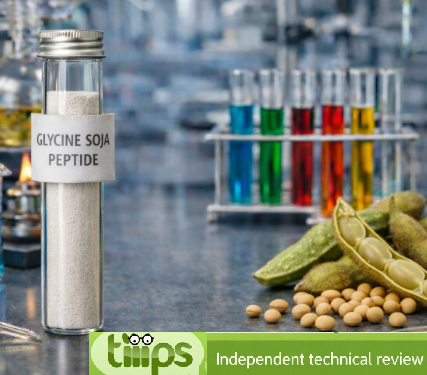
Glycine Soja Peptide typically appears as a white to light beige powder, depending on the extraction and hydrolysis process. It has a mild, characteristic odor and is soluble in water, forming clear or slightly turbid solutions. These peptides are known for their ability to improve the texture of formulations and provide a smooth feel to the skin.
Production Process:
Seed Collection and Preparation: Soybean seeds are harvested, cleaned, and prepared for protein extraction.
Protein Extraction: Proteins are extracted from the seeds using aqueous or enzymatic methods.
Hydrolysis: The extracted proteins are hydrolyzed using enzymes to break them down into smaller peptide fragments.
Purification and Concentration: The peptide solution is purified to remove impurities and concentrated to enhance the peptide content.
Drying and Formulation: The concentrated peptide solution is dried to form a powder and then incorporated into various cosmetic and skincare products.
Main uses
Cosmetics.
Used in haircare (shampoos, conditioners, masks, leave-ons) and skincare (serums/creams/lotions) to support a conditioning positioning and improve feel (slip, softness, more uniform touch).
INCI functions (within the cosmetics chapter).
Film-forming agent. It produces, upon application, a very thin continuous film with an optimal balance of cohesion, adhesion and stickiness on skin, hair or nails to counteract or limit damage from external phenomena such as chemicals, UV rays and pollution.
Hair conditioning agent. A significant number of ingredients with specific and targeted purposes may co-exist in hair shampoo formulations: cleansers, conditioners, thickeners, matting agents, sequestering agents, fragrances, preservatives, special additives. However, the indispensable ingredients are the cleansers and conditioners as they are necessary and sufficient for hair cleansing and manageability. The others act as commercial and non-essential auxiliaries such as: appearance, fragrance, colouring, etc. Hair conditioning agents have the task of increasing shine, manageability and volume, and reducing static electricity, especially after treatments such as colouring, ironing, waving, drying and brushing. They are, in practice, dispersants that may contain cationic surfactants, thickeners, emollients, polymers. The typology of hair conditioning agents includes: intensive conditioners, instant conditioners, thickening conditioners, drying conditioners. They can perform their task generally accompanied by other different ingredients.
Skin conditioning agent. It is the mainstay of topical skin treatment as it has the function of restoring, increasing or improving skin tolerance to external factors, including melanocyte tolerance. The most important function of the conditioning agent is to prevent skin dehydration, but the subject is rather complex and involves emollients and humectants that can be added in the formulation.
Nutritional use note and bioactive compounds
For cosmetic use, a “nutritional” framing is not relevant. In terms of formulation-relevant bioactive content, the ingredient is characterized primarily by oligopeptides (di-/tri-peptides) derived from soy proteins: any accessory micro-components depend on grade and process, so realistic evaluation should rely on supplier specifications and CoA.
Calories (energy value)
In the cosmetic context (topical use), energy value is not an operational parameter. In addition, the ingredient is typically used at low percentages, making any energy contribution practically irrelevant for formulation purposes.
Identification data and specifications
| Characteristic | Value |
|---|---|
| INCI name | Glycine Soja Peptide |
| common name | soy peptides (peptide fraction) |
| common name | soya / soybean |
| botanical family | Fabaceae |
| CAS number | not assigned for this entry in the inventory (blank field) |
| EC/EINECS number | not assigned for this entry in the inventory (blank field) |
| molecular formula | not applicable (peptide mixture) |
| molecular weight | not applicable as a single value (mixture; predominantly di-/tri-peptides) |
| typical commercial form | aqueous solution or solution in glycols/carriers, or powder/granulate for reconstitution (grade-dependent) |
| functions (cosmetic use) | film forming, hair conditioning, skin conditioning |
Physico-chemical properties (indicative)
| Characteristic | Value | Note |
|---|---|---|
| chemical nature | oligopeptide mixture | low-molecular fraction from soy proteins |
| water solubility | generally good | depends on assay, carriers, and process |
| pH stability | better in moderate ranges | pH extremes may affect odor/color and performance |
| heat sensitivity | generally compatible with standard cosmetic processing | avoid prolonged thermal stress, especially in solution |
| microbiological sensitivity | possible in aqueous matrices | requires preservative strategy and process control |
| critical parameters | peptide profile, assay, impurities, odor/color | determine repeatability and formula compatibility |
Functional role and practical mechanism of action
In formulas, Glycine Soja Peptide tends to contribute a film forming effect that can improve surface feel (a fuller and more uniform touch) and conditioning on hair and skin. In haircare, the practical goal is often improved combability and a softer hair feel; in skincare, improved comfort and a perception of smoother skin.
Formulation compatibility
It is generally compatible with emulsions and aqueous gels, but may affect clarity and rheology in highly electrolyte-rich systems or with sensitive polymer networks. In the presence of complex fragrances or borderline preservative systems, organoleptic drift (odor/color) can emerge over time, so accelerated stability and full preservative-package compatibility are recommended.
Use guidelines (indicative)
Use should follow the supplier’s technical sheet, with attention to: recommended pH window, process addition point (to avoid unnecessary thermal stress), and preservation requirements. In development, it is useful to run comparative sensory evaluation (with/without the ingredient) and verify organoleptic stability over shelf-life.
Quality, grades, and specifications
Quality drivers include: peptide cut/profile (di-/tri-peptide distribution), assay, impurities, moisture/carrier solvents, and batch-to-batch consistency. For soy-derived raw materials, it is also appropriate to consider management of potential protein traces and correct supply-chain communication, depending on positioning and target consumers.
Implementation of GMP (good manufacturing practice; benefit: reduces variability and contamination) is particularly relevant to ensure repeatable peptide profile and microbiological control for aqueous grades.
Safety, regulatory, and environment
Generally considered safe for topical and oral use. It is important to follow recommended guidelines and dosages to avoid potential allergic reactions or adverse effects. Safety assessments are necessary for new formulations or high concentrations.
In cosmetics, available evaluations for soy proteins and peptides indicate a safety profile consistent with the reported current use levels, while acknowledging that real safety depends on the finished product (concentration, exposure route, user population). Operationally, key watchpoints are: quality/impurities, microbiological control (if supplied in solution), and management of potential individual sensitivities.
Formulation troubleshooting
Organoleptic instability (odor/color) over shelf-life.
Typical cause: interactions with preservatives/fragrance or thermal stress during processing. Action: optimize processing, verify compatibility, select a more stable grade, and retune the preservative system.
Haze or loss of clarity in gels/serums.
Typical cause: interaction with polymers or salts/electrolytes. Action: run compatibility screening, reduce electrolytes, and select a more tolerant rheology system.
Conclusion
Glycine Soja Peptide is a soy peptide fraction, typically di-/tri-peptides, used in cosmetics for film forming and conditioning functions on skin and hair. To achieve repeatable performance, grade quality (peptide profile, assay, carriers), compatibility with pH and preservatives, and careful verification of organoleptic and microbiological stability of the finished product are decisive.

