



Prunus avium wood extract: properties, uses, pros, cons, safety
(Avium wood extract)
Prunus avium wood extract is an extract obtained from the wood of Prunus avium (sweet cherry, family Rosaceae). In cosmetics and personal care it is mainly used as a skin feel ingredient and to support skin conditioning, with a technical rationale linked to the presence of polyphenolic and tannin fractions typically found in woody materials. As with many wood-derived extracts, real performance depends strongly on the process (solvent, concentration, standardization) and on the impurity/color profile, which can affect the cosmetic base.
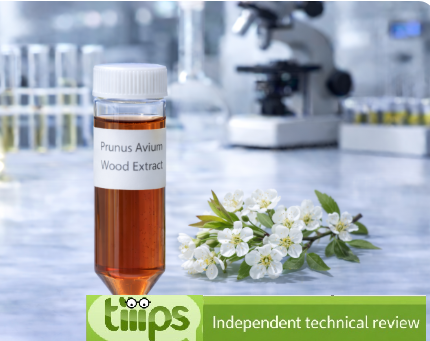
Definition
It is not a single molecule: it is a mixture of constituents extracted from the woody matrix. The INCI name does not specify a single method: the product may be a hydroalcoholic, glycolic, glyceric, or other cosmetically suitable extract, supplied as a solution or as a powder (typically on a carrier). In formulation, the main goal is not perfuming, but contributing to sensoriality and conditioning.
Main uses
Food.
Not relevant: it is intended for the cosmetic scope.
Cosmetics.
Used in creams, serums, lotions, and body products aimed at comfort and improved skin feel; sometimes in scalp products as a botanical component, depending on the formulation concept.
INCI functions.
Skin conditioning agent. It represents the cornerstone of topical skin treatment as it has the function of restoring, increasing or improving skin tolerance to external factors, including melanocyte tolerance. The most important function of a conditioning agent is to prevent skin dehydration, but the topic is rather complex and involves emollients and humectants that can be added to the formulation.
Medicine.
Not an active substance. Any traditional use of Prunus species does not automatically translate into cosmetic claims without finished-product support.
Pharmaceutical.
Possible use as a botanical component in certain topical products, subject to quality and finished-product dossier.
Industrial use.
Botanical ingredient for “natural” cosmetic formulations or for sensorial/antioxidant positioning, depending on supplier specifications.
Key constituents
A typical wood extract profile may include, with variable percentages:
Polyphenols and flavonoids (antioxidant fraction, often solvent-dependent).
Tannins (astringent/sensorial contribution and possible impact on color and compatibility).
Other phenolics and secondary compounds from the woody matrix (which may influence stability, odor, and chromaticity).
Practical note: “antioxidant/soothing” describes a compositional rationale, but concrete cosmetic outcomes (comfort, perceived redness reduction, barrier support) depend on dose, vehicle, synergies, and the base formula.
Nutritional use note and bioactive compounds
It is not a nutritional ingredient and is not intended for ingestion. Interest in bioactive compounds is limited to the cosmetic context (sensorial support and potential antioxidant contribution in formula).
Identification data and specifications
| Characteristic | Value |
|---|---|
| INCI name | Prunus avium wood extract |
| Botanical source | Prunus avium (family Rosaceae) |
| Type | wood extract (mixture) |
| CAS number | 85566-22-9 |
| EC number (EINECS) | 287-632-2 |
| Molecular formula | not applicable (mixture) |
| Molecular weight | not applicable (mixture) |
| Commercial form | solution or powder (depends on grade and carrier) |
| Variability note | depends on solvent, concentration, and supplier standardization |
Physico-chemical properties (indicative)
| Characteristic | Indicative value | Note |
|---|---|---|
| Appearance | liquid or powder | process and carrier dependent |
| Color | yellow-amber to brown | typical of phenolics/tannins |
| Odor | mild, woody/earthy | variable intensity |
| Solubility | variable | higher if carried in water/glycerin/glycols |
| Stability | dependent on light/air/temperature | possible color/odor drift |
| Formula impact | possible coloration/haze | to be evaluated by base and packaging |
Functional role and mechanism of action (practical)
The main contribution is conditioning and sensorial: the extract may support a more “comfortable” skin feel and improve the formula’s feel, also thanks to phenolic components that can contribute to balancing oxidative stress in cosmetic systems. The perception of “protection” often derives from the whole formula (emollients, humectants, film-formers) rather than the extract alone.
Formulation compatibility
To be verified case-by-case, with attention to:
color (risk of darkening or changes over time),
solubility and haze/precipitation risk in the presence of electrolytes,
interactions with cationic polymers or extreme ph systems,
stability in emulsions and cleansers (addition order and process temperature).
Production process
The process may vary by supplier, but typically includes:
Raw material preparation
Wood selection, possible seasoning, and size reduction (chips/powder) to increase extraction surface.
Extraction
Maceration/percolation or assisted extraction with cosmetically suitable solvents (water, hydroalcoholic blends, glycerin/glycols). Solvent choice influences the profile: more polar (more phenolic fraction), more hydroalcoholic (intermediate profile and often higher extraction of aromatic compounds).
Separation and clarification
Filtration and clarification to remove insolubles; possible treatment to reduce haze and stabilize color.
Concentration and standardization (when applicable)
Concentration under controlled conditions and standardization via blending or marker titration (if used).
Packaging
Filling into suitable packaging (light/air barrier when needed) to reduce oxidation and chromatic/olfactive drift.
Safety, regulation, and environment
In general it is considered suitable for cosmetic use at normal levels, but technical management should consider batch quality, potential impurities (metals, residual solvents if the process is not solvent-free), and finished-product skin compatibility.
Allergen.
Not typically classified as an allergen. However, as with many botanical extracts, individual sensitivities are possible in predisposed subjects; assessment is on the finished product.
Contraindications (brief).
Use caution on very reactive or compromised skin, and in leave-on products with high botanical load. For “clean” formulas, carefully verify preservation and microbiological stability.
Environment.
Impact depends on wood sourcing and the extraction solvent/process. Traceability and responsible biomass sourcing (wood-processing by-products, sustainable forestry) reduce environmental risk.
Formulation troubleshooting
Finished product darkening over time.
Action: lower dose, select a lighter/standardized grade, optimize compatible antioxidants and barrier packaging.
Haze or precipitation.
Action: verify solubility in the real base, review extract solvent/vehicle, addition order, and electrolyte compatibility.
Woody odor too noticeable.
Action: lower dose or balance with fragrance/masking; evaluate a deodorized grade if available.
Conclusion
Prunus avium wood extract is a wood-derived extract used in cosmetics mainly as a skin conditioning agent, with a rationale linked to polyphenols and tannins. Performance depends strongly on extraction type and supplier standardization; key management points are compatibility (color/solubility), long-term stability, and finished-product evaluation.
Mini-glossary
Extract. Mixture of substances obtained from a plant matrix using a suitable solvent. Benefit: enables delivery of functional/sensorial fractions in cosmetics.
Tannins. Polyphenols with astringent activity and antioxidant contribution. Benefit: can influence sensoriality and color stability.
Standardization. Process to reduce batch-to-batch variability (markers or analytical fingerprint). Benefit: improves repeatability of performance and compatibility.
Carrier. Support/vehicle of an extract in powder or solution form. Benefit: facilitates dosing and integration into formulations.

