



Amyris balsamifera oil acetylated: properties, uses, pros, cons, safety
Amyris balsamifera oil acetylated is an acetylated essential oil obtained from the essential oil of Amyris balsamifera (family Rutaceae), often commercially associated with a “sandalwood-like” profile (warm, woody, balsamic). Acetylation is a targeted chemical modification mainly intended to convert part of the oil’s alcoholic components (especially sesquiterpene alcohols) into the corresponding acetate esters, with the practical aim of modulating stability, volatility, and formulation behavior, while maintaining a similar olfactive signature that is often more “rounded” and controllable.
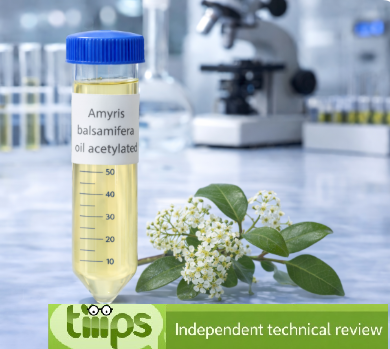
For more information: Amyris balsamifera
Definition
It is not a single molecule: it is a mixture derived from amyris essential oil that has undergone acetylation. In practical terms, acetylation introduces acetyl groups onto a portion of constituents bearing hydroxyl functions (terpenic alcohols), generating an acetate fraction. This can reduce the polarity of some constituents, shift the evaporation profile (dry-down), and, in some cases, improve the robustness of the note in complex formulas (e.g., soaps, detergents, systems with olfactive-stability constraints).
Main uses
Cosmetics
Primarily used as a perfuming ingredient in leave-on and rinse-off products (creams, oils, cleansers, body/hair products) and as a component in fragrance bases where warm woody notes and a sensory “fixative” effect are desired.
INCI functions
Perfuming. Unlike fragrance, which can also contain slightly less pleasant or characteristic odours, the term perfume indicates only very pleasant fragrances. Used for perfumes and aromatic raw materials.
Key constituents
The typical profile is dominated by sesquiterpenes and especially sesquiterpene alcohols and their acetate derivatives. Practically, the material is expected to contain: a fraction of acetates derived from sesquiterpene alcohols present in the starting oil, a residual fraction of non-acetylated alcohols, and a portion of hydrocarbon sesquiterpenes. The actual composition strongly depends on the oil’s origin, acetylation conditions (degree of conversion), and the producer’s standardization.
The acetylated Amyris balsamifera oil retains many of the key chemical constituents of the original oil but with modifications introduced through acetylation:
- Amyrisol: The major sesquiterpene, contributing to the oil’s woody aroma, though its structure may be altered slightly.
- Eudesmol: A sesquiterpene alcohol, offering an earthy and woody scent, potentially modified by acetylation.
- Cedrol: A sesquiterpene alcohol, providing a deep, woody fragrance, with possible changes in its properties due to acetylation.
- Acetylated Compounds: The acetylation introduces acetyl groups (CH3CO) to some of these components, potentially affecting their volatility, solubility, and stability.
Identification data and specifications
| Characteristic | Value |
|---|---|
| INCI name | Amyris balsamifera oil acetylated |
| Botanical source | Amyris balsamifera (family Rutaceae) |
| Preparation type | acetylated essential oil (mixture) |
| CAS number | 83863-22-3 |
| EC number (EINECS) | 281-091-6 |
| Molecular formula | not applicable (mixture) |
| Molecular weight | not applicable (mixture) |
| Main use | perfuming agent in cosmetics and perfumery |
| Variability note | profile depends on origin, process, and degree of acetylation |
Physico-chemical properties (indicative)
| Characteristic | Indicative value | Note |
|---|---|---|
| Physical state | oily liquid | typical of fragrance raw materials |
| Color | pale yellow to amber | batch/oxidation dependent |
| Odor | woody, warm, balsamic | often “softer” than the unmodified oil |
| Water solubility | insoluble / very low | typical of terpenes/esters |
| Solubility in organic solvents | good | miscible with many solvents and fragrance bases |
| Volatility | medium-low | the sesquiterpene fraction is less volatile |
| Oxidative stability | sensitive | requires management of light/air/temperature |
Functional role and mechanism of action
In fragrance, it acts as a base note: the sesquiterpene fraction provides persistence and woody “body”. By converting part of the alcohols into acetates, acetylation can alter the evaporation curve and olfactive performance, with the practical effect of greater control over dry-down and better integration in certain bases (especially where long-term olfactive stability is a key driver).
Formulation compatibility
Generally compatible with anhydrous systems, fragrance bases, and the oil phase of emulsions. In detergency it may require appropriate solubilization to limit haze or phase separation. Compatibility should be verified with respect to solvents used, surfactants, electrolytes, and process conditions (temperature, shear, order of addition).
Production process
A typical industrial process can be summarized into four operational steps, with variants depending on the manufacturer and internal quality standards.
Essential oil extraction.
The botanical raw material (mainly aromatic wood and/or woody parts) is steam-distilled to obtain the “crude” essential oil containing the volatile terpene/alcohol fraction.
Acetylation reaction.
The essential oil is reacted with an acetylating agent (typically acetic anhydride or, in some processes, acetyl chloride) under controlled conditions and with suitable catalysis. The practical goal is to acetylate part of the hydroxyl groups of terpenic alcohols, generating the corresponding acetate esters and modulating olfactive and stability behavior.
Quench, washes, and purification.
After the reaction, neutralization/quench and washing steps are used to remove residual reagents, by-products, and catalysts. Clarification/filtration follows, and when needed, refining to reduce “harsh” notes or reactive impurities that could affect stability and tolerability.
Standardization and quality control.
The product is brought to specification via blending and analytical controls, focusing on compositional fingerprint (GC profile), sensorial characteristics (odor, color), and stability-related parameters (oxidation and drift over time). Standardization is particularly important because natural variability and acetylation degree can differ between batches.
Safety, regulation, and environment
Like many terpene-based fragrance raw materials, it may present irritation or sensitization risk in predisposed individuals, with risk potentially increased if the material is oxidized. Acetylation can modify the reactivity profile of certain constituents (reducing the free-alcohol fraction), but it does not eliminate the need for a finished-product assessment.
Allergen.
It is not a single “allergen” by itself. Depending on batch profile and oxidation, it may contain fragrance components that contribute to sensitization; management relies on quality control and appropriate assessment/labeling where applicable.
Contraindications
Use caution on very reactive skin and in leave-on products with high fragrance levels. Avoid oxidized batches and manage stability through suitable packaging and storage conditions.
Formulation troubleshooting
Note fading or changing over time.
Action: improve barrier packaging, reduce headspace, use compatible antioxidants, control light/temperature.
Haze or phase separation in detergents.
Action: adjust solubilizer and fragrance system; verify compatibility with electrolytes and cloud point.
Perceived irritation in the finished product.
Action: reduce dosage, check batch oxidation, rebalance the fragrance, and repeat skin-compatibility assessment according to brand procedures.
Conclusion
Amyris balsamifera oil acetylated is a fragrance raw material obtained by acetylation of amyris essential oil, with the aim of making its woody-balsamic profile more manageable. Its technical value is mainly in perfumery and cosmetics as a base note and structural olfactive component. Reliability depends on process consistency (degree of acetylation), control of process residues, and management of oxidative stability.
Mini-glossary
Acetylation. Reaction that introduces an acetyl group onto molecules with suitable functional groups (e.g., alcohols), often forming acetate esters. Benefit: can modulate volatility and stability of raw materials.
GC (gas chromatography). Analytical technique to profile volatile components. Benefit: quality control, consistency, and authenticity checks.
Dry-down. Fragrance evolution over time after application. Benefit: describes persistence and base-note performance.

