



Rosin acrylate: properties, uses, pros, cons, safety
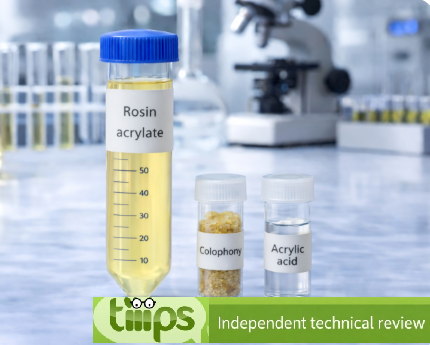
Rosin acrylate is a resin obtained as the reaction product between rosin (colophony, a natural mixture rich in resin acids derived from conifers) and acrylic acid. In practice it is not a single molecule, but a UVCB (a mixture with variable composition): its functional “identity” is that of a film former and, in many applications, a tackifier/adhesion resin. In cosmetics it is used mainly to create a continuous film on hair or skin, increasing hold, humidity resistance, and the “structural feel” of the deposit (with the practical aim of reducing tackiness and improving film behavior compared with some resins that are more brittle or more tacky).
Definition
Rosin acrylate can be described as acrylic-modified rosin, where the resin matrix (resin acids and derivatives) is transformed into a material more suitable for film formation through reaction with acrylic acid. From a formulation standpoint, it is useful to view it as a film rheology modifier: it contributes to cohesion, substrate adhesion (hair/skin), and durability of the deposit. Actual performance depends on the degree of modification, component distribution, and the manufacturer’s specifications (solubility, residual acidity, apparent molecular mass, color).
Main uses
Cosmetics
Rosin acrylate is used as a film-forming agent and fixative, especially in hair styling products. It typically appears in: hairsprays, fixing sprays, styling gels/creams, finishing products, where a drier, more stable hold is needed, with a film that resists humidity and handling better than overly plastic or overly tacky systems. It may also appear as a binder/film former in certain make-up formulations or products requiring an adherent, coherent deposit, when solvent compatibility and sensory profile allow it.
INCI functions
Hair fixative. This ingredient has the ability to create, with its protective film, stiffness and hold in the hair, and also has the ability to form, with its hydrophilic and elastic properties, bonds between the hair fibres, to keep the hair in a particular shape for a certain time. In short, it allows physical control of the hairstyle.
Film-forming agent. It produces, upon application, a very thin continuous film with an optimal balance of cohesion, adhesion and stickiness on skin, hair or nails to counteract or limit damage from external phenomena such as chemicals, UV rays and pollution.
Industrial use
It is used as a functional resin in systems requiring adhesion and a resistant film: adhesives and binders, and in some applications such as paints, lacquers, and coatings where a tackifying/film-forming resin component improves wetting, cohesion, and performance of the dried film.
Key constituents
As a UVCB, it cannot be described with a clean list of single molecules. In practical terms, it can be traced back to: fractions derived from the resin acids of rosin (with a typical predominance of abietane-type components; abietic acid is often cited as a major component of the starting rosin) and their reaction products/adducts with acrylic acid, with variability linked to the raw material (rosin origin) and process conditions. This variability affects color, odor, solubility, and especially “film quality” (hardness, tack, humidity resistance, brittleness).
Identification data and specifications
| Characteristic | Value | Note |
|---|---|---|
| INCI name | Rosin acrylate | Cosmetic denomination |
| Origin | rosin (colophony) + acrylic acid | Reaction product (UVCB) |
| CAS number | 83137-13-7 | “Rosin, reaction products with acrylic acid” |
| EC number (EINECS) | 280-192-2 | EU identifier |
| Molecular formula | not applicable (mixture) | UVCB |
| Molecular weight | not applicable (mixture) | Not a single value |
| Main use | film former / hair fixing | Mainly in hair styling cosmetics |
| Variability note | high | Depends on rosin and process |
Chemical-physical properties (indicative)
| Characteristic | Indicative value | Note |
|---|---|---|
| Physical state | resinous solid / crystalline | Often amber-colored |
| Color | amber–orange–brown | Depends on batch and oxidation |
| Odor | resinous | Generally mild but perceptible |
| Water solubility | very low / insoluble | Typical of resins |
| Solubility in solvents | good in suitable systems | Depends on modification degree and solvent |
| Film behavior | adherent, coherent film | Contributes to hold and durability |
| Sensitivity to heat/oxygen | possible | Packaging and storage management recommended |
Functional role and mechanism of action
In formulation, rosin acrylate works by film formation: after evaporation of the carrier (water/solvent), the coalescing resin forms a continuous network that: increases adhesion to the substrate, improves mechanical strength of the deposit, and stabilizes shape (hair) or distribution (deposit on skin/pigments). In hair styling products, the most sought-after technical benefit is a balance between set-hold and tack: an overly tacky film feels sticky, while an overly rigid one can be brittle or powdery; the selected resin grade and the combination with plasticizers/humectants determine the sensory outcome.
Formulation compatibility
Rosin acrylate performs best in systems where solubilization (or a stable dispersion) is ensured and where the film can form without phase separation. In practice, key points are: compatibility with solvents and co-solvents, interaction with film-forming polymers (synergies or antagonisms on tack), and sensitivity to electrolytes and pH changes in aqueous systems. In hairsprays and styling products, performance also depends strongly on ambient humidity, plasticizer content, and the evaporation profile of the carrier.
Pros and cons
Pros
Strong film-forming capacity contributing to hold and durability of the deposit.
Potential improvement in perceived set and reduction of tack in selected systems (vs more “sticky” resins).
Versatile as a functional resin beyond cosmetics (adhesives/binders, coatings).
Cons
Potential risk of skin sensitization in predisposed individuals (a common theme for rosin-derived substances).
Potential eye irritation if the finished product is not properly designed (relevant for aerosols and periocular areas).
Batch variability and color/odor profile: may require tight specifications and quality controls.
If poorly balanced, it can increase film stiffness or feel less “soft” (plasticizers and optimization needed).
Safety, regulatory, and environmental aspects
Safety profile (practical)
Rosin acrylate, as a rosin-derived UVCB, should be managed carefully, especially regarding sensitization. Available regulatory/technical-toxicological assessments (often using read-across from rosin maleate/fumarate materials) indicate likely significant skin sensitization for the rosin-derivative category and also report evidence of eye irritation in analogous materials. Conversely, analogous materials often show low acute toxicity (oral/dermal) and absence of strong skin irritation, but these points do not replace a finished-product assessment.
Allergen
It is not a single “fragrance allergen” in the classic sense, but it is potentially sensitizing as a rosin-derived substance. In practice: pay attention to consumers with a history of colophony/rosin allergy or contact dermatitis, and be particularly cautious with leave-on products or aerosol exposure.
Contraindications (brief)
Use caution on reactive or compromised skin; avoid high concentrations in leave-on products without a sound formulation rationale and internal evaluations. For aerosols, manage particle profile and exposure to mucous membranes/eyes. In industrial settings, avoid exposure to heated fumes from rosin-based substances (risk of occupational respiratory symptoms).
Formulation troubleshooting
Film too rigid or “powdery” on hair: rebalance with suitable plasticizers and/or combine with a more flexible film former.
Residual stickiness: reduce resin level, review humectants and solvent profile, check compatibility among film-forming polymers.
Haze/instability in an aqueous system: revise solubilization/neutralization system and ionic strength (electrolytes).
Periocular stinging or discomfort (spray): reduce exposure to eyes/mucosa, revise aerosol technology and overall tolerability of the finished product.
Conclusion
Rosin acrylate is a rosin-derived UVCB resin whose primary functions are film forming and hair fixing, useful when an adherent and durable deposit is required. Its technical advantage is the ability to build films with good hold; its main limitation is the potential sensitization profile typical of rosin derivatives, which requires careful dosage selection, attention to the target group (sensitive skin/allergy-prone users), and rigorous finished-product evaluation.
Mini-glossary
UVCB. A mixture with Unknown or Variable composition, Complex reaction products or Biological materials: it does not have a single molecular formula or a single molecular weight.
Sensitization. An immune response that can lead to allergic contact dermatitis in predisposed individuals after repeated or sufficient exposure.

