



Glycyrrhiza glabra root water: properties, uses, pros, cons, safety
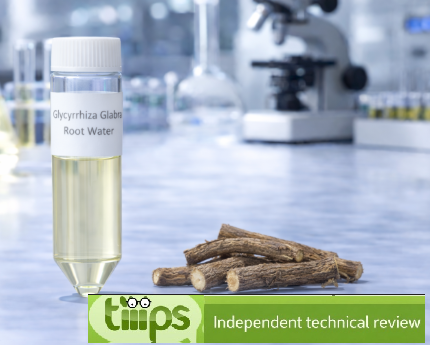
Glycyrrhiza glabra root water is a cosmetic ingredient obtained from the roots of Glycyrrhiza glabra (licorice, family Fabaceae) as an aromatic water/aqueous solution containing hydrophilic fractions of the botanical material. In formulation it is mainly used to support a more comfortable skin feel and to contribute to soothing and antioxidant positioning in leave-on products (toners, mists, aqueous serums, gels) and, in some cases, in gentle rinse-off products.
For more information: Licorice
Definition
It is not a single molecule: it is an aqueous matrix containing water-soluble root constituents in a diluted form compared with concentrated extracts (e.g., glycolic or dry extracts). This generally makes it “milder” in terms of sensorial impact and risk of overdosing, but also more dependent on process quality, preservation, and supplier standardization. Functional output depends on production method (aqueous extraction/infusion, distillation, combinations), actual concentration, and microbiological stability of the system.
Main uses
Food.
Not relevant within the cosmetic scope.
Cosmetics.
Typical use as an “active” aqueous phase in products for sensitive or redness-prone skin, in toners and functional waters, in lightweight serums, and in soothing gels. It is often positioned for skin comfort and antioxidant support, sometimes within brightening/even-tone concepts as a co-support (depending on the formulation strategy).
INCI functions.
Antioxidant agent. Ingredient that counteracts oxidative stress and prevents cellular damage. Free radicals, pathological inflammatory processes, reactive nitrogen species and reactive oxygen species are responsible for the aging process and for many diseases caused by oxidation.
Skin conditioning agent. It represents the cornerstone of topical skin treatment as it has the function of restoring, increasing or improving skin tolerance to external factors, including melanocyte tolerance. The most important function of a conditioning agent is to prevent skin dehydration, but the topic is rather complex and involves emollients and humectants that can be added to the formulation.
Industrial use.
Botanical raw material for “delicate” or “natural” cosmetic lines, with variability managed through quality specs and microbiological controls.
Key constituents
In a root water, constituents are usually present at low to moderate levels and mainly within the hydrophilic fraction. Among the most relevant markers (with amounts strongly process-dependent):
Glycyrrhizin.
A triterpenoid saponin typical of the root, often associated with a soothing/comfort profile.
Flavonoids (e.g., liquiritin, isoliquiritin).
A phenolic fraction frequently cited for antioxidant contribution and support to a more even-looking skin tone (within cosmetic scope).
Phenolic compounds.
A heterogeneous set of hydrophilic phenolics contributing to antioxidant properties and potentially to sensorial modulation.
Technical note: compared with concentrated extracts, a root water can be gentler but also less “potent” per unit dose; standardization (if available) is therefore a key driver.
Identification data and specifications
| Characteristic | Value |
|---|---|
| INCI name | Glycyrrhiza glabra root water |
| Botanical source | Glycyrrhiza glabra (family Fabaceae) |
| CAS number | 84775-66-6 |
| EC number (EINECS) | 283-895-2 |
| Type | root water/aqueous solution (mixture) |
| Molecular formula | not applicable (mixture) |
| Molecular weight | not applicable (mixture) |
| Variability note | depends on production method, concentration, and preservation |
Physico-chemical properties (indicative)
| Characteristic | Indicative value | Note |
|---|---|---|
| Appearance | clear liquid → slightly opalescent | depends on dissolved solids and filtration |
| Odor | mild, herbaceous/sweet | variable intensity |
| Consistency | aqueous | typically used as part of phase A |
| Color | colorless → pale straw-yellow | phenolics may influence color |
| Solubility | in water | aqueous component by definition |
| Stability | sensitive to microbial contamination | requires adequate preservation |
Functional role and mechanism of action (practical)
The main contribution is conditioning and “support” antioxidant activity:
Soothing/skin comfort.
The saponin and phenolic fractions may contribute to reduced discomfort sensation and improved perceived tolerance, especially in formulas oriented toward sensitive skin.
Antioxidant.
The phenolic component can help limit superficial oxidative stress, synergizing with primary antioxidants in the formula.
Sensoriality.
As a “functional water”, it can improve freshness and lightness in toners and mists without adding heaviness.
Production process
The process varies by supplier; the most common approaches include:
Aqueous extraction/infusion.
Roots are washed, milled or cut and treated with water (sometimes under controlled temperature) to extract the hydrophilic fraction; solids are then separated.
Distillation or co-distillation.
In some cases a “root water” may derive from distillation/condensation-type processes (more typical of hydrosols). For licorice, it is more often an aqueous extract rather than a true aromatic hydrosol.
Filtration and clarification.
Fine filtration to reduce particulates and improve visual stability, with controls on haze and color.
Stabilization and packaging.
Microbiological preservation (compatible preservative system or sterile process, if applicable) and packaging suitable to limit contamination and organoleptic drift.
Safety, regulation, and environment
Safety.
Glycyrrhiza glabra root water is generally considered suitable for cosmetic use at normal concentrations. As with many botanicals, tolerability depends on the finished product (ph, preservatives, fragrances, surfactants).
Allergen.
Not typically classified as an allergen. Individual reactions are possible, especially on very reactive skin or in the presence of other sensitizing components in the finished product.
Contraindications (brief).
Use caution in case of known sensitivity to licorice or similar botanical extracts; on extremely sensitive skin prefer fragrance-free formulas and well-tolerated preservative systems.
Environment.
Impact is driven by supply chain and process: aqueous extraction and traceable sourcing tend to be favorable; the critical variable remains microbiological management (preservatives, packaging, shelf-life).
Formulation troubleshooting
Microbiological instability or “fermented” odor.
Action: review preservation, incoming microbiological checks, tank and packaging hygiene; reduce free water activity with compatible co-solvents if needed.
Haze/precipitation.
Action: optimize filtration, control electrolytes and ph, evaluate compatibility with polymers and surfactants.
Low perceived efficacy.
Action: verify supplier titration/markers, increase dose within compatibility, or switch to a more concentrated extract (glyceric/glycolic) if the concept allows.
Conclusion
Glycyrrhiza glabra root water is an aqueous matrix derived from licorice root used in cosmetics to support skin comfort and a light antioxidant profile, with easy integration into toners and water-based formulas. Performance is strongly process- and standardization-dependent; key drivers are batch quality, microbiological stability, and compatibility with the preservative system.
Mini-glossary
Saponins. Molecules with a lipophilic and a sugar portion; often associated with soothing profiles and surface interactions. Benefit: supports sensoriality and comfort in delicate formulas.
Flavonoids. Plant polyphenols with antioxidant activity. Benefit: contributes to protection against superficial oxidative stress.
Root water. An aqueous solution derived from plant material, distinct from concentrated extracts. Benefit: easy integration and light sensoriality.

