



Panax ginseng
Description
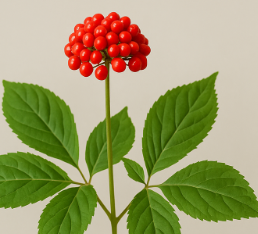
Panax ginseng is a perennial herbaceous species belonging to the botanical family Araliaceae, commonly known as Asian or Korean ginseng. It develops a fleshy, often branched rhizome (root), which is the most important part from the herbal and commercial point of view. From this rhizome arises a usually single, upright stem about 30–60 cm tall, bearing at its top a whorl of 3–6 leaves.
The leaves are palmately compound, each composed of 3–5 (sometimes 7) ovate–lanceolate leaflets, with finely serrated margins and a relatively thin yet resilient texture. At the centre of the leaf whorl, a simple umbel develops, carrying numerous small greenish to whitish–green flowers. The fruit is a bright red berry, typically containing two reniform (kidney-shaped) seeds. The plant is slow-growing and requires several years before producing roots of suitable size and quality for herbal use.
 |  |
Botanical classification (APG IV system)
| Category | Data |
|---|---|
| Common name | Asian ginseng, Korean ginseng |
| Botanical name | Panax ginseng C.A.Mey. |
| Kingdom | Plantae |
| Clade | Angiosperms → Eudicots → Asterids |
| Order | Apiales |
| Family | Araliaceae |
| Genus | Panax |
| Species | Panax ginseng C.A.Mey. |
Indicative nutritional values per 100 g (dried root of Panax ginseng)
Values refer to dried root and may vary with cultivar, origin, age of the root and processing.
| Component | Approximate value per 100 g |
|---|---|
| Energy | ~ 330–340 kcal |
| Total carbohydrates | ~ 70 g |
| — of which sugars | ~ 5–10 g |
| Dietary fiber | ~ 3–10 g |
| Proteins | ~ 10–13 g |
| Total lipids | ~ 1–3 g |
| — of which saturated fatty acids (SFA) | ~ 0.3–0.6 g |
| — monounsaturated fatty acids (MUFA) | ~ 0.1–0.4 g |
| — polyunsaturated fatty acids (PUFA) | ~ 0.5–1.5 g |
| Sodium | very low |
| Main minerals | potassium, magnesium, phosphorus; traces of other elements |
| Vitamins | trace amounts, mainly B-group and vitamin C |
At typical herbal-use portions (often in the order of 1–2 g of dried root or equivalent), the caloric and macronutrient contribution to the daily diet is minimal; the interest is mainly related to its phytochemical profile (ginsenosides, polysaccharides, etc.) rather than to its energy content.
Lipid profile and acronyms note
The overall fat content of dried Panax ginseng root is low. Within this fraction, saturated fatty acids (SFA, Saturated Fatty Acids) are present in small quantities; when they predominate over unsaturated fats in the overall diet they are generally considered less favorable for cardiovascular health. Monounsaturated fatty acids (MUFA, MonoUnsaturated Fatty Acids) are usually regarded as more beneficial when they replace SFA in the diet. Polyunsaturated fatty acids (PUFA, PolyUnsaturated Fatty Acids), which include both omega-6 and omega-3 series, are important for cell membrane structure and for modulating inflammatory processes; in Panax ginseng they contribute only modestly in absolute quantitative terms, given the low total fat content and the small usual serving sizes.
Distribution, Ecology And Cultivation Aspects
Panax ginseng is native to the cool, montane temperate regions of East Asia, particularly northeastern China, the Korean Peninsula and parts of the Russian Far East. In the wild it grows in the understorey of cool, moist deciduous forests, where it prefers:
Shaded or semi-shaded exposures, protected from direct, intense sunlight.
Deep, well-drained, humus-rich soils, often slightly acidic.
Cool climates, with cold winters and mild summers.
Consistently moist soil, without prolonged waterlogging.
Cultivation aims to reproduce these understorey conditions, using shade structures or planting under tree canopies. Propagation is done either by seed (which has strong dormancy and slow germination) or by division of root/rhizome segments. To obtain high-quality roots, a cultivation period of typically 4–6 years or more is required. The crop is sensitive to water and temperature stress, and to soil-borne diseases, so careful management of shade, moisture and soil health is essential.
Chemical Composition And Root Characteristics
The root of Panax ginseng contains a characteristic group of triterpenoid saponins known as ginsenosides, regarded as the primary active constituents. Ginsenosides are usually classified into two major structural groups: protopanaxadiol-type and protopanaxatriol-type, along with several minor structures.
In addition to ginsenosides, the root also contains:
Polysaccharides, including bioactive heteropolysaccharides.
Phenolic compounds and phenolic acids.
Peptides, polyacetylenes, phytosterols and fatty acids.
Vitamins and minerals in relevant trace amounts.
The total ginsenoside content and the relative profile of individual ginsenosides depend on factors such as plant age, root part (main root vs lateral roots), soil and climate conditions, and processing methods. Technological processing (for example, producing “white ginseng” by air-drying or “red ginseng” by steaming followed by drying) can alter the ginsenoside profile, generating derivative compounds specific to red ginseng.
Traditional Uses And Modern Applications
In East Asian traditional medicine, Panax ginseng is regarded as a tonic and adaptogenic plant, historically used to:
Support resistance to fatigue and psychophysical stress.
Promote general vitality and energy.
Support cognitive functions and capacity for concentration.
Contribute to an overall functional balance of the organism.
Traditional preparations include dried root decoctions, fluid extracts, standardised dry extracts, powders in capsules and various multi-herb formulations.
In modern contexts, standardised ginseng extracts are used as adjuncts in several situations (fatigue, physical performance, cognitive wellbeing), always within the limits of official guidelines, considering dosage, duration of use, contraindications and potential interactions (e.g. with anticoagulants, hypoglycaemic drugs or other therapies). Clinical evidence is heterogeneous, and responsible use requires attention to individual health status and medical advice where appropriate.
Root Quality And Commercial Requirements
Quality assessment of Panax ginseng roots combines morphological, chemical and hygienic criteria, including:
Root appearance: characteristic shape (often “man-shaped” in premium grades), uniform colour, absence of mould, deep cracks, insect damage or internal defects.
Declared cultivation age, which strongly influences size and ginsenoside content.
Total ginsenoside content and, where required, minimum levels of specific marker ginsenosides according to pharmacopoeial or regulatory standards.
Degree of drying and residual moisture, compatible with good stability and storage life.
Botanical purity, excluding other Panax species or foreign roots.
Microbiological quality and contaminant control (heavy metals, pesticide residues, mycotoxins) in line with regulations for herbal raw materials.
For ginseng extracts, in addition to ginsenoside titration, important aspects include:
Extraction method (solvent type, temperature, concentration).
Reproducibility of the phytochemical profile from batch to batch.
Stability of ginsenosides and other constituents over the declared shelf life.
Production process
Plant material
Cultivated in cool climates on well-drained soils, usually under artificial shade structures or forest-like shade.
Typical cultivation cycle of 4–6 years before harvest, to allow sufficient accumulation of ginsenosides in the roots.
Harvesting of the fleshy roots in autumn, when the aerial part begins to senesce and the plant enters vegetative rest.
Primary preparation of the root
Removal of soil by careful washing.
Elimination of damaged lateral roots or decayed parts.
If required, cutting into whole roots, broken roots, or slices, depending on the intended commercial use.
Drying of the root (white ginseng)
Drying in air or low-temperature dryers to preserve heat-sensitive constituents.
Drying is complete when the roots break with a snap and residual moisture is low enough for safe storage.
The resulting product is “white ginseng”, with pale yellowish–white roots.
Heat treatment (red and other types of ginseng)
To obtain “red ginseng”, fresh roots are subjected to steaming/heat treatment followed by drying.
Thermal treatment modifies the ginsenoside profile and color (reddish–brown roots), producing material with a different phytochemical and organoleptic pattern compared with white ginseng.
Further variants (e.g. “black ginseng”) are produced by multiple cycles of steaming and drying, further altering the composition.
Production of extracts
Crushing or milling of dried roots.
Extraction with water, ethanol, or hydroalcoholic mixtures under controlled time, temperature, and solvent ratio.
Filtration and vacuum concentration of the extract.
Drying (spray drying, vacuum drying, granulation) to obtain dry extracts standardized in ginsenosides or other markers.
Optional standardization with inert carriers to maintain a constant assay.
Quality control typically includes ginsenoside content, chromatographic profile, microbiological status, heavy metals, pesticides, residual solvents (for extracts), and moisture.
Applications
Herbal and dietary supplement field
In East Asian traditional medicine, Panax ginseng is used as a general tonic and adaptogen, especially in:
States of fatigue and reduced physical or mental performance.
Preparations intended to support stress response, immune function, and overall vitality.
In modern supplements it is employed as:
Standardized dry extracts in capsules, tablets, or sachets.
Liquid extracts and tonics where permitted.
Complex formulations combined with other tonic/adaptogenic botanicals.
Food field
Panax ginseng is not a staple food, but may appear as an ingredient in:
Herbal teas and decoctions.
Plant-based energy or tonic drinks, in countries where such uses are allowed.
Selected functional foods where the presence of ginseng is mainly traditional-health oriented and at relatively low levels.
Cosmetic field
Extracts (typically Panax Ginseng Root Extract) are used in:
Facial care products with tonifying or anti-age positioning.
Formulas for stressed or environmentally exposed skin, usually combined with other antioxidants.
Scalp and hair products (lotions, shampoos) aimed at improving the appearance and vitality of hair in synergy with other actives.
Use conditions and claims must always be aligned with local regulations for botanicals, supplements, and cosmetics.
Nutrition & health
At typical supplement dosages, the caloric contribution of ginseng is negligible; the key interest lies in ginsenosides and other bioactive constituents.
Preclinical studies (in vitro and in vivo) on Panax ginseng extracts suggest:
Antioxidant and anti-inflammatory effects.
Immunomodulatory actions and protective effects on organs such as heart, liver, and nervous system.
Potential support to glucose and lipid metabolism.
Anti-fatigue activity and improved exercise tolerance in various experimental models.
Clinical studies in humans indicate possible benefits in areas such as perceived fatigue, subjective well-being, and some aspects of cognitive function, although with heterogeneous designs and outcomes.
Overall, Panax ginseng should be regarded as a complementary support within a healthy lifestyle, not as a substitute for evidence-based medical treatment.
In individuals with chronic diseases or under drug treatment (e.g. anticoagulants, antiplatelets, antidiabetics, antihypertensives), medical advice before use is recommended.
Portion note
There is no standard food portion for ginseng.
In practice:
Herbal teas/decoctions: typically a few grams of dried root per day, often in combination with other herbs.
Food supplements: daily doses usually in the range of hundreds of milligrams of standardized dry extract, according to the manufacturer’s specifications.
Dosages must follow label directions and, when needed, the advice of a healthcare professional.
Allergens and intolerances
Panax ginseng is not classified as a major allergen in standard food allergen lists.
Possible individual reactions include gastrointestinal discomfort, insomnia, agitation, headache, or cutaneous reactions in sensitive subjects.
Potential interactions (largely based on data for the Panax genus):
With anticoagulant/antiplatelet drugs, due to a possible effect on hemostasis.
With antidiabetic medications, via modulation of glycemia.
With antihypertensive therapies, through possible effects on blood pressure and heart rate.
In multi-ingredient products, major allergens often derive from excipients or other ingredients (soy, gluten, milk, etc.) and must be checked on the label.
Storage and shelf-life
Dried root
Store in a cool, dry place, protected from direct light and heat.
Use closed containers (multi-layer bags, lined cartons, rigid containers) to limit moisture uptake and contamination.
Under appropriate conditions, dried roots typically maintain commercial quality for about 2–3 years, with microbiological quality under control.
Dry extracts
Store in hermetic, preferably opaque containers, in a dry environment.
Limit exposure to oxygen and humidity, which can accelerate degradation of ginsenosides and other sensitive constituents.
Typical shelf-life is 24–36 months, depending on purity, excipients, packaging, and storage conditions.
Safety and regulatory aspects
Use of Panax ginseng in food supplements is governed by national rules and any positive lists of allowed botanicals, sometimes including limits on daily doses or product categories.
In some jurisdictions it is also classified as a traditional medicinal plant, which may affect whether it is marketed as a supplement or as an herbal medicinal product.
Manufacturing must follow GMP (Good Manufacturing Practices) and HACCP (Hazard Analysis and Critical Control Points), with controls on:
Botanical identity (correct species, absence of adulteration or substitution).
Purity (absence of foreign matter and undesired plant species).
Contaminants (heavy metals, pesticides, mycotoxins) within legal limits.
Microbiological quality of raw material and extracts.
Residual solvents in extracts, within limits set by pharmacopeias and supplement regulations.
Any nutrition and health claims must comply with applicable regulations (e.g. EU Regulation (EC) 1924/2006 and national guidance on botanicals and claims).
Generally considered safe when used appropriately. However, excessive use or high doses may cause side effects such as insomnia, headaches, or gastrointestinal disturbances. People with specific health conditions or who are taking medications should consult a doctor before using Panax ginseng. (1)
Labeling
For herbal and supplement products, labeling typically includes:
Name of the plant material:
“Panax ginseng root” or “Panax ginseng radix”.
“Panax ginseng extract” for extracts.
For standardized extracts:
Drug-to-extract ratio (e.g. 10:1).
Declared content of total ginsenosides (e.g. expressed as ginsenosides equivalents of a reference marker).
Indication of the extraction solvent (e.g. ethanol/water).
For cosmetic products:
Typical INCI name: Panax Ginseng Root Extract.
Additional mandatory labeling elements:
Batch/lot number, best-before date or expiry date.
Storage conditions.
Directions for use and warnings (e.g. not recommended during pregnancy or lactation without medical advice; do not exceed the recommended daily dose; keep out of reach of children), according to national regulations.
INCI functions (cosmetics)
In cosmetic formulations, Panax ginseng is usually declared as:
Panax Ginseng Root Extract
Main functions:
Skin conditioning: Helps maintain the skin in good condition.
Emollient / skin protecting: Contributes to softening and smoothing the skin and to protecting it from external factors.
Tonic: Provides a pleasant sensation of tonicity and “revitalization” to skin and hair.
Hair conditioning: Helps improve combability, softness, and overall appearance of hair, often in combination with other scalp-care actives.
Formulators must consider pH, solvent system, compatibility with the cosmetic base, and stability of the extract over the product’s shelf-life. CAS: 84650-12-4 EC number 283-493-7
Conclusion
Panax ginseng is a plant of high phytotherapeutic and nutraceutical relevance, characterized by a complex profile of ginsenosides and other bioactive metabolites.
Its main use is as dried root and standardized extracts, employed in supplements aimed at supporting the body in conditions of fatigue and stress, and in selected cosmetic formulations with tonifying and protective positioning.
Proper management of cultivation, harvesting, post-harvest handling, extraction process, standardization, and analytical controls makes it possible to obtain high-quality and safe raw materials, used in accordance with current regulatory frameworks and without overstating therapeutic properties beyond the available evidence.
Mini-glossary
Ginsenosides: Triterpenoid saponins characteristic of the genus Panax, considered among the main contributors to the biological activities of ginseng and widely used as quality markers for extract standardization.
Standardized dry extract: Preparation obtained after extraction and drying, in which the content of one or more reference substances (e.g. total ginsenosides) is kept within defined limits.
GMP – Good Manufacturing Practices: Set of manufacturing principles that ensure product quality, safety, and traceability along the entire production chain.
HACCP – Hazard Analysis and Critical Control Points: Systematic approach to hazard analysis and critical control point management used to guarantee the hygienic-sanitary safety of foods, supplements, and raw materials.

