



Tommy Lee, complete biography, rock drummer, Mötley Crüe, percussion style, and artistic career
Profile
Tommy Lee is an American drummer, musician, and performer, born in Athens on October 3, 1962 and raised between Greece and the United States. He is best known as a founding member of Mötley Crüe, one of the most representative bands of 1980s hard rock and glam metal.
Tommy Lee is considered a central figure not only for his musical contribution, but for redefining the drummer’s role as a visual, stage, and media element, turning the drum kit into a spectacular instrument as well as a sonic one.
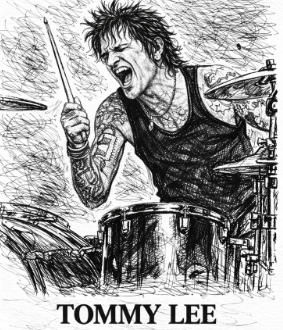
Context and formation (From the 1970s to the early 1980s)
During adolescence, Tommy Lee approached music in a landscape dominated by:
British and American hard rock,
classic heavy metal,
arena rock.
From the earliest years he developed an energetic, physical style, strongly influenced by visual impact and rhythmic power. He left the traditional school path early to dedicate himself fully to music, entering the Los Angeles rock scene.
The birth of Mötley Crüe and the rise (1981–1984)
In 1981 Tommy Lee founded Mötley Crüe together with Nikki Sixx, Mick Mars, and Vince Neil. The band quickly emerged on the Los Angeles circuit thanks to:
provocative image,
aggressive yet accessible sound,
strong stage charisma.
Lee contributed decisively to shaping the group’s identity, with a powerful, essential, groove-oriented drumming approach, capable of supporting direct, high-intensity songs.
The 1980s: global success and rock iconography (1985–1989)
During the mid and late 1980s, Mötley Crüe reached peak commercial success. In this period Tommy Lee became an iconic figure in mainstream rock.
Distinctive elements of his presence:
energetic, recognizable drumming style,
spectacular use of a rotating drum kit on stage,
strong media exposure,
extreme, transgressive image.
He helped consolidate the idea of the rock concert as a total event, where music, excess, and spectacle coexist.
Percussion style (discursive analysis)
Tommy Lee’s drumming language is characterized by:
powerful, direct hits,
simple but effective rhythmic structures,
attention to groove more than technical complexity,
strong integration with bass and guitar,
a physical, performative approach to the instrument.
His style prioritizes emotional impact and rhythmic drive, making it ideal for hard rock and mass-audience metal.
The 1990s: changes, experimentation, and side projects (1990–1999)
In the 1990s, within a changed musical landscape, Tommy Lee entered a phase of transformation. Alongside his activities with Mötley Crüe, he explored:
alternative and industrial sonorities,
electronic crossovers,
solo projects and collaborations.
This period shows an artist interested in challenging his own role, moving beyond the boundaries of classic hard rock.
Solo career and other projects (2000–2010)
In the new millennium, Tommy Lee pursued a parallel path as a solo artist and as a member of alternative projects. His work integrated:
industrial rock,
electronic elements,
rhythmic experimentation.
At the same time, he remained a central figure in pop culture, with an ongoing presence in media and in the international rock scene.
Mötley Crüe reunions and recent activity (2010–today)
From the 2010s onward, Tommy Lee took part in various Mötley Crüe reunions, returning steadily to large-scale live activity. In this phase he:
reaffirmed the band’s historic role,
maintained a coherent, recognizable drumming style,
continued to experiment in solo contexts as well.
Live performance remains the core of his artistic activity.
Concerts and stage dimension
Tommy Lee is known for turning the concert into a true visual performance. His live shows are characterized by:
a mobile, rotating drum kit,
direct engagement with the audience,
a strong theatrical component,
fusion between music and spectacle.
This approach influenced generations of rock and metal drummers.
Solo career
Studio albums
| Year | Album | Main tracks |
|---|---|---|
| 2002 | Never a Dull Moment | Hold Me Down · Tryin’ to Be Me |
| 2005 | Tommyland: The Ride | Good Times · Hello, Again |
| 2020 | Andro | Knock Me Down · Tops |
Side projects – Methods of Mayhem
(Rap metal / alternative metal project founded by Tommy Lee)
Studio albums
| Year | Album | Main tracks |
|---|---|---|
| 1999 | Methods of Mayhem | Get Naked · New Skin |
| 2003 | A Public Disservice Announcement | Stars · Only One |
Major participation with historic bands
Mötley Crüe
(Tommy Lee is a founding member and drummer)
Studio albums (complete selection of the period with Tommy Lee)
| Year | Album | Main tracks |
|---|---|---|
| 1981 | Too Fast for Love | Live Wire · Piece of Your Action |
| 1983 | Shout at the Devil | Shout at the Devil · Looks That Kill |
| 1985 | Theatre of Pain | Home Sweet Home · Smokin’ in the Boys Room |
| 1987 | Girls, Girls, Girls | Girls, Girls, Girls · Wild Side |
| 1989 | Dr. Feelgood | Dr. Feelgood · Kickstart My Heart |
| 1997 | Generation Swine | Afraid · Beauty |
| 2008 | Saints of Los Angeles | Saints of Los Angeles · Motherfucker of the Year |
(Note: Tommy Lee did not participate in the 1994 self-titled album nor in New Tattoo (2000).)
Key collaborations and appearances
| Year | Artist / Project | Track / Album |
|---|---|---|
| 1998 | Rob Zombie | Hellbilly Deluxe (percussion) |
| 2001 | Nine Inch Nails | Remixes and live performances |
| 2015 | Smashing Pumpkins | Live performances |
| 2021 | Post Malone | Live collaborations |
Compilations and multimedia projects
| Year | Project | Note |
|---|---|---|
| 2004 | The Dirt(soundtrack) | Contribution as songwriter |
| 2022 | Pam & Tommy(TV series) | Musical consultancy |
Final overview
Solo studio albums: 3
Albums with Methods of Mayhem: 2
Studio albums with Mötley Crüe (with Tommy Lee): 7
Years active: 1979–present

