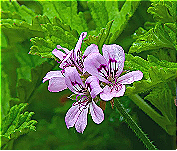
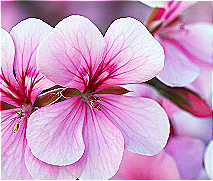
Rose geranium (Pelargonium roseum)
Rose geranium (Pelargonium roseum), commonly known as the rose-scented geranium, is a species of Pelargonium belonging to the Geraniaceae family. This plant is native to South Africa and is renowned for its fragrant, rose-scented leaves. It is commonly cultivated for its aromatic qualities and ornamental value.
Botanical classification
Plant characteristics
Pelargonium roseum is characterized by:
Size and shape: A compact, bushy perennial herb that typically grows to a height of 0.5 to 1 meter. It has a dense, rounded form.
Leaves: Rounded, deeply lobed, and covered with fine hairs that give them a velvety texture. They emit a distinctive rose-like fragrance when crushed.
Flowers: Small, often pink or pale mauve, appearing in clusters. They are less prominent than the leaves but add to the plant’s decorative appeal.
Fruit: A small capsule that splits open when mature to release seeds.
Soil and light: Prefers well-drained soils and thrives in full sun to partial shade. Well-suited to various garden conditions and can tolerate some drought.
Chemical composition and structure
The chemical composition of Pelargonium roseum includes:
Essential oils: Rich in geraniol, which contributes to its rose-like fragrance. Geraniol is also noted for potential antimicrobial and anti-inflammatory properties.
Phenolic compounds: Contribute to the aromatic profile and potential antioxidant effects.
Flavonoids: Present in the leaves, providing additional antioxidant benefits.
Uses and benefits
Aesthetic: Popular in ornamental gardens due to fragrant foliage and attractive appearance. Often used in decorative pots and as ground cover.
Cosmetic: Essential oil derived from Pelargonium roseum is used in perfumery and skincare products for its pleasant scent and potential skin benefits, including soothing and anti-inflammatory effects.
Medicinal: Traditionally used in herbal medicine for calming and aromatic properties. The essential oil may be used in aromatherapy for stress relief, although scientific evidence for some medicinal claims is limited.
Culinary: In some regions, the aromatic leaves are used to flavor dishes or in herbal teas.
Applications
Gardening: Ideal for garden beds, borders, and containers. Fragrant leaves and attractive flowers support ornamental use.
Cosmetics: Essential oil used in perfumes, lotions, and other skincare products for fragrance and potential therapeutic properties.
Medicinal: Employed in traditional remedies and aromatherapy for calming effects and pleasant aroma.
Culinary: Used to flavor or garnish dishes and beverages in some contexts.
Environmental and safety considerations
Environmental impact: Generally considered low impact when cultivated responsibly. Often grown in gardens and does not pose a significant risk to local ecosystems.
Safety: Generally safe for use. Essential oils should be used with caution as they may cause skin irritation in sensitive individuals. People allergic to plants or with very sensitive skin should be cautious.
References__________________________________________________________________________
Pirali-Kheirabadi K, Razzaghi-Abyaneh M, Halajian A. Acaricidal effect of Pelargonium roseum and Eucalyptus globulus essential oils against adult stage of Rhipicephalus (Boophilus) annulatus in vitro. Vet Parasitol. 2009 Jun 10;162(3-4):346-9. doi: 10.1016/j.vetpar.2009.03.015.
Abstract. In a laboratory trial, in west-central Iran, the acaricidal effects of the essential oils (EOs) prepared from two medicinal plants, i.e. Pelargonium roseum and Eucalyptus globulus on the adult stage of Rhipicephalus (Boophilus) annulatus were evaluated. For this purpose, the engorged females of R. (B) annulatus were exposed to two-fold serial dilutions of oils (0.31-5.0%) using a "dipping method" in vitro. The engorged ticks were immersed in different plant dilutions (eight per dilution) for 1min then each replicate was incubated in separate petri dishes at 26 degrees C and 80% relative humidity. The mortality rate for adult ticks exposed to different dilutions of P. roseum and E. globulus EO's showed a dose-dependent decrease. It was however significant only for the 2.5% and 5.0% dilutions of P. roseum EO, when compared to the non-treated control (P<0.05). The mass of produced eggs in adult female ticks exposed to both P. roseum and E. globulus EOs had decreased dose-dependently. It was significant for only 2.5% and 5.0% dilutions of P. roseum EO, comparing the non-treated control (P<0.05). The highest decrease in egg laying was reported for ticks treated with 5% dilutions of P. roseum (87.5%) and E. globosus (25%) (P<0.05). This is the first report that details the acaricidal activity of EO's obtained from P. roseum and E. globosus against R. (B) annulatus. The results show that both plants, particularly P. Roseum can be considered as potential candidates for biocontrol of R. (B) annulatus in the field.
Carmen G, Hancu G. Antimicrobial and Antifungal Activity of Pelargonium roseum Essential Oils. Adv Pharm Bull. 2014 Dec;4(Suppl 2):511-4. doi: 10.5681/apb.2014.075.
Abstract. Purpose: The antiseptic qualities of aromatic and medicinal plants and their extracts have been recognized since antiquity, while attempts to characterize these properties in the laboratory date back the beginning of the XX(th) century. In the current study essential oils obtained from Pelargonium roseum (Geraniacea) were analyzed for their antibacterial and antifungal activities. Methods: The antimicrobial activity of the Pelargonium essential oil was tested against Gram-negative bacteria (Pseudomonas aeruginosa, Proteus mirabilis, Escherichia coli), Gram-positive bacteria (Staphylococcus aureus, Enterococcus faecalis) and fungi (Candida albicans). Disc diffusion method was used to study antimicrobial activity. Results: Inhibition zones showed that the studied essential oils were active against all of the studied bacteria. In the case of Candida albicans, the complete inhibition of the fungus's development was observed. In the cases of Pseudomonas aeruginosa and Staphylococcus aureus we observed an inhibition comparable to that obtained by the use of an appropriate antimicrobial substance. Conclusion: The volatile oils exhibited considerable inhibitory effects against all the organisms under test, in some cases comparable with those of the reference antibiotics. There were no considerable differences between the antimicrobial activities of the oil obtained by distillation and commercially available Pelargonium oils.
Fan GW, Wang P, Liu YS, Sang YL, Liu N, Hao YJ. Insecticidal activity of two Pelargonium essential oils and head transcriptome analysis of stored-product pest Tribolium castaneum (Herbst) (Coleoptera: Tenebrionidae) in response to citronellyl formate fumigation. Pestic Biochem Physiol. 2025 Mar;208:106278. doi: 10.1016/j.pestbp.2024.106278.