



Rosa moschata seed oil: properties, uses, pros, cons, safety
General description
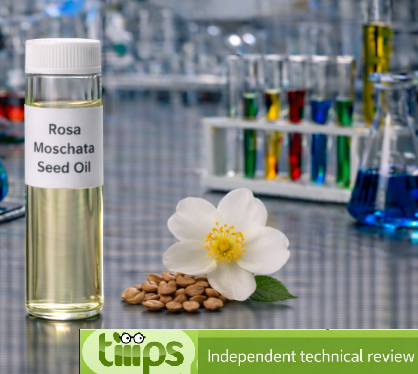
Rosa moschata seed oil, also known as rose musk seed oil, is obtained from the seeds of Rosa moschata, commonly referred to as musk rose. This vegetable oil is widely valued in the cosmetics and skin care industries for its nourishing, emollient, and regenerative properties.
It is particularly suitable for formulations intended to improve overall skin quality, support skin renewal, reduce the visible appearance of scars and wrinkles, and provide deep and long-lasting hydration.
Chemical composition and structure
Rosa moschata seed oil is characterized by a functional and rich lipid profile, composed of multiple bioactive compounds:
Essential fatty acids
In particular linoleic acid (omega-6) and alpha-linolenic acid (omega-3), which are key to maintaining barrier function, skin elasticity, and hydration.Vitamin E (tocopherols)
A potent antioxidant that helps protect the skin from oxidative stress and supports the integrity of skin lipids.Phenolic compounds
Including ellagic acid, providing antioxidant and soothing activity that can support the management of inflammatory processes.Squalene
A naturally derived emollient with affinity to skin lipids, supporting hydration, protection, and a soft skin feel.
From a structural perspective, these constituents include:
long hydrocarbon chains (fatty acids),
aromatic rings (phenolic compounds),
unsaturated cyclic structures (squalene),
all of which contribute to the oil’s cosmetic performance.
| Compound class | Examples | Main cosmetic role |
|---|---|---|
| Fatty acids | Linoleic, alpha-linolenic | Skin barrier, elasticity |
| Vitamin | Vitamin E | Antioxidant |
| Phenolics | Ellagic acid | Soothing, anti-aging support |
| Hydrocarbons | Squalene | Emollient, protective |
Physical properties
Appearance: light yellow to golden liquid, with variability depending on extraction method and degree of refining
Odor: delicate, slightly earthy and nutty, typical of rose seed oils
Solubility: soluble in oils and lipid-based solvents; insoluble in water
| Parameter | Description |
|---|---|
| Physical state | Liquid |
| Color | Light yellow–golden |
| Odor | Earthy, slightly nutty |
| Solubility | Lipid-soluble |
Production process
Production of Rosa moschata seed oil follows controlled steps designed to preserve functional constituents:
Harvesting
Seeds are collected from fully ripe fruits to ensure a high content of bioactive components.Extraction
The oil is primarily obtained by cold pressing, the preferred method to preserve the natural profile and lipid integrity. Solvent extraction may be used as an alternative.Purification
Filtration and, when needed, light refining to remove impurities and improve stability.Formulation
The purified oil is incorporated into creams, serums, facial oils, and other cosmetic products.
| Step | Objective |
|---|---|
| Harvesting | Maximize active content |
| Extraction | Preserve functional lipids |
| Purification | Improve quality and stability |
| Formulation | Cosmetic integration |
Applications
Cosmetics – skin care
Improves texture, elasticity, and radiance
Supports the reduction of the visible appearance of scars, wrinkles, and dehydration-related signs
Provides deep hydration and nourishment
Cosmetics – hair care
Can be used in hair products to enhance conditioning, shine, and support scalp comfort
INCI functions
Skin conditioning agent – emollient
Supports barrier restoration by supplying exogenous lipids that reduce transepidermal water loss (TEWL), improve hydration, and help protect against inflammatory phenomena.Skin conditioning agent
Improves skin tolerance to external stressors and supports comfort, acting synergistically with humectants and other emollients present in the formulation.
Environmental and safety considerations
Environmental impact
Production of Rosa moschata seed oil can have a favorable sustainability profile, provided that:
seeds are harvested responsibly
extraction processes are managed in an environmentally considerate manner
Safety
Rosa moschata seed oil is generally considered safe for use in cosmetics and personal care products at recommended concentrations.
Caution is advised for individuals with sensitivity or allergy to plants from the family Rosaceae.
Technical datasheet: https://materie-prime.farmalabor.it/schede/8190506.PDF

