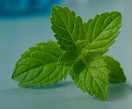
Menta verde
(Foglie e sommità di Mentha spicata)
Descrizione
La menta verde (Mentha spicata) è una pianta erbacea perenne appartenente alla famiglia delle Lamiaceae, caratterizzata da foglie lanceolate, colore verde brillante e profumo fresco, dolce e leggermente mentolato. È meno pungente della menta piperita e possiede un profilo aromatico dominato dal carvone, che le conferisce la tipica nota di menta dolce.
Le foglie vengono utilizzate fresche, essiccate o trasformate in estratti, oli essenziali e aromi naturali per applicazioni alimentari, farmaceutiche e cosmetiche.
Valori nutrizionali indicativi per 100 g
(foglia fresca)
Energia: 43–50 kcal
Proteine: 3–4 g
Carboidrati: 7–8 g
Lipidi: 0,6–1 g
Fibre: 3–8 g
Vitamine: vitamina C, vitamina A (beta-carotene), alcune vitamine del gruppo B
Minerali: calcio, ferro, potassio, manganese
L’uso alimentare tipico (1–5 g di foglie fresche, 0,1–1 g di essiccato) fornisce un contributo nutrizionale molto modesto.
Principali sostanze contenute
Carvone (molecola aromatica principale)
Limonene e altri monoterpeni
Flavonoidi (luteolina, apigenina, derivati glicosidici)
Acidi fenolici (acido rosmarinico, caffeico)
Clorofille e pigmenti naturali
Composti volatili caratteristici dell’olio essenziale
Fibre, carboidrati complessi e piccole quantità di proteine
Processo di produzione
(foglie essiccate e prodotti a base di menta verde)
Coltivazione in pieno campo o coltura protetta.
Raccolta allo stadio di massima aromaticità.
Selezione e pulizia: rimozione di steli e corpi estranei.
Essiccazione controllata (aria calda, bassa temperatura) per preservare oli essenziali.
Cernita e taglio delle foglie essiccate.
Macinazione eventuale per ottenere menta tritata o polveri.
Per estratti:
estrazione in acqua, etanolo o solventi alimentari;
filtrazione e concentrazione;
incapsulazione (per aromi in polvere).
Confezionamento in sacchi o contenitori schermati da luce e umidità.
Controlli di qualità secondo GMP/HACCP.
Proprietà fisiche
Aspetto: foglie intere o frammentate, verdi o verde-oliva.
Odore: fresco, dolce, erbaceo, leggermente mentolato.
Sapore: rinfrescante, aromatico, dolce, meno pungente della menta piperita.
Umidità (essiccata): 8–12%
Solubilità: i composti aromatici sono estratti da acqua calda, alcool o oli.
Proprietà sensoriali e tecnologiche
Conferisce una nota dolce, fresca e pulita ai cibi.
Persistenza aromatica elevata, con minore aggressività rispetto alla peppermint.
Le foglie fresche rilasciano aromi più delicati; l’essiccato è più concentrato.
Gli estratti permettono una standardizzazione del profilo aromatico.
La menta verde può mitigare retrogusti metallici o amari in prodotti funzionali.
Impieghi alimentari
Bevande: tisane, tè alla menta, tè freddo, acque aromatizzate, limonate, energy drink.
Dolci e dessert: caramelle, gomme da masticare, cioccolato, gelati, sorbetti, mousse.
Piatti salati: insalate fresche, cous cous, tabbouleh, carni bianche, salse fredde (yogurt, kefir).
Prodotti da forno: biscotti, torte, dolci aromatizzati (via estratti o polveri).
Prodotti lattiero-caseari: yogurt, dessert, gelati.
Integratori e prodotti funzionali: barrette, polveri solubili, sciroppi, spray orali.
Nutrizione e salute
La menta verde non apporta nutrienti significativi alle dosi d’uso, ma contiene molecole aromatiche e fenoliche con potenziali effetti antiossidanti.
La tradizione erboristica associa la menta verde a:
Questi effetti rientrano nel campo erboristico e non possono essere indicati come claim sugli alimenti senza autorizzazioni specifiche.
Generalmente ben tollerata ai normali consumi.
Nota porzione
Foglie fresche: 1–5 g per porzione.
Essiccato/polvere: 0,1–1 g.
Estratti/aromi: 0,01–0,3% nel prodotto finito.
Allergeni e intolleranze
La menta verde non è un allergene maggiore.
Possibili rare sensibilità agli oli essenziali in soggetti sensibili.
Naturalmente priva di glutine e lattosio.
Verificare eventuali allergeni presenti nei carrier di estratti o aromi.
Conservazione e shelf-life
Fresco: in frigorifero, 3–7 giorni.
Essiccato: al riparo da luce, umidità e calore; shelf-life 12–24 mesi.
Estratti/aromi:
liquidi: 12–24 mesi;
incapsulati: 18–36 mesi.
Principali rischi: ossidazione, perdita di aroma, assorbimento di umidità.
Sicurezza e regolatorio
Considerata sicura secondo le normative alimentari europee e internazionali.
Soggetta a controlli su:
Produzione conforme a GMP/HACCP.
Gli oli essenziali devono rispettare eventuali limiti d’uso stabiliti per aromi.
Etichettatura
Troubleshooting
Aroma troppo debole: foglie vecchie o estratto degradato → aumentare dosa o usare prodotto più fresco.
Note erbacee troppo marcate: eccesso di essiccato → bilanciare con zucchero o agrumi.
Perdita di colore: degrado ossidativo → conservare in assenza di luce.
Instabilità in bevande acide: preferire forme solubili/emulsionate.
Sostenibilità e filiera
La menta è una coltura a basso impatto se gestita correttamente:
I processi di estrazione e distillazione generano reflui che devono essere gestiti secondo indicatori ambientali come BOD/COD.
Disponibili linee biologiche e filiere fair trade.
Principali funzioni INCI (cosmesi)
(come “Mentha Viridis (Spearmint) Leaf Extract”, “Mentha Viridis Leaf Oil”)
Fragrance (nota fresca, dolce, erbacea)
Rinfrescante e tonificante
Utilizzata in prodotti per: dentifrici, collutori, deodoranti, shampoo, shower gel, creme corpo.
Funzioni INCI:
Fragranza. Ha un ruolo decisamente importante nella formulazione di prodotti cosmetici in quanto fornisce la possibilità di migliorare, mascherare o aggiungere profumo al prodotto finale aumentandone la commerciabilità. E' in grado di creare un odore gradevole percepibile, mascherare un cattivo odore. Il consumatore si aspetta sempre di trovare un profumo gradevole o particolare in un prodotto cosmetico.
Profumo. A differenza della fragranza che può contenere anche odori leggermente meno gradevoli o caratteristici, la dizione profumo indica soltanto le profumazioni molto gradevoli. Utilizzato per profumi e materie prime aromatiche.
Conclusione
La menta verde è un ingrediente aromatico versatile, sicuro e molto apprezzato per il suo profilo fresco, dolce e erbaceo, ideale in bevande, dolci, prodotti lattiero-caseari, piatti freddi e prodotti funzionali. Una filiera controllata, standardizzazione dell’aroma e corretta conservazione garantiscono un ingrediente stabile, sicuro e di alta qualità, adatto sia all’industria sia all’uso domestico.
Mini-glossario
SFA – Saturated Fatty Acids (acidi grassi saturi): grassi da limitare se consumati in eccesso; presenti in quantità minime nella menta verde.
MUFA – acidi grassi monoinsaturi: presenti in piccole quantità.
PUFA – acidi grassi polinsaturi: più sensibili all’ossidazione, presenti in tracce.
TFA – acidi grassi trans: non presenti naturalmente nella menta.
GMP/HACCP – Sistemi di gestione qualità e sicurezza per la produzione alimentare.
BOD/COD – Indicatori del carico inquinante delle acque reflue.
Carvone – Monoterpene aromatico principale responsabile dell’aroma caratteristico della menta verde.
Bibliografia__________________________________________________________________________
Peshkova A, Zinicovscaia I, Cepoi L, Rudi L, Chiriac T, Yushin N, Anh TT, Manh Dung H, Corcimaru S. Effects of Gold Nanoparticles on Mentha spicata L., Soil Microbiota, and Human Health Risks: Impact of Exposure Routes. Nanomaterials (Basel). 2024 May 29;14(11):955. doi: 10.3390/nano14110955.
Abstract. Nanoparticles, due to their extensive production and application, can have significant consequences for the environment, including soil and plant pollution. Therefore, it is very important to assess how nanoparticles will affect plants depending on the exposure pathways. The effect of gold nanoparticles in a concentration range of 1-100 mg/L on Mentha spicata L. during a 28-day experiment was investigated. Two routes of nanoparticles exposure were applied: root and foliar. Transmission electron microscopy was used to characterize nanoparticles and their effect on plant leaves' ultrastructure. Gold content in soil and plant segments was determined using k0-neutron activation analysis. For root exposure, gold was mainly accumulated in soil (15.2-1769 mg/kg) followed by root systems (2.99-454 mg/kg). The maximum accumulation of gold in leaves (5.49 mg/kg) was attained at a nanoparticle concentration of 100 mg/L. Foliar exposure resulted in the maximum uptake of gold in leaves (552 mg/kg) and stems (18.4 mg/kg) at the highest applied nanoparticle concentration. The effect of nanoparticles on the Mentha spicata L. leaves' biochemical composition was assessed. Nanoparticles affected the content of chlorophyll and carotenoids and led to an increase in antioxidant activity. Root exposure to gold nanoparticles resulted in an increase in the number of starch grains in chloroplasts and also suppressed the activity of the soil microbiota. Gold extraction from mint leaves into herbal infusion varied from 2 to 90% depending on the concentration of nanoparticles in the solution and the exposure route. The health risk as a result of gold exposure via herbal tea intake was assessed through estimated daily intake. The hazard quotient values were found to be less than the cutoff, indicating that a cup of tea infusion should not cause a serious impact to human health.
Han L, Gao Y, Guo Y, Ma H, Jian X. Study on Antioxidant Activity of Spearmint Essential Oil and Pure Dew. Stud Health Technol Inform. 2023 Nov 23;308:55-61. doi: 10.3233/SHTI230824.
Abstract. Spearmint essential oil and pure dew were used as research objects, the antioxidant capacity of spearmint was evaluated by measuring the scavenging capacity of superoxide anion radical and hydroxyl radical, providing technical support for the subsequent development and utilization of spearmint truffle and essential oil. The results showed that when the volume fraction (V/V) of spearmint essential oil was 1%, its antioxidant capacity was the strongest, and its scavenging rates of superoxide anion radical and hydroxyl radical were 50.94% and 90.11% respectively; When the volume fraction (V/V) of spearmint hydrosol was 100%, its antioxidant capacity was the strongest, and its scavenging rates of superoxide anion radical and hydroxyl radical were 47.65% and 45.60%.
Zhang LL, Chen Y, Li ZJ, Li X, Fan G. Bioactive properties of the aromatic molecules of spearmint (Mentha spicata L.) essential oil: a review. Food Funct. 2022 Mar 21;13(6):3110-3132. doi: 10.1039/d1fo04080d.
Abstract. Spearmint belongs to the genus Mentha in the family Labiatae (Lamiaceae), which is cultivated worldwide for its remarkable aroma and commercial value. The aromatic molecules of spearmint essential oil, including carvone, carveol, dihydrocarvone, dihydrocarveol and dihydrocarvyl acetate, have been widely used in the flavors and fragrances industry. Besides their traditional use, these aromatic molecules have attracted great interest in other application fields (e.g., medicine, agriculture, food, and beverages) especially due to their antimicrobial, antioxidant, insecticidal, antitumor, anti-inflammatory and antidiabetic activities. This review presents the sources, properties, synthesis and application of spearmint aromatic molecules. Furthermore, this review focuses on the biological properties so far described for these compounds, their therapeutic effect on some diseases, and future directions of research. This review will, therefore, contribute to the rational and economic exploration of spearmint aromatic molecules as natural and safe alternative therapeutics.
Zheljazkov VD, Cantrell CL, Astatkie T, Hristov A. Yield, content, and composition of peppermint and spearmints as a function of harvesting time and drying. J Agric Food Chem. 2010 Nov 10;58(21):11400-7. doi: 10.1021/jf1022077.
Abstract. Peppermint ( Mentha × piperita L.) and spearmints ('Scotch' spearmint, M. × gracilis Sole, and 'Native' spearmint, Mentha spicata L.) are widely grown essential oil crops in more northern latitudes; however, there is limited information on how harvest time and drying influence peppermint and spearmint yield, oil composition, and bioactivity, when grown south of the 41st parallel. In this 2-year study, the effects of harvest time and drying on the yield, oil composition, and bioactivity of peppermint ('Black Mitcham' and 'B90-9'), 'Scotch' spearmint, and 'Native' spearmint were evaluated. Peppermint oil from the dried material had higher menthol and eucalyptol concentrations. Menthone in both peppermint cultivars decreased from harvest 1 (late June) to harvest 5 (late August) or 6 (early September), whereas menthol increased. (-)-Carvone in spearmints accumulated early, before flowering, allowing for early harvest. Oil yields from the dried spearmint biomass reached the maximum at harvest 3 (mid-July). The essential oil compositions of the four mint genotypes were similar to that of 11 commercially available oils, suggesting that these genotypes can be grown in the hot, humid environment of the southeastern United States. The antioxidant activities (ORAC(oil) values) of the essential oils were 4372, 1713, 1107, and 471 μmol of TE L(-1) for 'Scotch' spearmint, 'Native' spearmint, peppermint, and Japanese cornmint ( Mentha canadensis ), respectively. The oils of the four mint genotypes did not affect ruminal fermentation in vivo, and did not exhibit antimicrobial, antileishmanial, or antimalarial activity at levels that would warrant bioassay-directed fractionation in a drug-discovery screening program. Specifically, the oils did not show greater than 50% growth inhibition against Leishmania donovani , Plasmodium falciparum clones D6 and W2, Candida albicans , Escherichia coli , Pseudomonas aeruginosa , Cryptococcus neoformans , Mycobacterium intracellulare , or Aspergillus fumigates at 50 μg mL(-1).
Piras A, Porcedda S, Falconieri D, Maxia A, Gonçalves M, Cavaleiro C, Salgueiro L. Antifungal activity of essential oil from Mentha spicata L. and Mentha pulegium L. growing wild in Sardinia island (Italy). Nat Prod Res. 2021 Mar;35(6):993-999. doi: 10.1080/14786419.2019.1610755.
Abstract. This study aims to evaluate the antifungal activity of Mentha spicata L. and Mentha pulegium L. from Sardinia and to assess their efficacy on virulence factors for Candida albicans, particularly on the inhibition of the germ tube formation. The major compounds of the essential oils were carvone (62.9%) for M. spicata and pulegone (86.2%) for M. pulegium. The essential oil from M. spicata showed a more preeminent effect against Cryptococcus neoformans and the dermatophytes Trichophyton rubrum and T. verrucosum (0.32 μL/mL). Both oils were very effective in inhibiting C. albicans germ tube formation, at doses well below their MIC (0.16 μL/mL).
Mkaddem M, Bouajila J, Ennajar M, Lebrihi A, Mathieu F, Romdhane M. Chemical composition and antimicrobial and antioxidant activities of Mentha (longifolia L. and viridis) essential oils. J Food Sci. 2009 Sep;74(7):M358-63. doi: 10.1111/j.1750-3841.2009.01272.x.
Abstract. The study was aimed to investigate essential oil chemical composition (gas chromatography/flame ionization detection [GC-FID] and gas chromatography/mass spectrometry [GC-MS]) and antioxidant (1,1-diphenyl-2-picrylhydrazyl free radical (DPPH) and 2,2'-azinobis-3-ethylbenzothiazoline-6-sulphonate [ABTS] assays) and antimicrobial (Gram-positive and Gram-negative bacteria, fungi, and yeast) activities of essential oils extracted from leaves of Mentha longifolia L. and Mentha viridis. GC-MS analysis revealed that M. longifolia was constituted by pulegone (54.41%) as a major component followed by isomenthone (12.02%), 1,8-cineole (7.41%), borneol (6.85%), and piperitenone oxide (3.19%). M. viridis was rich in carvone (50.47%), 1,8-cineole (9.14%), and limonene (4.87%). The antioxidant activity by ABTS assay showed IC(50) values of 476.3 +/- 11.7 and 195.1 +/- 4.2 mg/L for M. longifolia and M. viridis, respectively, the DPPH assays have resulted in a moderate IC(50) (>8000 mg/L and 3476.3 +/- 133 mg/L for M. longifolia and M. viridis, respectively). Antimicrobial activity showed that Listeria monocytogenes and Klebsiella pneumoniae bacteria were more inhibited by the 2 essential oils tested. Escherichia coli was least susceptible. A strong activity was also observed on fungi and yeasts. Carvone, thymol, and piperitone oxide have not been detected in Tunisian M. longifolia. Camphor is reported for the 1st time for M. viridis. Antioxidant and antibacterial activities were correlated to chemical composition.




