



Syringa vulgaris meristem cell culture: properties, uses, pros, cons, safety
Syringa vulgaris meristem cell culture is a cosmetic raw material obtained from cultured meristematic cells of Syringa vulgaris (common lilac, family Oleaceae). It is a “biotech” ingredient designed to provide a more repeatable profile than conventional botanical extracts, reducing dependence on seasonality and agronomic variability. In formulation it is mainly used to support antioxidant and skin protective functions in leave-on products (serums, creams, lotions, masks) and, at times, in targeted treatments.
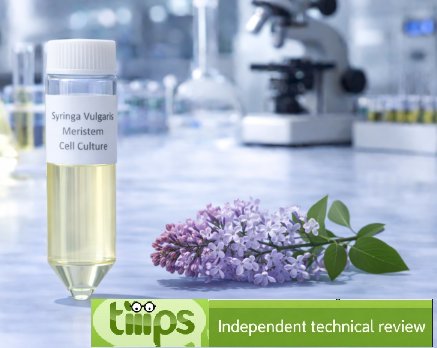
Definition
It is not a single molecule: it is a suspension (or an extract/filtrate, depending on the commercial grade) derived from in vitro culture of meristematic cells of Syringa vulgaris. The term “meristem cell culture” identifies the type of preparation (cell culture) rather than a fixed composition: the chemical profile depends on the culture medium, growth conditions, extraction approach, and the supplier’s standardization strategy.
Main uses
Food.
Not relevant.
Cosmetics.
Typical use in formulas aiming at antioxidant support, protection from environmental stressors, and improvement of overall skin appearance. It may be included in anti-aging routines and “urban defense” products, where the practical objective is to support cosmetic film quality and product comfort over time.
Medicine.
Not a drug. Any evidence on plant components or lilac extracts should not be transferred into claims without finished-product data.
Pharmaceutical.
Possible use in dermocosmetic contexts or high-quality-control formulations, subject to specifications and dossier requirements.
Industrial use.
Biotechnological raw material for cosmetic lines requiring batch-to-batch consistency and process traceability.
Key constituents
In a meristem-cell-culture ingredient, the content can be attributed to chemical classes typical of the plant and cellular metabolome, with variable levels and often standardized against selected markers:
Phenolic compounds. Possible presence of phenolic acids (e.g., syringic acid, caffeic acid), relevant for antioxidant contribution.
Flavonoids. Possible presence of flavonoids (e.g., quercetin, kaempferol) associated with antioxidant profiles and support to skin comfort.
Aromatic components. Trace odor molecules may be present, but the olfactory profile depends on the grade and carrier.
Saponins and polar fractions. Generally at lower levels, with a potential “conditioning” contribution in delicate formulas.
Technical note. Mentioning individual compounds is representative: robust evaluation requires supplier specifications (markers, ranges, analytical method).
Identification data and specifications
| Characteristic | Value |
|---|---|
| INCI name | Syringa vulgaris meristem cell culture |
| Short description | suspension of cultured meristematic cells of Syringa vulgaris |
| CAS number | 90063-50-6 |
| EC number (EINECS/ELINCS) | 290-008-2 |
| Origin | biotechnological (plant cell culture) |
| Molecular formula | not applicable (mixture) |
| Molecular weight | not applicable (mixture) |
Physico-chemical properties (indicative)
| Characteristic | Indicative value | Note |
|---|---|---|
| Appearance | clear liquid → pale yellow | depends on filtration and carrier |
| Odor | mild, sometimes floral | grade-dependent |
| Solubility | typically in water and/or hydroalcoholic blends | depends on carrier |
| pH | neutral → slightly acidic | depends on standardization |
| Stability | sensitive to light/temperature/contamination | requires suitable packaging and preservation |
Functional role and mechanism of action (practical)
Antioxidant support.
Phenolic and flavonoid fractions can contribute to limiting superficial oxidative stress, synergizing with primary antioxidants in the formula.
Skin protection.
The ingredient is used to support “barrier” function in a cosmetic sense, i.e., to improve perceived skin resilience against external stressors, with effects depending on the formulation system (emollients, humectants, film formers, and preservation).
Repeatability and quality.
The operational advantage of cell culture is the potential for a more consistent and controllable profile versus extensive-harvest extracts, provided the supplier applies robust quality control and standardization.
Production process
Culture start-up.
Selection of meristem tissue and initiation under sterile conditions on a controlled nutrient medium.
Growth and accumulation.
Cultivation in a bioreactor or equivalent systems with control of critical parameters (nutrients, oxygenation, temperature, time), aimed at reproducibility of the metabolic profile.
Harvest and separation.
Collection of cell biomass and separation of the liquid fraction, depending on the final ingredient type (suspension, filtrate, extract).
Extraction and purification.
Extraction with cosmetically suitable solvents (water and/or ethanol, depending on grade), followed by filtration to remove cell residues and stabilize appearance.
Standardization and carrier formulation.
Alignment of each batch to specifications (selected markers, turbidity, color, microbiological parameters) and preparation in an appropriate carrier for cosmetic use.
INCI functions
Antioxidant agent. Ingredient that counteracts oxidative stress and prevents cellular damage. Free radicals, pathological inflammatory processes, reactive nitrogen species and reactive oxygen species are responsible for the aging process and many diseases caused by oxidation.
Skin protectant. Creates a protective barrier on the skin to defend it from harmful substances, irritants, allergens, pathogens that can cause various inflammatory conditions. These products can also improve the natural skin barrier and, in most cases, more than one is needed to achieve an effective result.
CAS: 90063-50-6 EC number 290-008-2
Safety, regulation, and environment
Safety.
Generally considered suitable for cosmetic use at normal concentrations, with assessment to be performed on the finished product (pH, preservatives, fragrance, compatibility with potentially irritating actives).
Allergen.
Not typically classified as an allergen. As with many botanical/biotech ingredients, individual reactions are possible, especially on very reactive skin or in complex formulas.
Environment.
Cell culture can reduce pressure on extensive harvesting; real impact depends on the manufacturing plant, solvent/energy consumption, and life-cycle management.
Formulation troubleshooting
Haze or visual instability.
Action: optimize filtration/clarification of the grade, verify compatibility with electrolytes, polymers, and surfactants; control pH.
Loss of perceived efficacy.
Action: verify standardization (markers) and dosage; evaluate synergy with primary antioxidants and packaging (light/oxygen).
Microbiological issues.
Action: validate preservation and challenge testing, incoming microbiological controls and process hygiene, choose more protective packaging.
Conclusion
Syringa vulgaris meristem cell culture is a biotechnology ingredient based on meristematic cell culture, used in cosmetics to support antioxidant and skin protective functions. Practical value depends primarily on supplier quality, standardization, stability, and compatibility with the formulation and preservation system.
Mini-glossary
Meristematic cells. Plant tissues with high proliferative capacity used to initiate cell cultures. Benefit: foundation for repeatable, controlled processes.
Standardization. Batch alignment to defined markers and analytical ranges. Benefit: reduces variability and improves repeatability in formulation.
Carrier. The vehicle in which the ingredient is supplied (water, hydroalcoholic, glycols, etc.). Benefit: determines compatibility and use method.
Marker. Reference compounds used to control quality and consistency. Benefit: enables objective batch-profile control.

