



Soybean Oil Polyglyceryl-6 Esters: properties, uses, and INCI functions
Soybean Oil Polyglyceryl-6 Esters are a compound obtained via transesterification of Glycine max (soybean) oil with Polyglyceryl-6. It is used in cosmetics, personal care, and, in certain formulations, also in the pharmaceutical field, mainly for its emulsifying, moisturizing, and conditioning performance.
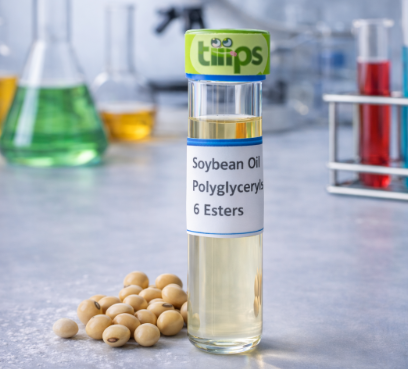
Chemical composition and structure
Soybean Oil Polyglyceryl-6 Esters derive from the esterification of fatty acids present in soybean oil with Polyglyceryl-6.
The final structure includes multiple ester bonds.
The combination of the lipid fraction (soybean oil) and polyglycerol contributes to:
formulation stability,
effective emulsifying functionality,
support of the finished product’s sensory profile.
Physical properties
Under typical conditions, Soybean Oil Polyglyceryl-6 Esters appears as:
A liquid ranging from clear to slightly yellow
A delicate odor
Solubility: soluble in oils and organic solvents, and generally dispersible in water
From a formulation standpoint, the structure enables it to act as:
An effective emulsifier
A moisturizing agent
A conditioning agent
A contributor to improved texture and stability in emulsions and complex systems
Production process
The production process can be summarized in four main steps:
Soybean oil extraction
From Glycine max seeds using cold pressing or solvent extraction methods.
Transesterification with Polyglyceryl-6
Reaction in the presence of a catalyst to obtain the target esters.
Purification
Removal of unreacted materials and by-products, with the aim of ensuring quality and batch-to-batch consistency.
Quality control
Testing for purity, stability, and composition, including chemical and microbiological analyses.
Applications
Cosmetic products
Used in creams, lotions, and emulsions
Improves stability, spreadability, and skin feel
Skin care
Suitable for products focused on:
hydration
support of the skin barrier
reduction of water loss
Hair care
Included in shampoos, conditioners, and styling products
Contributes to conditioning, softness, and improved manageability
Pharmaceutical products
Used as a formulation component with solubilizing and stabilizing roles, supporting the delivery and stability of active ingredients (depending on the formulation system)
Personal care products
Used in shower gels, soaps, and other cleansing products for:
emulsifying support
a conditioning effect and improved comfort on the skin
Environmental and safety considerations
Soybean Oil Polyglyceryl-6 Esters are generally considered safe for use in cosmetic, pharmaceutical, and personal care products. Use within recommended concentrations remains essential to ensure safety and performance.
Relevant environmental aspects:
Preferable sourcing from traceable and responsible supply chains
Adoption of production approaches aimed at reducing environmental impact (depending on manufacturer policies and industrial context)
INCI functions
Skin conditioning agent – emollient
Emollients improve the skin barrier by providing exogenous lipids that adhere to the skin, helping to:
reduce transepidermal water loss
improve hydration
support protection against dryness-related irritation
In practice, they can create a “barrier” effect that limits water evaporation. In cosmetics, emollients and moisturizers are often treated as closely related, even when humectants and occlusives are present.
Skin conditioning agent
Its role is to restore, increase, or improve skin tolerance to external factors. A key objective is preventing dehydration; the overall mechanism may involve emollient and humectant components included in the formulation.
Surfactant – emulsifying agent
Emulsions are thermodynamically unstable systems and require specific ingredients to stabilize them. An emulsifying agent:
forms an interfacial film
lowers surface tension
helps make two immiscible liquids compatible
The amount of emulsifier is a critical factor for emulsion stability and can influence sensory properties and the system’s surface/interfacial behavior.
Surfactant – cleansing agent
In cleansing products, surfactant action reduces surface tension, facilitating the removal of dirt and impurities from the skin surface.

