



Argan Oil Polyglyceryl-6 Esters: properties, uses, pros, cons, safety
Argan Oil Polyglyceryl-6 Esters is a cosmetic ingredient obtained via transesterification between argan oil (from Argania spinosa) and polyglyceryl-6. It is designed to provide a more amphiphilic profile than the starting oil, making it useful as an emollient and as emulsifying/cleansing support in skin-care and hair-care systems, particularly where an “oil-like” sensorial profile is desired with improved integration into aqueous phases.
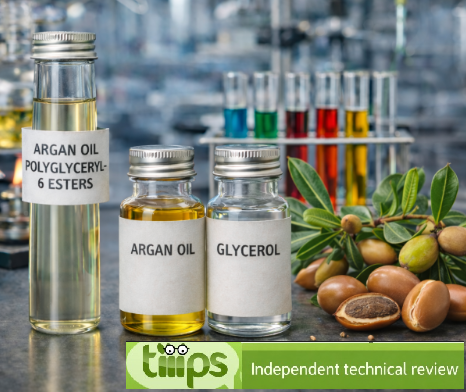
Synonyms: esters of argan oil and polyglyceryl-6 (descriptive); Argan Oil Polyglyceryl6 Esters (graphic variant).
For more information: Argan oil
Definition
Argan Oil Polyglyceryl-6 Esters is a mixture of esters obtained by “breaking” and reforming ester bonds of a vegetable oil with a polyglycerol component. In practice, the ingredient behaves as a bridge between the lipid and aqueous domains: it retains an emollient contribution typical of lipids, while introducing more polar groups that promote dispersion, wettability, and, depending on the surfactant system, support for emulsion formation and stabilization.
It is not a single substance with a unique molecular formula: it is a mixture whose functional output depends on grade, reaction ratio, argan-oil profile, and supplier specifications.
Chemical Composition and Structure
Argan Oil Polyglyceryl-6 Esters is composed of Polyglyceryl-6, which is a polymer of glycerol containing six glycerol units, esterified with the fatty acids derived from argan oil. The resulting structure includes multiple ester bonds, creating a stable and highly functional compound.
Physical Properties
Argan Oil Polyglyceryl-6 Esters typically appears as a clear to slightly yellow liquid or semi-solid, depending on the specific composition and processing methods used. It has a mild, neutral aroma and is soluble in oils and organic solvents but has limited solubility in water. The compound's structure allows it to act as an effective emulsifier, moisturizer, and conditioner, enhancing the texture and stability of cosmetic formulations.
Production Process
Synthesis of Polyglyceryl-6: Glycerol is polymerized to produce Polyglyceryl-6, a polymer containing six glycerol units.
Transesterification with Argan Oil: Polyglyceryl-6 is transesterified with argan oil to form Argan Oil Polyglyceryl-6 Esters. This reaction typically occurs in the presence of a catalyst to facilitate the formation of ester bonds.
Purification: The resulting Argan Oil Polyglyceryl-6 Esters is purified to remove any unreacted materials and by-products, ensuring a high-quality final product.
Quality Control: Rigorous quality tests are conducted to evaluate the purity, stability, and composition of the esters, including chemical and microbiological analyses.
Applications
Cosmetic Products: Used in creams, lotions, and emulsions for its emulsifying and moisturizing properties, enhancing the texture and stability of the formulations.
Skin Care: Ideal for products aimed at providing moisturizing and protective benefits due to its ability to improve skin barrier function and reduce water loss.
Hair Care: Incorporated into shampoos, conditioners, and styling products for its ability to condition and moisturize the hair.
Pharmaceutical Products: Utilized in various formulations for its solubilizing and stabilizing properties, enhancing the delivery and stability of active ingredients.
Personal Care Products: Used in body washes, soaps, and other personal care items for its emulsifying and moisturizing effects.
INCI Functions
Skin conditioning agent - Emollient. Emollients have the characteristic of enhancing the skin barrier through a source of exogenous lipids that adhere to the skin, improving barrier properties by filling gaps in intercorneocyte clusters to improve hydration while protecting against inflammation. In practice, they have the ability to create a barrier that prevents transepidermal water loss. Emollients are described as degreasing or refreshing additives that improve the lipid content of the upper layers of the skin by preventing degreasing and drying of the skin. The problem with emollients is that many have a strong lipophilic character and are identified as occlusive ingredients; they are oily and fatty materials that remain on the skin surface and reduce transepidermal water loss. In cosmetics, emollients and moisturisers are often considered synonymous with humectants and occlusives.
Surfactant - Emulsifying agent. Emulsions are thermodynamically unstable and are used to soothe or soften the skin and emulsify, so they need a specific, stabilising ingredient. This ingredient forms a film, lowers the surface tension and makes two immiscible liquids miscible. A very important factor affecting the stability of the emulsion is the amount of the emulsifying agent. Emulsifiers have the property of reducing the oil/water or water/oil interfacial tension, improving the stability of the emulsion and also directly influencing the stability, sensory properties and surface tension of sunscreens by modulating the filmometric performance.
Skin conditioning agent. It is the mainstay of topical skin treatment as it has the function of restoring, increasing or improving skin tolerance to external factors, including melanocyte tolerance. The most important function of the conditioning agent is to prevent skin dehydration, but the subject is rather complex and involves emollients and humectants that can be added in the formulation.
Surfactant - Cleansing agent. Cosmetic products used to cleanse the skin utilise the surface-active action that produces a lowering of the surface tension of the stratum corneum, facilitating the removal of dirt and impurities.
Environmental and Safety Considerations
Argan Oil Polyglyceryl-6 Esters is generally considered safe for use in cosmetic, pharmaceutical, and personal care products. It is non-irritating and suitable for all skin types. Proper use within recommended concentrations is essential to ensure safety and maximize effectiveness. Efforts to source raw materials sustainably and to use environmentally friendly production methods are important to mitigate any potential environmental impact.
Identification data and specifications
| Characteristic | Value |
|---|---|
| INCI name | Argan Oil Polyglyceryl-6 Esters |
| common name | esters of argan oil and polyglyceryl-6 |
| reference plant | Argania spinosa |
| botanical family | Sapotaceae |
| origin (typical) | vegetable-derived / synthesis from vegetable raw materials |
| CAS number | not always publicly available for this INCI entry (mixture) |
| EC/EINECS number | not always assigned or publicly reported (mixture) |
| CosIng reference | present in cosmetic inventories; some directories report a CosIng Ref No |
| molecular formula | not applicable (ester mixture) |
| molecular weight | not applicable as a single value (mixture; range depends on composition) |
| energy value (practical note) | not applicable in cosmetics; not a labeling parameter for topical use |
Physico-chemical properties (indicative)
| Characteristic | Value | Note |
|---|---|---|
| chemical nature | mixture of polyglyceryl fatty-acid esters | derived from argan oil and polyglyceryl-6 |
| appearance (typical) | viscous liquid or semi-liquid | depends on grade and temperature |
| water solubility | limited / dispersible | improves with co-surfactants or solubilizers |
| oil solubility | good | behaves as an emollient/ester |
| interfacial role | pronounced (amphiphilic) | useful in O/W, W/O, and cleansing systems |
| oxidative stability | dependent on the lipid fraction | may require antioxidant strategy and suitable packaging |
Functional role and practical mechanism of action
In formulas, Argan Oil Polyglyceryl-6 Esters combines an emollient contribution with the ability to reduce interfacial tension between water and oil, facilitating formation of more stable dispersed structures. In cleansers it can support removal of soil/sebum with improved post-rinse feel; in leave-on products it can improve slip and oil-phase uniformity, contributing to a silkier texture and a “less greasy” feel versus neat vegetable oil.
Formulation compatibility
It is generally compatible with emulsions and cleansing systems, but performance depends on overall system balance. In O/W it can reduce greasy feel and improve wettability; in cleansing oils it can support the oil-to-milk effect when properly paired with co-surfactants. The most common watchpoints are viscosity management (sensitive to polymers and salinity) and sensorial stability linked to oxidation of the lipid portion.
Use guidelines (indicative)
Use level is driven by the goal: emollient/texture booster or emulsifying/cleansing support. Operationally it is useful to define a performance target (stability, viscosity, feel, cleansing) and optimize the ratio with co-emulsifiers, surfactants, and thickeners. For formulas sensitive to odor or rancidity, it is advisable to use grades with tight specifications and confirm accelerated stability in real packaging.
Quality, grades, and specifications
Parameters that most often determine perceived quality and repeatability include: organoleptic profile (odor/color), oxidation index (e.g., peroxides, when declared), content of unreacted fractions (traces of free oil or free polyglyceryl), and microbiological specifications when supplied in blends with water or hydrophilic solvents.
Safety, regulatory, and environment
In cosmetics, practical safety depends on the finished product and raw-material quality. Risk management focuses on impurity control, oxidative stability (to limit degradation products that may worsen tolerability and odor), and batch-to-batch specification consistency. From a regulatory standpoint, the ingredient is present in cosmetic inventories and is used according to finished-product safety assessment and applicable labeling requirements.
Formulation troubleshooting
Emulsion instability (separation or viscosity drop).
Typical cause: non-optimal emulsifier balance or interaction with polymers/electrolytes. Action: retune co-emulsifiers, thickeners, and order of addition.
“Aged” odor over time.
Typical cause: oxidation of the lipid fraction. Action: tighter specs, compatible antioxidants, barrier packaging, and reduced headspace.
Conclusion
Argan Oil Polyglyceryl-6 Esters is a multifunctional ingredient combining emollience with amphiphilic behavior, making it useful for improving texture, stability, and sensoriality across many cosmetic categories. The most predictable performance is achieved by qualifying the grade (specs on oxidation and free fractions) and optimizing incorporation within the overall emulsifier/surfactant system.
Mini-glossary
Transesterification: a reaction that exchanges ester groups between an oil (triglycerides) and an alcohol (here, polyglycerol), forming new esters.
Amphiphilic: a molecule/mixture with both lipophilic and hydrophilic portions, useful for stabilizing water/oil interfaces.
Peroxides: indicators of primary lipid oxidation; higher values are often associated with instability and rancid odors.

