



Polyglyceryl-5 trioleate: properties, uses, pros, cons, safety
Description
Polyglyceryl-5 trioleate is a lipophilic ester obtained by the esterification of Polyglyceryl-5 with oleic acid. It is used in cosmetics, personal care, and in some cases pharmaceutical formulations thanks to its properties as a non-ionic emulsifier, emollient, and conditioning agent, typically providing a soft and silky sensory profile.
In formulation, it is especially useful to improve stability, spreadability, and skin feel, supporting the barrier function and helping reduce transepidermal water loss.
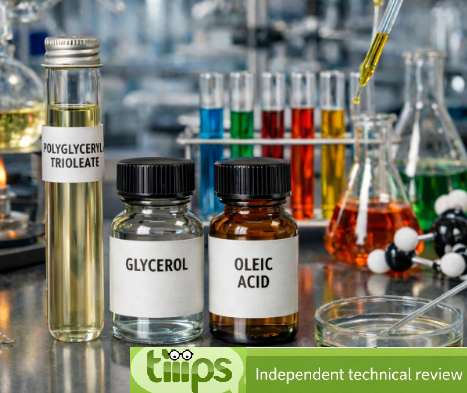
Chemical composition and structure
Polyglyceryl-5 trioleate is composed of:
Polyglyceryl-5
A glycerol oligomer with five glycerol units, characterized by multiple available hydroxyl groups.Three oleic chains (trioleate)
Derived from oleic acid, linked to the polyglycerol backbone through ester bonds.
This results in an amphiphilic structure, featuring:
a polar portion (residual polyglycerol groups),
a non-polar portion (oleic chains),
which supports emulsifying and co-emulsifying activity, as well as the emollient contribution typical of fatty esters.
Table 1 – Structural elements and functional role
| Element | Origin | Formulation role |
|---|---|---|
| Polyglyceryl-5 | Glycerol oligomer | Hydrophilic head, skin compatibility |
| Oleic chains (x3) | Oleic acid | Lipophilic phase, emollience, sensory profile |
| Ester bonds | Esterification reaction | Chemical-physical stability of the ester |
Physical properties
Polyglyceryl-5 trioleate typically appears as a clear to slightly yellow liquid, sometimes semi-solid depending on composition (distribution of ester species) and processing conditions.
It generally has a mild and neutral odor. It is lipid-soluble (soluble in oils and organic solvents) and shows limited water solubility, consistent with the predominance of the oleic fraction.
In emulsions it contributes to:
improved stability (especially as a co-emulsifier),
optimized texture,
reduced greasy feel with a more gliding finish.
Table 2 – Indicative physical properties (qualitative)
| Parameter | Description |
|---|---|
| Appearance | Clear / slightly yellow liquid (sometimes semi-solid) |
| Odor | Mild, neutral |
| Solubility | Oil-soluble; limited in water |
| Sensory function | Glide, softness, texture improvement |
Production process
Polyglyceryl-5 synthesis
Glycerol undergoes controlled polymerization to obtain a polyglycerol fraction with a predominance of 5-unit chains.Esterification with oleic acid
Polyglyceryl-5 reacts with oleic acid (or equivalent reactive derivatives) in the presence of a suitable catalyst, promoting the formation of ester bonds to reach the desired trioleate profile.Purification
Removal of unreacted materials and by-products (e.g., mono/di-ester fractions), with the goal of standardizing quality, odor, and performance.Quality control
Verification of purity, stability, compositional profile, and microbiological parameters when required by the intended use.
Applications
Cosmetic products
Used in creams, lotions, and emulsions as an emulsifier/co-emulsifier and sensory enhancer, supporting uniform and stable textures.
INCI functions
Skin conditioning agent - Emollient. Emollients have the characteristic of enhancing the skin barrier through a source of exogenous lipids that adhere to the skin, improving barrier properties by filling gaps in intercorneocyte clusters to improve hydration while protecting against inflammation. In practice, they have the ability to create a barrier that prevents transepidermal water loss. Emollients are described as degreasing or refreshing additives that improve the lipid content of the upper layers of the skin by preventing degreasing and drying of the skin. The problem with emollients is that many have a strong lipophilic character and are identified as occlusive ingredients; they are oily and fatty materials that remain on the skin surface and reduce transepidermal water loss. In cosmetics, emollients and moisturisers are often considered synonymous with humectants and occlusives.
Surfactant - Emulsifying agent. Emulsions are thermodynamically unstable and are used to soothe or soften the skin and emulsify, so they need a specific, stabilising ingredient. This ingredient forms a film, lowers the surface tension and makes two immiscible liquids miscible. A very important factor affecting the stability of the emulsion is the amount of the emulsifying agent. Emulsifiers have the property of reducing the oil/water or water/oil interfacial tension, improving the stability of the emulsion and also directly influencing the stability, sensory properties and surface tension of sunscreens by modulating the filmometric performance.
Skin care
Suitable for formulations aimed at:
indirect moisturization (barrier/emollience),
improved elasticity and comfort,
reduced dryness feel.
Hair care
Used in shampoos, conditioners, and styling products to enhance:
conditioning,
combability,
perceived softness and shine.
Pharmaceutical products
May be used as a component of lipidic/emulsified systems to improve solubilization, stability, and delivery of certain actives, depending on formulation rationale.
Personal care products
Included in cleansing and body products where it contributes to emollience and base stability.
Environmental and safety considerations
Polyglyceryl-5 trioleate is generally regarded as safe for use in cosmetics and personal care products at typical use concentrations. It is usually well tolerated and suitable for different skin types, including contexts requiring a milder sensory profile.

