



Polyglyceryl-3 decyltetradecyl ether: properties, uses, pros, cons, safety
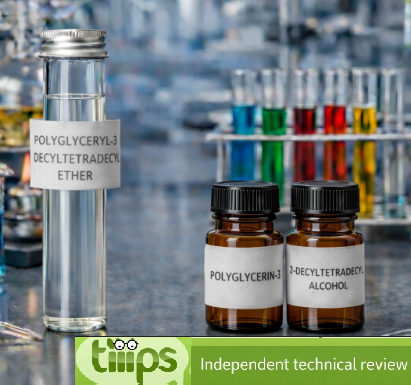
Polyglyceryl-3 decyltetradecyl ether – a non-ionic surfactant obtained via condensation (ether formation) between polyglycerin-3 and a long-chain fatty alcohol (decyltetradecyl alcohol), used mainly as an emulsifier and co-emulsifier.
Synonyms: polyglyceryl-3 decyltetradecyl ether (EN); poligliceril-3 decyltetradecyl etere (IT, descriptive); “polyglycerin-3 + decyltetradecyl alcohol, ether” (technical description)
INCI / Functions: surfactant – emulsifying (non-ionic)
Definition
Polyglyceryl-3 decyltetradecyl ether belongs to the polyglyceryl ether family: the “3” indicates the average number of glycerol units in the polyglycerol fraction. Practically, it behaves as a lipophilic/moderately lipophilic surfactant (depending on the real oligomer distribution and degree of etherification), useful to stabilize oil/water interfaces and modulate rheology and sensoriality in emulsions and hybrid systems.
It is typically considered a “structure” ingredient: it is not selected for a specific biological claim, but for its ability to improve stability, reduce phase separation, and enhance spreadability and “feel” in creams, lotions, and sometimes make-up and sunscreens.
Chemical Composition and Structure
Polyglyceryl-3 Decyltetradecyl Ether is composed of polyglycerin-3, a polymer derived from glycerol known for its excellent moisture-retention capabilities, and 2-decyltetradecyl alcohol, a long-chain fatty alcohol that provides emollient and conditioning properties. This combination results in a compound that is highly effective at stabilizing emulsions and improving the texture and feel of skincare and makeup products on the skin. The average molar ratio is 3 mol glycerol.
Physical Properties
Polyglyceryl-3 Decyltetradecyl Ether typically appears as a clear to slightly yellowish viscous liquid at room temperature. It is primarily soluble in oils and has limited solubility in water, making it particularly useful in oil-based cosmetic formulations where it can enhance stability and provide a rich, non-greasy feel.
Production Process
Synthesis: The production of Polyglyceryl-3 Decyltetradecyl Ether involves the esterification of polyglycerin-3 with 2-decyltetradecyl alcohol. This process requires precise control of reaction conditions to ensure the formation of a stable and effective ether.
Purification: Following synthesis, the compound undergoes extensive purification to remove any unreacted materials and by-products, ensuring its purity and suitability for cosmetic use.
Quality Control: Rigorous testing is conducted on the final product to assess its consistency, stability, and performance in various cosmetic formulations. These tests often include evaluations of viscosity, emulsion stability, and compatibility with other cosmetic ingredients.
Identification data and specifications
| Characteristic | Value |
|---|---|
| INCI name | Polyglyceryl-3 decyltetradecyl ether |
| INCI function | surfactant – emulsifying |
| Origin (common classification) | synthetic (per INCI dictionaries/cosmetic ingredient databases) |
| CAS number | not unique / often not listed in INCI dictionaries (verify supplier SDS) |
| EC/EINECS number | not unique / often not listed in INCI dictionaries (verify supplier SDS) |
| Molecular formula | not unique (oligomer mixture); “average” formula depends on distribution and degree of etherification |
| Molecular weight | not unique (mixture); typically given as an average value or range in supplier specification |
| Typical commercial form | surfactant raw material for emulsions (specs: viscosity/color/acid value vary by manufacturer) |
Physico-chemical properties (indicative)
| Characteristic | Value | Note |
|---|---|---|
| Physical state (20–25 °C) | viscous liquid or semi-solid | depends on purity and oligomer profile |
| Solubility | mainly in the oil phase; limited in water | typical of many polyglyceryl ethers with long alkyl chains |
| Ionic nature | non-ionic | often more tolerant with electrolytes than ionic systems (case by case) |
| Interfacial role | reduces surface tension and stabilizes emulsions | effectiveness depends on synergy with co-surfactants, polymers, and oil phase |
| pH range (use) | generally broad | overall stability is mainly driven by the formulation system, not pH alone |
Applications
Cosmetic Products: Widely used in creams, lotions, and serums where it acts as an effective emulsifier and surfactant, helping to blend and stabilize the mixture of oil and water components, and improving the product's overall texture and application properties.
Skin Care: Ideal for use in moisturizing and hydrating products, providing a smooth and enriching feel to the skin due to its emollient properties.
Makeup: Employed in foundations and concealers to enhance their moisturizing properties and ensure smooth, even coverage.
INCI Functions
Surfactant - Emulsifying agent. Emulsions are thermodynamically unstable and are used to soothe or soften the skin and emulsify, so they need a specific, stabilising ingredient. This ingredient forms a film, lowers the surface tension and makes two immiscible liquids miscible. A very important factor affecting the stability of the emulsion is the amount of the emulsifying agent. Emulsifiers have the property of reducing the oil/water or water/oil interfacial tension, improving the stability of the emulsion and also directly influencing the stability, sensory properties and surface tension of sunscreens by modulating the filmometric performance.
Formulation compatibility
In practice, Polyglyceryl-3 decyltetradecyl ether performance depends on three variables: oil phase (polarity and ester/oil profile), overall surfactant architecture (presence of co-emulsifiers, fatty alcohols, structuring esters), and process (emulsification temperature, shear, order of addition). In formulas rich in electrolytes or “difficult” actives, it is often used to increase emulsion robustness, but compatibility should still be verified with: fragrances, lipophilic UV filters, silicones, rheology polymers, and preservatives.
Practical note: to reduce variability, it is advisable to work with clear specifications on viscosity, acidity/neutralization index (where relevant), color, and free fractions (unreacted alcohol/starting materials), where provided by the supplier.
Use guidelines (indicative)
Use levels are formulation-dependent: as an emulsifier/co-emulsifier it can be used from low levels (stability/sensorial support) up to higher levels when it is part of the primary surfactant package. Final selection should be guided by: accelerated stability, thermal stress, freeze-thaw, packaging compatibility, and sensorial evaluation on skin.
Quality, grades, and specifications
Industrial quality is linked to the ingredient’s “mixture” nature: variations in polyglycerin oligomer distribution and degree of etherification can change viscosity, emulsifying power, and “feel.” Relevant QC parameters typically include: chromatographic profile/identity (where applicable), viscosity, color, acidity/hydroxyl value (if declared), and control of possible process residues per manufacturer specification.
Safety, regulatory, and environment
In cosmetics, the ingredient is used as a non-ionic surfactant: tolerability is generally manageable under normal use conditions, but the most common practical risk remains irritation/non-specific sensitization at higher levels, in very “cleansing” systems, or in reactive skin—especially in leave-on products that are not optimized. Safety assessment should always be performed on the finished product, considering impurities and use pattern (rinse-off vs leave-on), within a GMP framework and with full supply-chain technical documentation.
Polyglyceryl-3 Decyltetradecyl Ether is considered safe for use in cosmetic products and is generally well-tolerated by the skin. It is non-irritating and suitable for all skin types, including sensitive skin. Proper use within recommended concentrations is essential to ensure safety and maximize effectiveness.
In cosmetic labeling, Polyglyceryl-3 Decyltetradecyl Ether is listed under its INCI name, reflecting its chemical identity as 1,2,3-Propanetriol, homopolymer, 2-decyltetradecyl ethers (1:1) with an average molar ratio of 3 mol glycerol, used for regulatory and commercial purposes in the cosmetics industry.
Formulation troubleshooting
If phase separation is observed under hot/cold stress, it is usually more effective to adjust the overall emulsifier/co-emulsifier balance and the oil-phase polarity (rather than only increasing dose). If sensoriality feels “heavy,” it is often better to fine-tune light esters/volatile silicones or change the rheology modifier, instead of forcing the emulsifier above the necessary level.
Conclusion
Polyglyceryl-3 decyltetradecyl ether is a non-ionic emulsifier focused on performance: it supports stability and sensoriality across many emulsion types, with outcomes strongly driven by synergy with the oil phase, co-surfactants, and process. For controlled use, the key points are: batch-to-batch specifications, accelerated stability testing, and tolerability evaluation on the finished product.
Mini-glossary
Emulsifier: a substance that facilitates and stabilizes the dispersion of oil and water in an emulsion.
Non-ionic surfactant: a surfactant without a net electrical charge; often more flexible in formulations containing salts/electrolytes.
Polyglycerin: glycerol oligomers/polymers linked by ether bridges; the number (e.g., “3”) indicates the average chain length.
GMP: Good manufacturing practice; benefit: improves quality control and reduces contamination/process variability.

