



Sodium Coco/Babassu Sulfate: properties, uses, pros, cons, safety
Description
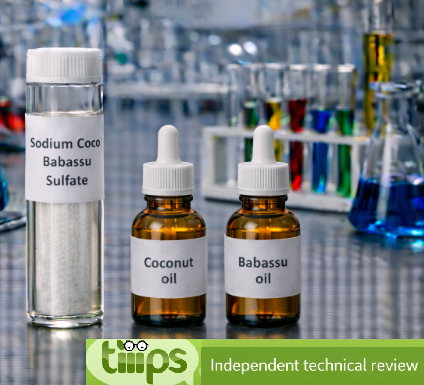
Sodium Coco/Babassu Sulfate is an anionic surfactant obtained from fatty alcohols derived from coconut and babassu (Orbignya oleifera) oils, then sulfated and neutralized with sodium.
It is widely used in cleansing and cosmetic products due to its strong detergency, foam performance, and good formulation compatibility, making it suitable for a broad range of personal care and household cleaning applications.
Chemical composition and structure
From a chemical standpoint, Sodium Coco/Babassu Sulfate is a mixture of sulfate esters of fatty alcohols (primarily C12–C14), converted into the corresponding sodium salt.
The molecule includes:
Lipophilic chain
Derived from coconut and babassu fatty alcohols, responsible for interaction with oils, sebum, and hydrophobic soils.Sulfate group (-OSO₃⁻ Na⁺)
A strongly ionic hydrophilic head enabling the surfactant to reduce surface tension and solubilize soils in aqueous media.
This amphiphilic structure underpins its high cleansing efficiency and the formation of abundant, stable foam.
Table 1 – Structural elements and functional role
| Element | Origin | Functional role |
|---|---|---|
| Lipophilic chain | C12–C14 fatty alcohols (coconut/babassu) | Interaction with oils and sebum |
| Sulfate group | Sulfation + sodium neutralization | Surface tension reduction, micelle formation |
Physical properties
Appearance: white to slightly yellow solid, as fine powder or granules
Solubility: highly soluble in water
Foaming behavior: produces a rich, creamy, persistent foam
Compatibility: suitable for both solid and liquid cleansing systems
These features make it particularly valuable in cleansing formulations where effective cleaning and a positive sensory experience are required.
Table 2 – Typical physical properties (qualitative)
| Parameter | Description |
|---|---|
| Physical form | Solid (powder/granules) |
| Color | White to pale yellow |
| Water solubility | High |
| Foam profile | Abundant and stable |
Production process
Manufacture of Sodium Coco/Babassu Sulfate follows controlled industrial steps:
Oil extraction
Coconut and babassu oils are extracted and purified as a source of fatty alcohols.Sulfation (esterification)
Fatty alcohols react with sulfuric acid to form sulfate esters
Reaction conditions are closely monitored to avoid degradation or side reactions
Neutralization
The sulfate esters are neutralized with sodium hydroxide, yielding the sodium salt
Purification
Removal of residual acid and undesired by-products.Drying and standardization
The product is dried and processed to a controlled particle size, ensuring consistent performance.Quality control
Testing of purity, solubility, cleansing power, and foaming capacity, in line with industrial standards.
Applications
Cosmetics
INCI functions
Cleansing agent
Helps remove dirt and impurities through its surfactant action, facilitating dispersion of lipophilic soils in water.Surfactant – emulsifying agent
Reduces interfacial tension between aqueous and oily phases, contributing to emulsion stability and positively influencing texture, sensory profile, and film-forming performance.Surfactant – cleansing agent
Promotes reduction of the stratum corneum surface tension, improving the cleansing efficiency of cosmetic products.
Personal cleansing products
Shampoos
Shower gels
Solid and liquid soaps
It is valued for the ability to effectively remove sebum and impurities while generating abundant foam.
Household cleaning products
Dishwashing liquids
Household multi-purpose cleaners
The combination of degreasing power and stable foam makes it effective in household cleaning applications.
Environmental and safety considerations
Safety
Sodium Coco/Babassu Sulfate is generally considered safe for use in cosmetic and cleansing products when used at recommended concentrations. As with other anionic surfactants, poorly balanced formulations may be potentially irritating, which is why it is often combined with milder co-surfactants.
Environmental impact
The material typically shows a good biodegradability profile. However, it is important to adopt:
sustainable sourcing practices for coconut and babassu oils
responsible manufacturing processes, to minimize overall environmental impact

