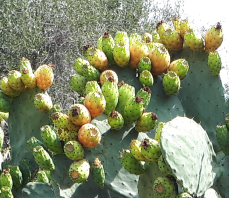
Opuntia ficus-indica, comunemente nota come fico d'India o prickly pear, è una specie di cactus originaria del Messico, ma ora ampiamente coltivata in regioni aride e semi-aride in tutto il mondo. Questo cactus è rinomato per i suoi frutti edibili, noti come fichi d'India o nopales, e per i suoi pad, utilizzati in varie applicazioni culinarie e medicinali. La pianta è anche apprezzata per le sue qualità ornamentali e la sua capacità di prosperare in climi difficili.
Classificazione Botanica
- Regno: Plantae
- Ordine: Caryophyllales
- Famiglia: Cactaceae
- Genere: Opuntia
- Specie: O. ficus-indica
Caratteristiche della Pianta
E' un grande cactus succulento che può raggiungere i 5 metri di altezza. Ha fusti appiattiti e a forma di padella chiamati "pad" (nopales), coperti di spine e a volte di peli glochidiali. La pianta produce fiori di colore giallo o rosso, che si sviluppano in frutti edibili noti come fichi d'India. Il frutto e i pad sono ricchi di nutrienti e hanno un sapore unico.
Composizione Chimica e Struttura
I fichi d'India e i pad di Opuntia ficus-indica contengono diversi composti benefici, tra cui:
- Mucillagine di Cactus: Una sostanza gelatinosa con proprietà idratanti e lenitive, utilizzata nei prodotti per la cura della pelle.
- Vitamine: Alta concentrazione di vitamina C, che supporta il sistema immunitario e la salute della pelle.
- Minerali: Contiene minerali essenziali come magnesio, calcio e potassio.
- Antiossidanti: Include flavonoidi e composti fenolici con proprietà antiossidanti che aiutano a combattere lo stress ossidativo.
Coltivazione
Opuntia ficus-indica prospera in suoli ben drenati, sabbiosi o ghiaiosi e richiede una piena esposizione al sole. È altamente resistente alla siccità e può tollerare temperature estreme. Il cactus viene solitamente propagato tramite pad o semi e beneficia di annaffiature minime. È essenziale proteggere la pianta dal gelo e maneggiarla con attenzione a causa delle spine.
Usi e Benefici
Culinario: I pad (nopales) e i frutti (fichi d'India) sono utilizzati in una varietà di piatti, tra cui insalate, zuppe e marmellate. Sono noti per il loro sapore distintivo e benefici nutrizionali.
Medico: Utilizzato tradizionalmente per gestire il diabete, migliorare la digestione e fornire effetti anti-infiammatori e antiossidanti. La mucillagine del cactus è usata nella cura della pelle per le sue proprietà idratanti.
Cosmetico: L'olio di semi di fico d'India è utilizzato nei prodotti per la cura della pelle per i suoi benefici idratanti e anti-invecchiamento. È incluso in creme, sieri e oli per il viso.
Applicazioni
Culinario: Utilizzato nella cucina messicana e mediterranea per i suoi pad e frutti aromatici. Anche trasformato in bevande e prodotti alimentari.
Medico: Utilizzato in integratori e rimedi tradizionali per i suoi benefici per la salute, inclusa la gestione del glucosio nel sangue e il supporto digestivo.
Cosmetico: Incorporato nelle formulazioni per la cura della pelle per le sue proprietà idratanti, anti-invecchiamento e lenitive.
Funzioni INCI:
Agente condizionante della pelle. Rappresenta il perno del trattamento topico della pelle in quanto ha la funzione di ripristinare, aumentare o migliorare la tolleranza cutanea a fattori esterni, compresa la tolleranza dei melanociti. La funzione più importante dell'agente condizionante è prevenire la disidratazione della pelle, ma il tema è piuttosto complesso e coinvolge emollienti ed umettanti che possono essere aggiunti nella formulazione.
Agente condizionante della pelle - Emolliente. Gli emollienti hanno la caratteristica di migliorare la barriera cutanea tramite una fonte di lipidi esogeni che aderiscono alla pelle migliorando le proprietà della barriera, riempiendo le lacune dei cluster intercorneocitari per migliorare l'idratazione proteggendo dall'insorgenza di infiammazioni. In pratica hanno la capacità di creare una barriera che previene la perdita di acqua transepidermica. Gli emollienti sono additivi sgrassanti o rinfrescanti che migliorano il contenuto lipidico degli strati superiori della pelle prevenendo lo sgrassamento e l'essiccazione della pelle. Il problema degli emollienti è che molti presentano un forte carattere lipofilo e sono identificati come ingredienti occlusivi; si tratta di materiali oleosi e grassi che permangono sulla superficie cutanea e riducono la perdita di acqua transepidermica. In cosmetica, emollienti ed idratanti sono sovente considerati sinonimi anche in presenza di umettanti ed occlusivi.
CAS 90082-21-6
EC number 290-109-1
Considerazioni Ambientali e di Sicurezza
Opuntia ficus-indica è generalmente sicuro per il consumo e l'uso nei cosmetici. Tuttavia, è importante maneggiare il cactus con attenzione per evitare lesioni causate dalle spine. È fondamentale adottare pratiche di coltivazione sostenibili per garantire un impatto ambientale minimo e promuovere la salute della pianta.
Bibliografia__________________________________________________________________________
Zhang Y, Chang H, Shao S, Zhao L, Zhang R, Zhang S. Anthocyanins from Opuntia ficus-indica Modulate Gut Microbiota Composition and Improve Short-Chain Fatty Acid Production. Biology (Basel). 2022 Oct 14;11(10):1505. doi: 10.3390/biology11101505.
Abstract. Opuntia ficus-indica is rich in a variety of active substances, such as anthocyanins, flavonoids, and polysaccharides. Some studies have shown that anthocyanins extracted from natural plants can regulate intestinal flora. The fruit was used as raw material, and anthocyanins were extracted from it. In vivo experiments were used to study the effect of Opuntia ficus-indica anthocyanins on the mouse intestine by 16S rRNA high-throughput sequencing (NovaSeq 6000 platform) and gas chromatography (hydrogen flame ionization detector (FID)) methods. Microbiota and effects of short-chain fatty acids (SCFAs). The results showed that after feeding anthocyanins, the diversity of intestinal microorganisms in mice was significantly increased (p < 0.05), the ratio of Firmicutes/Bacteroidetes (F/B value) was significantly decreased (p < 0.05), the relative abundances of beneficial bacteria Lactobacillus, Bifidobacterium, Prevotella, and Akkermansia in the intestinal tract of mice were significantly increased (p < 0.05), and the relative abundance of pathogenic bacteria Escherichia-Shigella and Desulfovibrio decreased significantly (p < 0.05). Furthermore, anthocyanins significantly increased the content of short-chain fatty acids in the cecum of mice, among which the content of acetic acid, propionic acid, and butyric acid increased the most. Opuntia ficus-indica anthocyanins can change the microbial diversity and flora composition of the mouse gut and promote the production of short-chain fatty acids. The findings provide a theoretical basis for the use of Opuntia ficus-indica anthocyanins as dietary supplements to regulate human intestinal flora.
Aragona M, Lauriano ER, Pergolizzi S, Faggio C. Opuntia ficus-indica (L.) Miller as a source of bioactivity compounds for health and nutrition. Nat Prod Res. 2018 Sep;32(17):2037-2049. doi: 10.1080/14786419.2017.1365073. Epub 2017 Aug 14. PMID: 28805459.
Abstract. Plants with beneficial properties are known in traditional medicine. Nowadays, in spite of widespread availability of synthetic compounds, the search goes towards natural compounds to lower cost and few side effects. The increasing interest in preventive medicine encourages use of nutraceuticals, bioactive compounds of vegetable origin with important nutritional values. Among the medicinal plants, Opuntia ficus-indica (L.) Miller (Family Cactaceae, subfamily Opuntiodeae, Genus Opuntia, subgenus Platyopuntia, species Opuntia ficus-indica (L.) Miller) is widely known for its beneficial properties. The aim of the present review is to stress the major classes of Opuntia components and their medical interest through emphasis on some of their biological effects, particularly those having the most promising expected health benefits and therapeutic impacts on fish and mammals.
Silva MA, Albuquerque TG, Pereira P, Ramalho R, Vicente F, Oliveira MBPP, Costa HS. Opuntia ficus-indica (L.) Mill.: A Multi-Benefit Potential to Be Exploited. Molecules. 2021 Feb 11;26(4):951. doi: 10.3390/molecules26040951.
Abstract. Consumer interest in foods with enhanced nutritional quality has increased in recent years. The nutritional and bioactive characterization of fruits and their byproducts, as well as their use in the formulation of new food products, is advisable, contributing to decrease the global concerns related to food waste and food security. Moreover, the compounds present in these raw materials and the study of their biological properties can promote health and help to prevent some chronic diseases. Opuntia ficus-indica (L.) Mill. (prickly pear) is a plant that grows wild in the arid and semi-arid regions of the world, being a food source for ones and a potential for others, but not properly valued. This paper carries out an exhaustive review of the scientific literature on the nutritional composition and bioactive compounds of prickly pear and its constituents, as well as its main biological activities and applications. It is a good source of dietary fiber, vitamins and bioactive compounds. Many of its natural compounds have interesting biological activities such as anti-inflammatory, hypoglycemic and antimicrobial. The antioxidant power of prickly pear makes it a good candidate as an ingredient of new food products with fascinating properties for health promotion and/or to be used as natural extracts for food, pharmaceutic or cosmetic applications. In addition, it could be a key player in food security in many arid and semi-arid regions of the world, where there are often no more plants.
Shinga MH, Fawole OA. Opuntia ficus indica mucilage coatings regulate cell wall softening enzymes and delay the ripening of banana fruit stored at retail conditions. Int J Biol Macromol. 2023 Aug 1;245:125550. doi: 10.1016/j.ijbiomac.2023.125550. Epub 2023 Jun 23. PMID: 37356689.
Zhou M, Wen C, Ming Y, Zhang L, Lyu X. Distribution and bioactivity of polyphenols in Opuntia ficus-indica (L. ) Mill. Wei Sheng Yan Jiu. 2022 May;51(3):463-469. Chinese. doi: 10.19813/j.cnki.weishengyanjiu.2022.03.020.
Abstract. Objective: To study the distribution of the polyphenols of Opuntia ficus-indica(L. ) Mill, and study its antioxidant and the inhibition of sugar digestive enzyme activities by vitro experiments. Methods: Using ethanol as solvent, free polyphenols, esterified polyphenols, and insoluble bonded polyphenols were extracted from the peel, pulp and seeds of Opuntia ficus-indica(L. ) Mill, and their contents were determined by the Folin-Ciocalteu method. Antioxidant activity was measured according to their ability to scavenge DPPH, OH and ABTS~(+ )radicals, and the inhibition of α-glucosidase and α-amylase activities by various types of polyphenols in various parts was observed in vitro. Results: The peel polyphenol content of Opuntia ficus-indica(L. ) Mill was(1427.15±34.48) mg GAE/100 g, the pulp polyphenol content was(525.88±51.66) mg GAE/100 g, and the seed polyphenol content was(256.92±3.81) mg GAE/100 g. The free polyphenols, esterified polyphenols, and insoluble bonded polyphenols of different parts of Opuntia ficus-indica(L. ) Mill have the ability to scavenge DPPH, OH and ABTS~(+ )radicals, and the seeds had the strongest antioxidant capacity among all parts, the esterified polyphenols and insoluble bonded polyphenols of pulp and seeds of Opuntia ficus-indica(L. ) Mill have inhibitory effects on the activities of α-glucosidase and α-amylase, with seed polyphenols have the strongest inhibitory ability. Conclusion: Opuntia ficus-indica(L. ) Mill has the highest content of polyphenols in the peel, and seed polyphenols have good antioxidant and the inhibition of sugar digestive enzyme activities.




