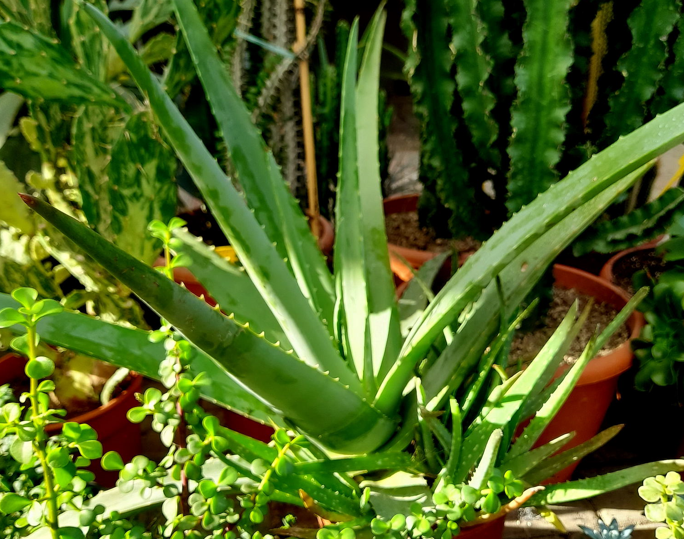
Aloe barbadensis (Miller) o Aloe vera è una pianta ricca di polpa rinomata per i suoi usi medicinali e cosmetici. Questa pianta perenne sempreverde è originaria della Penisola Arabica ma è coltivata in tutto il mondo. Le sue foglie spesse e carnose contengono una sostanza gelificante molto apprezzata per le sue proprietà lenitive e curative. L'aloe vera è utilizzata ampiamente nella cura della pelle, negli integratori alimentari e nella medicina tradizionale.
Classificazione Botanica:
- Regno: Plantae
- Ordine: Asparagales
- Famiglia: Asphodelaceae
- Genere: Aloe
- Specie: Aloe barbadensis
Caratteristiche della Pianta:
- Forma di Crescita: Aloe vera è una succulenta che forma una rosetta con foglie spesse e carnose disposte alla base. Cresce fino a 60-90 cm di altezza e si espande verso l'esterno.
- Foglie: Le foglie sono lunghe, a forma di lancia, e hanno una superficie liscia di colore verde o verde-grigiastro con bordi seghettati. Contengono una sostanza gelificante trasparente al loro interno.
- Fiori: Aloe vera produce spighe di fiori alti fino a 90 cm di altezza. I fiori sono tubolari e possono variare dal giallo all'arancio o rosso. La fioritura avviene solitamente in inverno o all'inizio della primavera.
- Frutti: La pianta produce una capsula che contiene numerosi piccoli semi.
Composizione Chimica e Struttura:
- Gel di Aloe Vera: Il gel all'interno delle foglie è composto da:
- Polisaccaridi: Come l'acemannano, responsabile degli effetti lenitivi e curativi della pianta.
- Vitamine: Tra cui vitamine A, C ed E, note per le loro proprietà antiossidanti.
- Minerali: Come calcio, magnesio, zinco e potassio, che contribuiscono al profilo nutrizionale della pianta.
- Enzimi: Inclusi amilasi e lipasi, che aiutano nella scomposizione di zuccheri e grassi.
- Aminoacidi: Il gel di aloe vera contiene 20 degli 22 aminoacidi essenziali necessari al corpo umano.
Come Coltivarla:
- Suolo: Aloe vera preferisce terreni ben drenati, idealmente un mix sabbioso o limoso. È importante evitare condizioni di ristagno idrico, che possono portare alla marcescenza delle radici.
- Clima: Aloe vera prospera in climi caldi ed è adatta per le zone di rusticità USDA 8-11. Richiede molta luce solare e cresce meglio a temperature comprese tra 15-30°C.
- Irrigazione: La pianta è resistente alla siccità e dovrebbe essere annaffiata con parsimonia. Lasciare asciugare il terreno tra un'annaffiatura e l'altra per evitare eccesso di acqua.
- Propagazione: Aloe vera può essere propagata tramite polloni o "pups" che crescono attorno alla base della pianta. Questi possono essere separati e ripiantati quando sono abbastanza grandi.
Usi e Benefici:
- Cura della Pelle: Il gel di aloe vera è ampiamente utilizzato in prodotti per la cura della pelle grazie alle sue proprietà idratanti, lenitive e antinfiammatorie. Aiuta ad alleviare scottature, piccole ustioni e irritazioni cutanee.
- Cura dei Capelli: L'aloe vera è inclusa in prodotti per capelli per promuovere un cuoio capelluto e capelli sani. Aiuta a condizionare i capelli, ridurre la forfora e lenire un cuoio capelluto pruriginoso.
- Integratori Alimentari: Il succo di aloe vera è consumato per i suoi potenziali benefici digestivi e disintossicanti. Si ritiene che aiuti nella digestione e supporti la salute intestinale complessiva.
- Medicina Tradizionale: L'aloe vera è stata utilizzata nella medicina tradizionale per secoli per trattare varie condizioni, tra cui ferite, problemi digestivi e infiammazioni.
Applicazioni:
- Cosmetici e Cura Personale: L'aloe vera è un ingrediente comune in lozioni, creme, gel e shampoo grazie alle sue proprietà idratanti e lenitive.
- Farmaceutici: Utilizzata in formulazioni topiche per ustioni, ferite e condizioni cutanee per i suoi effetti curativi.
- Industria Alimentare: Il succo di aloe vera è utilizzato come bevanda salutare e in vari prodotti alimentari per i suoi presunti benefici per la salute.
Considerazioni Ambientali e di Sicurezza:
- Impatto Ambientale: Aloe vera è una coltura sostenibile che richiede poca acqua e può prosperare in condizioni aride. Ha una bassa impronta ambientale rispetto ad altre colture più esigenti in termini di acqua.
- Sicurezza: L'aloe vera è generalmente sicura per l'uso topico e interno se utilizzata correttamente. Tuttavia, alcune persone possono sperimentare reazioni allergiche o irritazioni cutanee. È consigliabile eseguire un test cutaneo prima di applicare su ampie aree.
Le più comuni Aloe, utilizzate da medicina e cosmesi sono :
- Aloe barbadensis
- Aloe ferox
- Aloe greatheadii
Studi
L'uso delle erbe è un metodo consolidato per la cura di certe malattie, però le erbe possono innescare effetti collaterali e possono interagire con altre erbe, integratori o farmaci. Per queste ragioni si dovrebbe procedere con prudenza nell'assunzione solo con l'assistenza di un medico (1). In ogni caso, è importante che vengano stabilite quantità e frequenza di assunzione che solo un medico può prescrivere.
Dalla pianta vengono ricavati lattice e gel con una lunga storia di terapia topica e locale, come cura per ustioni, ferite, irritazione della pelle e costipazione e, nella medicina ayurvedica, viene usata contro le malattie della pelle, tuttavia l'ingestione è stata associata a diversi disturbi fisici (2).
Abbonda di antrachinoni, enzimi vegetali, utili metaboliti secondari aromatici triciclici, tra i quali l'aloe emodina e il chrysophanol (3).
Contiene vitamine antiossidanti (A, C, E, B12), niacina, riboflavina e acido folico e, usati come stimolante lassativo, antielmintico. Vi si trova anche potassio, calcio, magnesio, rame, zinco, cromo, ferro e magnesio lattato (4) oltre a polisaccaridi (glucomannani), aminoacidi, acidi grassi (lupeolo e campesterolo), lipidi, steroli vegetali, tannini ed enzimi (amilasi, catalasi e perossidasi) utilizzati come medicinali a base di erbe.
Pelle
Aloe vera ha migliorato l'epitelizzazione e il tessuto di granulazione delle ferite da ustione nei pazienti con ustione superficiale di secondo grado (5) ed ha aumentato significativamente i livelli di indice di elasticità della pelle (6) ed i livelli di collagene (7).
Apparato digerente
L'aloe è stata utilizzata per la cura di malattie che riguardano l'apparato digerente ed in particolare è stata strettamente associata alla gastro protezione avendo dimostrato il potenziale per alleviare le lesioni gastriche acute indotte dall'alcol (8).
Diabete
La somministrazione di Aloe vera ha mostrato il ripristino dei livelli di glucosio nel sangue a livelli normali con un aumento concomitante dei livelli di insulina esercitando quindi effetti antidiabetici, migliorando la secrezione di insulina, la funzione delle cellule β del pancreas e ripristinando la massa delle isole pancreatiche (9).
Ossa
I risultati di questo studio indicano che l'Aloe è una fonte eccellente di sostanze fitochimiche antiossidanti e anti-osteoporotiche (10).
Denti
L'aloe vera può rivelarsi un collutorio efficace grazie alla sua capacità di ridurre la placca dentale (11).
Per approfondimenti:
Aloe vera studi
Bibliografia_____________________________________________________________________
(1) Aloe - University of Maryland - Medical Center http://umm.edu/health/medical/altmed/herb/aloe
(2) Boudreau M, Beland F (2006) An evaluation of the biological and toxicological properties of Aloe barbadensis (miller), Aloe vera. J Environ Sci Heal C 24: 103–154
Abstract. Aloe barbadensis (Miller), Aloe vera, has a long history of use as a topical and oral therapeutic. The plant is the source of two products, gel and latex, which are obtained from its fleshy leaves. Aloe vera products contain multiple constituents with potential biological and toxicological activities, yet the active components elude definition. Ingestion of Aloe vera is associated with diarrhea, electrolyte imbalance, kidney dysfunction, and conventional drug interactions; episodes of contact dermatitis, erythema, and phototoxicity have been reported from topical applications. This review examines the botany, physical and chemical properties, and biological activities of the Aloe vera plant.
(3) Enhancement of Anti-Inflammatory Activity of Aloe vera Adventitious Root Extracts through the Alteration of Primary and Secondary Metabolites via Salicylic Acid Elicitation
Yun Sun Lee, Hyun Kyoung Ju, Yeon Jeong Kim, Tae-Gyu Lim, Md Romij Uddin, Yeon Bok Kim, Jin Hong Baek, Sung Won Kwon, Ki Won Lee, Hak Soo Seo, Sang Un Park, Tae-Jin Yang
PLoS One. 2013; 8(12): e82479. Published online 2013 Dec 16. doi: 10.1371/journal.pone.0082479
Abstract. Aloe vera (Asphodeloideae) is a medicinal plant in which useful secondary metabolites are plentiful. Among the representative secondary metabolites of Aloe vera are the anthraquinones including aloe emodin and chrysophanol, which are tricyclic aromatic quinones synthesized via a plant-specific type III polyketide biosynthesis pathway. However, it is not yet clear which cellular responses can induce the pathway, leading to production of tricyclic aromatic quinones. In this study, we examined the effect of endogenous elicitors on the type III polyketide biosynthesis pathway and identified the metabolic changes induced in elicitor-treated Aloe vera adventitious roots. Salicylic acid, methyl jasmonate, and ethephon were used to treat Aloe vera adventitious roots cultured on MS liquid media with 0.3 mg/L IBA for 35 days. Aloe emodin and chrysophanol were remarkably increased by the SA treatment, more than 10-11 and 5-13 fold as compared with untreated control, respectively. Ultra-performance liquid chromatography-electrospray ionization mass spectrometry analysis identified a total of 37 SA-induced compounds, including aloe emodin and chrysophanol, and 3 of the compounds were tentatively identified as tricyclic aromatic quinones. Transcript accumulation analysis of polyketide synthase genes and gas chromatography mass spectrometry showed that these secondary metabolic changes resulted from increased expression of octaketide synthase genes and decreases in malonyl-CoA, which is the precursor for the tricyclic aromatic quinone biosynthesis pathway. In addition, anti-inflammatory activity was enhanced in extracts of SA-treated adventitious roots. Our results suggest that SA has an important role in activation of the plant specific-type III polyketide biosynthetic pathway, and therefore that the efficacy of Aloe vera as medicinal agent can be improved through SA treatment.
(4) Shelton M. Aloe vera, its chemical and therapeutic properties. Int J Dermatol. 1991;30:679–683. doi: 10.1111/j.1365-4362.1991.tb02607.x
(5) Irani PS, Varaie S. Comparison of the Effect of Aloe Vera Gel and Nitrofurazone 2% on Epithelialization and Granulation Tissue Formation Regarding Superficial Second-Degree Burns. Iran J Med Sci. 2016 May;41(3 Suppl):S3.
Abstract. Background: Therapeutic effects of various treatment options in burn wound healing have been one of the most controversial issues in wound care. Aloe Vera is an herbal medicine, which has wound healing effects on chronic wound. The present study was carried out to examine and compare the effect of Aloe Vera gel and nitrofurazone 2% on epithelialization and granulation tissue formation with respect to superficial second-degree burns....Conclusion: In conclusion, Aloe Vera gel enhanced epithelialization and granulation tissue of burn wounds in superficial second-degree burn patients better than nitrofurazone 2%. The mechanism of the remarkable efficacy of Aloe Vera gel in the epithelialization and granulation tissue of burn injuries may be explained by its hydrocolloid and moisturizing and anti-inflammatory effects.
(6) Tanaka M, Yamamoto Y, Misawa E, Nabeshima K, Saito M, Yamauchi K, Abe F, Furukawa F. Aloe sterol supplementation improves skin elasticity in Japanese men with sunlight-exposed skin: a 12-week double-blind, randomized controlled trial. Clin Cosmet Investig Dermatol. 2016 Nov 10;9:435-442. doi: 10.2147/CCID.S118947. Erratum in: Clin Cosmet Investig Dermatol. 2016 Dec 16;10 :1.
Abstract. Background/objective: Recently, it was confirmed that the daily oral intake of plant sterols of Aloe vera gel (Aloe sterol) significantly increases the skin barrier function, moisture, and elasticity in photoprotected skin. This study aimed to investigate whether Aloe sterol intake affected skin conditions following sunlight exposure in Japanese men....Results: Depending on the time for the revelation of the sunlight, the b* value and melanin index increased and the skin moisture decreased. After taking an Aloe sterol tablet daily for 12 weeks, the skin elasticity index (R2, R5, and R7) levels were significantly higher than the baseline value. There were no differences between the groups in these skin elasticity values. In the subgroup analysis of subjects aged <46 years, the change in the R5 and R7 was significantly higher in the Aloe group than in the placebo group at 8 weeks (P=0.0412 and P=0.0410, respectively). There was a difference in the quantity of sun exposure between each subject, and an additional clinical study that standardizes the amount of ultraviolet rays is warranted. No Aloe sterol intake-dependent harmful phenomenon was observed during the intake period. Conclusion: Aloe sterol ingestion increased skin elasticity in the photodamaged skin of men aged <46 years.
(7) Tanaka M, Yamamoto Y, Misawa E, Nabeshima K, Saito M, Yamauchi K, Abe F, Furukawa F. Effects of Aloe Sterol Supplementation on Skin Elasticity, Hydration, and Collagen Score: A 12-Week Double-Blind, Randomized, Controlled Trial. Skin Pharmacol Physiol. 2016;29(6):309-317. doi: 10.1159/000454718.
(8) Park CH, Son HU, Yoo CY, Lee SH. Low molecular-weight gel fraction of Aloe vera exhibits gastroprotection by inducing matrix metalloproteinase-9 inhibitory activity in alcohol-induced acute gastric lesion tissues. Pharm Biol. 2017 Dec;55(1):2110-2115. doi: 10.1080/13880209.2017.1371770.
Abstract. Context: Aloe has been used for the prevention and cure of various diseases and symptoms including burns, injuries, oedema and pain. Objective: This study determines the specific inhibitory activity of matrix metalloproteinase (MMP)-9 induced by the low molecular-weight gel fraction of Aloe vera (L.) Burm.f. (lgfAv) on alcohol-induced acute gastric lesions....Conclusions: The present findings suggest that lgfAv has the potential to alleviate alcohol-induced acute gastric lesions, which is mediated in part, mainly by the suppression of the mRNA expression of MMP-9.
(9) Noor A, Gunasekaran S, Vijayalakshmi MA. Improvement of Insulin Secretion and Pancreatic β-cell Function in Streptozotocin-induced Diabetic Rats Treated with Aloe vera Extract. Pharmacognosy Res. 2017 Dec;9(Suppl 1):S99-S104. doi: 10.4103/pr.pr_75_17.
Abstract. Background: Diabetes mellitus is a metabolic disorder characterized by chronic hyperglycemia. Plant extracts and their products are being used as an alternative system of medicine for the treatment of diabetes. Aloe vera has been traditionally used to treat several diseases and it exhibits antioxidant, anti-inflammatory, and wound-healing effects. Streptozotocin (STZ)-induced Wistar diabetic rats were used in this study to understand the potential protective effect of A. vera extract on the pancreatic islets. Objective: The aim of the present study was to evaluate the A. vera extract on improvement of insulin secretion and pancreatic β-cell function by morphometric analysis of pancreatic islets in STZ-induced diabetic Wistar rats....Conclusion: A. vera extract exerts antidiabetic effects by improving insulin secretion and pancreatic β-cell function by restoring pancreatic islet mass in STZ-induced diabetic Wistar rats.
(10) Sun YN, Li W, Lee SH, Jang HD, Ma JY, Kim YH. Antioxidant and anti-osteoporotic effects of anthraquinones and related constituents from the aqueous dissolved Aloe exudates. Nat Prod Res. 2017 Dec;31(23):2810-2813. doi: 10.1080/14786419.2017.1295238.
Abstract. In this study, 25 known anthraquinones and related compounds were isolated from aqueous dissolved Aloe exudates. The antioxidant and anti-osteoporotic activities of the isolated compounds were then investigated. Compounds 8, 11, 20, and 23 showed good antioxidant activity based on peroxyl radical-scavenging and reducing capacity assays at a concentration of 10.0 μM. Additionally, compounds 7, 9, 15-16, 18, 21-22 and 24-25 showed potent peroxyl radical-scavenging activities with values ranging from 5.28 to 14.60 at 10.0 μM. Moreover, compounds 8, 11, 15, 20 and 22 exhibited significantly suppressed tartrate-resistant acid phosphatase (TRAP) activity in nuclear factor-κB ligand-activated osteoclastic RAW 264.7 cells, with values of 125.67, 118.54, 127.64, 125.82 and 124.98%, respectively. These results indicate that Aloe is an excellent source of antioxidant and anti-osteoporotic phytochemicals.
(11) Gupta RK, Gupta D, Bhaskar DJ, Yadav A, Obaid K, Mishra S. Preliminary antiplaque efficacy of aloe vera mouthwash on 4 day plaque re-growth model: randomized control trial. Ethiop J Health Sci. 2014 Apr;24(2):139-44. doi: 10.4314/ejhs.v24i2.6.
Abstract. Background: Due to increasing resistance to antibiotics and rising incidence of oral diseases, there is a need for alternative treatment modalities to combat oral diseases. The aim of the present study was to access the effect of Aloe vera mouthwash on the dental plaque in the experimental period of 4 days and to compare it with the bench mark control chlorhexidine and placebo (saline water)....Conclusion: The results of the present study indicated that Aloe vera may prove an effective mouthwash due to its ability in reducing dental plaque.




