



Butyrospermum parkii is the name used in INCI nomenclature to indicate shea butter, a vegetable fat obtained from the seeds of the Vitellaria paradoxa tree (botanical synonym Butyrospermum parkii), belonging to the family Sapotaceae. The seeds, contained in fruits similar to small drupes, are rich in lipids which, after drying and processing, give rise to a solid or semi-solid mass, white-ivory to pale yellow in color, with a characteristic odor that can be more pronounced in less refined grades.
As a traditional food ingredient in some regions of Africa, shea butter (Butyrospermum parkii) is used as a cooking fat, condiment and component of sauces and typical dishes. It consists mainly of fatty acids such as oleic and stearic acid, with a significant unsaponifiable fraction (tocopherols and other bioactive compounds).
In the cosmetic sector, the name Butyrospermum parkii butter refers to the same butter used in creams, balms, lip balms, hair products and skin care formulations, where it is appreciated for its emollient and protective properties.
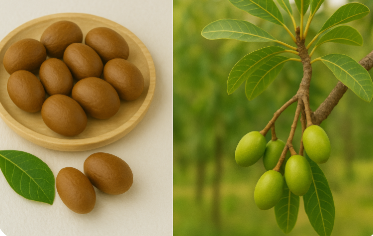
Botanical Classification:
- Kingdom: Plantae
- Order: Sapindales
- Family: Sapotaceae
- Genus: Butyrospermum
- Species: Butyrospermum parkii
Plant Characteristics:
- Growth Form: The Shea tree is a large, evergreen tree that can grow up to 15-20 meters (49-66 feet) in height. It has a broad, spreading canopy and a trunk with a rough, greyish bark.
- Leaves: The leaves of the Shea tree are leathery, elliptic to lance-shaped, and dark green. They are typically 10-20 cm (4-8 inches) long, with a glossy appearance and are arranged alternately on the branches.
- Flowers: The Shea tree produces small, fragrant flowers that are creamy white or pale yellow. These flowers are borne in clusters and are relatively inconspicuous.
- Fruit: The fruit is a green, fleshy drupe that ripens to a yellowish-brown color. It contains a single large seed, known as the shea nut, which is encased in a thick, fibrous shell.
Chemical Composition and Structure:
- Shea Butter:The primary product derived from Butyrospermum parkiiis shea butter, extracted from the seeds. Shea butter is composed of:
- Stearic Acid: Approximately 30-50%
- Oleic Acid: Approximately 40-60%
- Linoleic Acid: Approximately 3-10%
- Palmitic Acid: Approximately 4-8%
- Other Components: It also contains triterpenes, phytosterols, and vitamins A, E, and F, which enhance its skin-nourishing and antioxidant properties.
How to Cultivate It:
- Soil: Shea trees grow best in well-drained, sandy loam soils. They are adaptable to various soil types but prefer moderately fertile conditions.
- Climate: The tree thrives in a tropical climate with distinct wet and dry seasons, preferring temperatures between 25-40°C (77-104°F). It is drought-tolerant but benefits from sufficient rainfall.
- Watering: While drought-resistant once established, young trees benefit from regular watering during dry periods. Adequate irrigation is crucial during the initial stages of growth.
- Propagation: Shea trees are usually propagated from seeds. The seeds should be collected from mature fruits and sown in prepared nursery beds. Once seedlings are large enough, they can be transplanted.
Uses and Benefits:
- Skincare: Shea butter is used in a variety of skincare products due to its moisturizing, anti-inflammatory, and emollient properties. It helps to hydrate, soothe, and improve the elasticity of the skin.
- Haircare: It is also used in hair products to condition and nourish the hair and scalp, reducing dryness and enhancing shine.
- Medicinal: In traditional medicine, shea butter is applied to treat minor burns, wounds, and skin irritations. It has anti-inflammatory and healing properties.
- Culinary: In some African regions, shea butter is used as a cooking fat and in traditional dishes.
Applications:
- Cosmetics and Personal Care: Shea butter is a common ingredient in lotions, creams, soaps, and lip balms. Its rich, hydrating qualities make it ideal for many cosmetic formulations.
- Pharmaceuticals: Its soothing and healing properties make it useful in topical treatments for conditions like eczema and psoriasis.
- Food Industry: Although less common, shea butter can be found in some food products and confections in West Africa.
Environmental and Safety Considerations:
- Environmental Impact: The Shea tree plays a vital role in its native ecosystem, preventing soil erosion and providing habitat for wildlife. Sustainable harvesting practices are crucial to minimize environmental impact.
- Safety: Shea butter is generally safe for topical use and is well-tolerated by most skin types. However, individuals with nut allergies should be cautious as it is derived from a nut.
Studies
It is mainly made up of fatty acids (1).
- 28-56% Stearic acid
- 34-61% Oleic acid
- Gallic acid
The trees that provide a higher content of these fatty acids are those from West Africa rather than from East Africa.
Medicine.
It is used in traditional medicine for the treatment of various diseases, including inflammation and fever. This is an ethyl acetate capable of exerting an anti-inflammatory and anti-rheumatoid action (2).
Two derivatives, glucosylcucurbic acid and methyl glucosylcucurbate, were recently isolated from the shea kernel. These and their derivatives of cucurbic acid and cucurbate methyl, were evaluated for their melanogenesis-inhibiting cancer properties (3).
For more information:

