



Sunflower (Helianthus annuus) is an annual herbaceous plant belonging to the botanical family Asteraceae. It is characterized by a tall, sturdy stem, large heart-shaped leaves and the typical large flower head (capitulum), with bright yellow ray florets on the outside and darker disc florets in the center, from which the achenes commonly known as “sunflower seeds” develop. It is widely cultivated worldwide both as an ornamental plant and as an oilseed crop.
As a food ingredient, Helianthus annuus provides mainly sunflower seeds and sunflower oil. The seeds, eaten whole (hulled) or lightly toasted, are used in snacks, muesli, baked goods, salads and cereal bars, and contain mostly unsaturated fats, plant proteins, fiber, vitamin E and minerals such as magnesium and selenium. Sunflower oil, extracted from the seeds, is used as a dressing and cooking oil, in mayonnaise, sauces and preserves, as well as an ingredient in many processed foods.
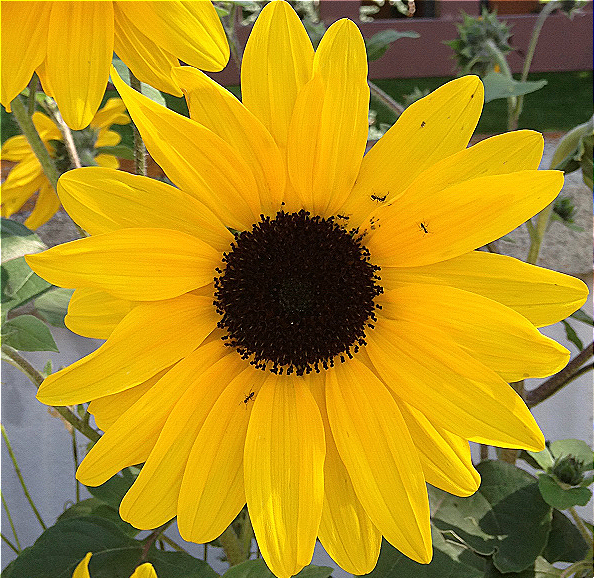
Botanical Classification:
- Kingdom: Plantae
- Order: Asterales
- Family: Asteraceae
- Genus: Helianthus
- Species: Helianthus annuus
Plant Characteristics:
- Growth Form: Helianthus annuus is an upright, herbaceous annual that typically grows to a height of 1.5 to 3 meters (5 to 10 feet). It has a robust, erect stem with large, coarse leaves.
- Leaves: The leaves are broad, ovate to lanceolate, and can be up to 30 cm (12 inches) long. They are typically rough-textured and have a coarsely toothed margin.
- Flowers: The plant is famous for its large, composite flower heads, which consist of numerous small florets arranged in a spiral pattern. The outer florets are yellow and resemble petals, while the inner florets are typically brown or purple. Flower heads can reach up to 30 cm (12 inches) in diameter.
- Fruit: The fruit is a large, single-seeded achene, commonly referred to as a sunflower seed. The seeds are encased in a hard shell and are often harvested for their edible kernels.
Chemical Composition and Structure:
- Oil: Sunflower seeds are a rich source of oil, primarily composed of unsaturated fatty acids, including linoleic acid (omega-6) and oleic acid (omega-9). Sunflower oil is known for its light flavor and high smoke point.
- Proteins: The seeds contain proteins such as albumin and globulin, which are used in various food products and supplements.
- Vitamins and Minerals: Sunflower seeds are a good source of vitamin E, which is an antioxidant, as well as B vitamins, particularly folate. They also provide important minerals like magnesium, selenium, and zinc.
- Phytochemicals: Sunflower seeds contain phytosterols, which can help lower cholesterol levels, and various phenolic compounds that offer antioxidant benefits.
How to Cultivate It:
- Soil: Sunflowers prefer well-drained, loamy soils with a pH between 6.0 and 7.5. They are tolerant of a range of soil types but grow best in fertile soils.
- Climate: Sunflowers thrive in full sun and require warm temperatures for optimal growth. They are typically grown in temperate climates but can also adapt to a range of conditions.
- Watering: Regular watering is essential, especially during dry periods. However, sunflowers are relatively drought-tolerant once established.
- Propagation: Sunflowers are usually propagated from seeds. Seeds should be sown directly into the soil after the last frost date, at a depth of about 2.5 cm (1 inch).
- Maintenance: The plants require minimal maintenance. Regular weeding and occasional watering are generally sufficient. Support may be needed for tall varieties to prevent wind damage.
Uses and Benefits:
- Culinary Uses: Sunflower seeds are consumed as a snack, in granola bars, and as an ingredient in various dishes. Sunflower oil is used for cooking, salad dressings, and as a base for margarine.
- Industrial Uses: Sunflower oil is utilized in the production of biodiesel and as a base for various industrial applications. The plant's biomass can be used as animal feed or in composting.
- Ornamental Uses: Sunflowers are popular in gardens and floral arrangements due to their striking appearance and bright colors.
Applications:
- Food Industry: Sunflower seeds and oil are widely used in baking, cooking, and food processing. The seeds are also a source of protein and essential fatty acids.
- Cosmetics and Personal Care: Sunflower oil is used in skincare products for its moisturizing properties and as a carrier oil for essential oils.
- Agriculture: Sunflowers are grown for their seeds, which can be used as livestock feed or for extracting oil. They are also used in crop rotation systems to improve soil health.
Environmental and Safety Considerations:
- Environmental Impact: Sunflowers are relatively low-maintenance and can be grown in various soil types, making them an environmentally friendly crop. However, they may require synthetic fertilizers and pesticides in commercial farming.
- Safety: Sunflower seeds and oil are generally safe for consumption. However, people with allergies to sunflower seeds should avoid them. Sunflower oil is considered safe for cooking, but its high omega-6 fatty acid content should be balanced with other dietary fats.
Sunflowerseed oils
The seeds contain a percentage of oil ranging from 35% to 42%.
There are three types of this oil:
Sunflowerseed oil or Linoleic sunflower oil
This is the most common sunflower oil with lower levels of saturated fats (11%) and vitamins E, F and linoleic acid. Linoleic acid contains omega6.
Use:
- in frying, oil tends to oxidize, like all oils
- raw to season the salad
Sunflowerseed oil - high oleic acid
A version with lower levels (8.5%) of saturated fats and vitamins E, F
Use:
- in frying, oil tends to oxidize, like all oils
- raw to season the salad
Sunflowerseed oil - mid oleic acid (mid-oleic acid sunflower oil) or NuSun sunflower oil or with a medium oleic content
Version like the previous one, with lower level (9%) of saturated fats and vitamins E, F.
Use:
- in frying, oil tends to oxidize, like all oils
- raw to season the salad
Sunflower oil studies
In this study a review of the advancements in the development of sunflower oil varieties containing high stearic (∼18%) and high oleic (∼70%) acids which makes them healthy and sustainable alternatives to palm oil. First, the high-stearic-high-oleic sunflower crops can have grain and oil yield as high as 4036 and 1685 kg/ha and oleic and stearic acid yield up to ∼73 and ∼21%. Second, high-stearic-high-oleic oils obtained from mutant and hybrid sunflower cultivars have higher oxidative stability index and therefore have better stability, quality, and functionality than regular sunflower oil. Given this progress, natural healthy high-stearic-high-oleic sunflower oil can now be grown in both the hemispheres in a sustainable manner with the currently available advanced technology and without damaging the ecosystem as is currently happening with palm oil cultivation (1).
Sunflower oil has sodium content, but also stand out for high content of niacin, vitamin B6, folates, vitamin E and high amount of linoleic acid.
Sunflower oil and olive oil
The aim of this study was to compare the in vivo effects of a diet rich in virgin olive oil or sunflower oil on the lipid profile and on LDL susceptibility to oxidative modification in free-living Spanish male patients with peripheral vascular disease. A total of 20 Spanish male subjects diagnosed with peripheral vascular disease were randomly divided into two groups (n = 10) receiving different supplements, virgin olive oil and sunflower oil for 4 months. The adaptation of patients to the experimental supplements was demonstrated since plasma and LDL fatty acids composition reflected dietary fatty acids. No differences in triglycerides, total cholesterol, LDL-cholesterol or HDL-cholesterol concentrations were found between the groups of patients. A significantly higher LDL susceptibility to oxidation was observed after sunflower oil intake in comparison with virgin olive oil, in spite of an increase in LDL alpha-tocopherol concentration in sunflower oil group. The results of the present study provide further evidence that sunflower-oil-enriched diets does not protect LDL against oxidation as virgin olive oil does in patients with peripheral vascular disease (2). Copyright 2003 Elsevier Ltd.
Oxidation
Lipid oxidation causes changes in quality attributes of vegetable oils. Synthetic antioxidants have been used to preserve oils; however, there is interest in replacing them with natural ones. Garlic and its thiosulfinate compound allicin are known for their antioxidant activities. This study assesses a novel formulation, the supercritical fluid extract of garlic, on sunflower oil oxidation during an accelerated shelf-life test. The oxidative degradation of oily samples can be limited by using supercritical fluid extract of garlic as it is a safe and an effective natural antioxidant formulation (3). © 2016 Society of Chemical Industry.

