Aspergillus is a genus of filamentous fungi (moulds) belonging to the phylum Ascomycota. They grow as powdery or velvety colonies on organic substrates such as cereals, dried fruit, spices, bread and animal feed, especially under favourable humidity and temperature conditions. The genus includes numerous species, some considered useful and others potentially harmful.
As an “ingredient” or processing aid in the food sector, some selected and controlled species – in particular Aspergillus oryzae – are used in the traditional production of fermented foods (such as miso, soy sauce, sake), where they help break down starches and proteins and contribute to the development of characteristic aromas. Other species, such as Aspergillus flavus or Aspergillus parasiticus, can produce mycotoxins (e.g. aflatoxins) and are regarded as undesirable food contaminants, which is why strict controls are applied along the agri-food chain.
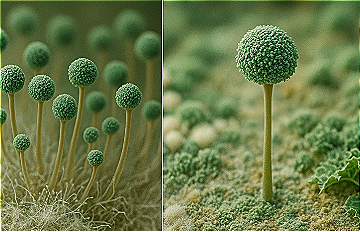
Botanical Classification:
Kingdom: Fungi
Division: Ascomycota
Class: Eurotiomycetes
Order: Eurotiales
Family: Aspergillaceae
Genus: Aspergillus
Characteristics:
The genus Aspergillus is characterized by:
Morphology: Aspergillus species typically produce conidiophores, which are specialized structures that bear conidia (asexual spores). These conidiophores are often branched, and the conidia are produced in large quantities.
Colony Appearance: Colonies of Aspergillus on solid media can appear fluffy or powdery, and the color can vary widely depending on the species, ranging from green to black to yellow.
Growth Conditions: Aspergillus species grow well at a variety of temperatures, generally from 20°C to 37°C. They can thrive in various substrates, including organic matter, grains, and even in harsh conditions.
Chemical Composition and Structure:
The chemical composition of Aspergillus includes:
Cell Wall Polysaccharides: The cell wall is composed of polysaccharides such as glucans and chitin, which provide structural integrity.
Secondary Metabolites: Various species of Aspergillus produce secondary metabolites including mycotoxins (such as aflatoxins and ochratoxins) and other bioactive compounds with potential medicinal and industrial applications.
Proteins and Enzymes: Aspergillus species are known for their production of extracellular enzymes, such as amylases, proteases, and cellulases, which are valuable in industrial processes.
Uses and Benefits:
Biotechnological Applications: Aspergillus species are used in the production of enzymes (e.g., amylases and proteases) that are crucial for various industrial processes, including food and beverage production and detergent manufacturing.
Medicinal: Some species produce antibiotics (e.g., penicillin derivatives) and other pharmaceuticals that are used in medical treatments.
Industrial: Used in the fermentation process to produce acids, alcohols, and other chemicals. They also play a role in the production of traditional fermented foods such as soy sauce and miso.
Research: Aspergillus species serve as model organisms in research due to their well-understood genetics and biochemistry.
Applications:
Industrial Fermentation: Employed in the production of enzymes and other biochemicals used in food processing, detergent manufacturing, and biofuel production.
Pharmaceuticals: Used to produce antibiotics and other medicinal compounds.
Food Industry: Contributes to the production of fermented products and additives.
Environmental Management: Some species are used in bioremediation to degrade pollutants and waste products.
Cosmetics
Aspergillus/rosa damascena leaf/rice ferment filtrate
Hydrolyzed Aspergillus/Euglena/Rice Ferment
Aspergillus/rosa damascena leaf/rice ferment filtrate
Environmental and Safety Considerations:
Environmental Impact: Aspergillus species play a role in decomposing organic matter, contributing to nutrient recycling. However, some species can produce harmful mycotoxins that pose risks to human health and the environment.
Safety: While many species are beneficial, certain Aspergillus species can be pathogenic to humans and animals, particularly in immunocompromised individuals. Proper handling and monitoring are essential to prevent exposure to toxic mycotoxins.
References__________________________________________________________________________
Klich MA. Health effects of Aspergillus in food and air. Toxicol Ind Health. 2009 Oct-Nov;25(9-10):657-67. doi: 10.1177/0748233709348271.
Abstract. This review summarizes the health aspects of the medically important fungal genus Aspergillus. The morphology and systematics of the genus are explained as well as its biogeography. Major mycotoxins, the aspergilli that produce them, affected crops, and symptoms of the toxicoses are summarized, as are the major mycoses caused by aspergilli. The current status of the relationship between Aspergillus in the indoor environment and health issues are discussed.
Buzina W. Aspergillus--classification and antifungal susceptibilities. Curr Pharm Des. 2013;19(20):3615-28. doi: 10.2174/1381612811319200005.
Abstract. Aspergillus is one of the most important fungal genera for the man, for its industrial use, its ability to spoil food and not least its medical impact as cause of a variety of diseases. Currently hundreds of species of Aspergillus are known; nearly fifty of them are able to cause infections in humans and animals. Recently, the genus Aspergillus is subdivided into 8 subgenera and 22 sections. The spectrum of diseases caused by Aspergillus species varies from superficial cutaneous to invasive and systemic infections. All species of Aspergillus investigated so far are resistant against the antifungals fluconazole and 5-fluorocytosine, the range of susceptibilities to currently available antifungals is discussed in this paper.
Janssens I, Lambrecht BN, Van Braeckel E. Aspergillus and the Lung. Semin Respir Crit Care Med. 2024 Feb;45(1):3-20. doi: 10.1055/s-0043-1777259.
Abstract. The filamentous fungus Aspergillus causes a wide spectrum of diseases in the human lung, with Aspergillus fumigatus being the most pathogenic and allergenic subspecies. The broad range of clinical syndromes that can develop from the presence of Aspergillus in the respiratory tract is determined by the interaction between host and pathogen. In this review, an oversight of the different clinical entities of pulmonary aspergillosis is given, categorized by their main pathophysiological mechanisms. The underlying immune processes are discussed, and the main clinical, radiological, biochemical, microbiological, and histopathological findings are summarized.
Pitt JI. The current role of Aspergillus and Penicillium in human and animal health. J Med Vet Mycol. 1994;32 Suppl 1:17-32.
Abstract. Aspergillus and Penicillium are ubiquitous fungi, usually found as saprophytes. Only a few species are considered to be important in human or animal disease. However, many otherwise benign species are supreme opportunists and have been found increasingly as invaders of the immuno-compromised. This paper first describes with a broad brush modern approaches to the classification of these genera, the reasons behind some name changes and the effective forces now acting to stabilize names. Recent taxonomic schemes are described. The taxonomy of pathogenic Aspergillus and Penicillium species is outlined, the subgenera where pathogens occur identified, and the question of why particular species are pathogens addressed. The significance of Aspergillus and Penicillium in mammalian disease is heightened by their production of potent mycotoxins. The importance of Aspergillus flavus and aflatoxins as a cause of human death in parts of Africa and Asia and the impact of ochratoxins, produced by Penicillium verrucosum, on human and animal health in Europe will be emphasized. Possible mycotoxin ingestion from spores poses a further health threat.
Mamo FT, Abate BA, Zheng Y, Nie C, He M, Liu Y. Distribution of Aspergillus Fungi and Recent Aflatoxin Reports, Health Risks, and Advances in Developments of Biological Mitigation Strategies in China. Toxins (Basel). 2021 Sep 24;13(10):678. doi: 10.3390/toxins13100678.
Abstract. Aflatoxins (AFs) are secondary metabolites that represent serious threats to human and animal health. They are mainly produced by strains of the saprophytic fungus Aspergillus flavus, which are abundantly distributed across agricultural commodities. AF contamination is receiving increasing attention by researchers, food producers, and policy makers in China, and several interesting review papers have been published, that mainly focused on occurrences of AFs in agricultural commodities in China. The goal of this review is to provide a wider scale and up-to-date overview of AF occurrences in different agricultural products and of the distribution of A. flavus across different food and feed categories and in Chinese traditional herbal medicines in China, for the period 2000-2020. We also highlight the health impacts of chronic dietary AF exposure, the recent advances in biological AF mitigation strategies in China, and recent Chinese AF standards.
Valencia-Quintana R, Milić M, Jakšić D, Šegvić Klarić M, Tenorio-Arvide MG, Pérez-Flores GA, Bonassi S, Sánchez-Alarcón J. Environment Changes, Aflatoxins, and Health Issues, a Review. Int J Environ Res Public Health. 2020 Oct 27;17(21):7850. doi: 10.3390/ijerph17217850.
Abstract. Crops contaminated by aflatoxins (AFs), the toxic and carcinogenic mycotoxins produced namely by Aspergillus flavus and Aspergillus parasiticus, have severe impacts on human health. Changes in temperature and water availability related to actual climate changes (increased temperature, heavy rainfalls, and droughts) are modulating factors of mould growth and production of mycotoxins. To protect human and animal health from the harmful effects caused by AFs, the development of a safe and effective multifaceted approach in combating food and feed contamination with AFs is necessary. This review aims to collect and analyze the available information regarding AF presence in food and feed to reinforce AF management and to prevent health issues related to the AF exposure in the light of actual climate changes.




