L’Aspergillus è un genere di funghi filamentosi (muffe) appartenenti al phylum Ascomycota. Crescono come colonie polverose o vellutate su substrati organici come cereali, frutta secca, spezie, pane e mangimi, soprattutto in condizioni di umidità e temperatura favorevoli. Comprende numerose specie, alcune considerate utili, altre potenzialmente dannose.
Come “ingrediente” o coadiuvante tecnologico nel settore alimentare, alcune specie selezionate e controllate – in particolare Aspergillus oryzae – sono utilizzate nella produzione tradizionale di alimenti fermentati (ad esempio miso, salsa di soia, sakè), dove contribuiscono alla scomposizione di amidi e proteine e allo sviluppo di aromi caratteristici. Altre specie, come Aspergillus flavus o Aspergillus parasiticus, possono invece produrre micotossine (es. aflatossine) e sono considerate contaminanti indesiderati degli alimenti, motivo per cui vengono effettuati rigorosi controlli nella filiera agro–alimentare.
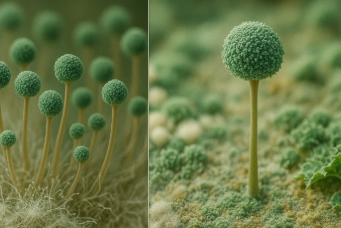
Classificazione botanica:
Regno: Fungi
Divisione: Ascomycota
Classe: Eurotiomycetes
Ordine: Eurotiales
Famiglia: Aspergillaceae
Genere: Aspergillus
Caratteristiche:
Il genere Aspergillus è caratterizzato da:
Morfologia: Le specie di Aspergillus producono tipicamente conidiòfori, strutture specializzate che portano i conidi (spore asessuali). Questi conidiòfori sono spesso ramificati, e i conidi sono prodotti in grandi quantità.
Aspetto delle colonie: Le colonie di Aspergillus su terreni solidi possono apparire soffici o polverose, e il colore può variare ampiamente a seconda della specie, andando dal verde al nero fino al giallo.
Condizioni di crescita: Le specie di Aspergillus crescono bene a una varietà di temperature, generalmente tra 20°C e 37°C. Possono prosperare su vari substrati, inclusi materiali organici, cereali e persino in condizioni avverse.
Composizione Chimica e struttura:
La composizione chimica di Aspergillus include:
Polisaccaridi della parete cellulare: La parete cellulare è composta da polisaccaridi come glucani e chitina, che forniscono integrità strutturale.
Metaboliti secondari: Diverse specie di Aspergillus producono metaboliti secondari, inclusi micotossine (come aflatossine e ocratossine) e altri composti bioattivi con potenziali applicazioni medicinali e industriali.
Proteine ed enzimi: Le specie di Aspergillus sono note per la produzione di enzimi extracellulari, come amilasi, proteasi e cellulasi, che sono preziosi nei processi industriali.
Usi:
Applicazioni biotecnologiche: Le specie di Aspergillus sono utilizzate nella produzione di enzimi (ad es. amilasi e proteasi) che sono cruciali per vari processi industriali, inclusi la produzione di alimenti e bevande e la fabbricazione di detersivi.
Medicinali: Alcune specie producono antibiotici (ad es. derivati della penicillina) e altri farmaci utilizzati nei trattamenti medici.
Industriali: Utilizzate nel processo di fermentazione per produrre acidi, alcoli e altri chimici. Giocano anche un ruolo nella produzione di alimenti fermentati tradizionali come salsa di soia e miso.
Ricerca: Le specie di Aspergillus servono come organismi modello nella ricerca grazie alla loro genetica e biochimica ben comprese
Applicazioni:
Fermentazione industriale: Impiegato nella produzione di enzimi e altri biochimici utilizzati nella lavorazione alimentare, nella produzione di detersivi e nei biocarburanti.
Farmaceutica: Utilizzato per produrre antibiotici e altri composti medicinali.
Industria alimentare: Contribuisce alla produzione di prodotti fermentati e additivi.
Gestione Ambientale: Alcune specie sono utilizzate nella bioremediation per degradare inquinanti e prodotti di scarto.
Cosmetica
Aspergillus/Buckwheat Ferment Extract
Hydrolyzed Aspergillus/Euglena/Rice Ferment
Aspergillus/rosa damascena leaf/rice ferment filtrate
Considerazioni ambientali e di sicurezza:
Impatto ambientale: Le specie di Aspergillus giocano un ruolo nella decomposizione della materia organica, contribuendo al riciclo dei nutrienti. Tuttavia, alcune specie possono produrre micotossine dannose che rappresentano rischi per la salute umana e ambientale.
Sicurezza: Anche se molte specie sono benefiche, alcune specie di Aspergillus possono essere patogene per gli esseri umani e gli animali, in particolare per gli individui immunocompromessi. È essenziale adottare pratiche di laboratorio adeguate per prevenire l'esposizione a micotossine tossiche.
Bibliografia__________________________________________________________________________
Klich MA. Health effects of Aspergillus in food and air. Toxicol Ind Health. 2009 Oct-Nov;25(9-10):657-67. doi: 10.1177/0748233709348271.
Abstract. This review summarizes the health aspects of the medically important fungal genus Aspergillus. The morphology and systematics of the genus are explained as well as its biogeography. Major mycotoxins, the aspergilli that produce them, affected crops, and symptoms of the toxicoses are summarized, as are the major mycoses caused by aspergilli. The current status of the relationship between Aspergillus in the indoor environment and health issues are discussed.
Buzina W. Aspergillus--classification and antifungal susceptibilities. Curr Pharm Des. 2013;19(20):3615-28. doi: 10.2174/1381612811319200005.
Abstract. Aspergillus is one of the most important fungal genera for the man, for its industrial use, its ability to spoil food and not least its medical impact as cause of a variety of diseases. Currently hundreds of species of Aspergillus are known; nearly fifty of them are able to cause infections in humans and animals. Recently, the genus Aspergillus is subdivided into 8 subgenera and 22 sections. The spectrum of diseases caused by Aspergillus species varies from superficial cutaneous to invasive and systemic infections. All species of Aspergillus investigated so far are resistant against the antifungals fluconazole and 5-fluorocytosine, the range of susceptibilities to currently available antifungals is discussed in this paper.
Janssens I, Lambrecht BN, Van Braeckel E. Aspergillus and the Lung. Semin Respir Crit Care Med. 2024 Feb;45(1):3-20. doi: 10.1055/s-0043-1777259.
Abstract. The filamentous fungus Aspergillus causes a wide spectrum of diseases in the human lung, with Aspergillus fumigatus being the most pathogenic and allergenic subspecies. The broad range of clinical syndromes that can develop from the presence of Aspergillus in the respiratory tract is determined by the interaction between host and pathogen. In this review, an oversight of the different clinical entities of pulmonary aspergillosis is given, categorized by their main pathophysiological mechanisms. The underlying immune processes are discussed, and the main clinical, radiological, biochemical, microbiological, and histopathological findings are summarized.
Pitt JI. The current role of Aspergillus and Penicillium in human and animal health. J Med Vet Mycol. 1994;32 Suppl 1:17-32.
Abstract. Aspergillus and Penicillium are ubiquitous fungi, usually found as saprophytes. Only a few species are considered to be important in human or animal disease. However, many otherwise benign species are supreme opportunists and have been found increasingly as invaders of the immuno-compromised. This paper first describes with a broad brush modern approaches to the classification of these genera, the reasons behind some name changes and the effective forces now acting to stabilize names. Recent taxonomic schemes are described. The taxonomy of pathogenic Aspergillus and Penicillium species is outlined, the subgenera where pathogens occur identified, and the question of why particular species are pathogens addressed. The significance of Aspergillus and Penicillium in mammalian disease is heightened by their production of potent mycotoxins. The importance of Aspergillus flavus and aflatoxins as a cause of human death in parts of Africa and Asia and the impact of ochratoxins, produced by Penicillium verrucosum, on human and animal health in Europe will be emphasized. Possible mycotoxin ingestion from spores poses a further health threat.
Mamo FT, Abate BA, Zheng Y, Nie C, He M, Liu Y. Distribution of Aspergillus Fungi and Recent Aflatoxin Reports, Health Risks, and Advances in Developments of Biological Mitigation Strategies in China. Toxins (Basel). 2021 Sep 24;13(10):678. doi: 10.3390/toxins13100678.
Abstract. Aflatoxins (AFs) are secondary metabolites that represent serious threats to human and animal health. They are mainly produced by strains of the saprophytic fungus Aspergillus flavus, which are abundantly distributed across agricultural commodities. AF contamination is receiving increasing attention by researchers, food producers, and policy makers in China, and several interesting review papers have been published, that mainly focused on occurrences of AFs in agricultural commodities in China. The goal of this review is to provide a wider scale and up-to-date overview of AF occurrences in different agricultural products and of the distribution of A. flavus across different food and feed categories and in Chinese traditional herbal medicines in China, for the period 2000-2020. We also highlight the health impacts of chronic dietary AF exposure, the recent advances in biological AF mitigation strategies in China, and recent Chinese AF standards.
Valencia-Quintana R, Milić M, Jakšić D, Šegvić Klarić M, Tenorio-Arvide MG, Pérez-Flores GA, Bonassi S, Sánchez-Alarcón J. Environment Changes, Aflatoxins, and Health Issues, a Review. Int J Environ Res Public Health. 2020 Oct 27;17(21):7850. doi: 10.3390/ijerph17217850.
Abstract. Crops contaminated by aflatoxins (AFs), the toxic and carcinogenic mycotoxins produced namely by Aspergillus flavus and Aspergillus parasiticus, have severe impacts on human health. Changes in temperature and water availability related to actual climate changes (increased temperature, heavy rainfalls, and droughts) are modulating factors of mould growth and production of mycotoxins. To protect human and animal health from the harmful effects caused by AFs, the development of a safe and effective multifaceted approach in combating food and feed contamination with AFs is necessary. This review aims to collect and analyze the available information regarding AF presence in food and feed to reinforce AF management and to prevent health issues related to the AF exposure in the light of actual climate changes.




