



Myrtle (Myrtus communis)
Description
Myrtus communis, commonly known as myrtle, is an evergreen shrub of the Myrtaceae family, typical of Mediterranean scrub in coastal and hilly areas. It usually reaches 1–3 metres in height and forms dense, compact bushes with numerous woody branches. The small, opposite, lanceolate leaves are leathery, glossy on the upper surface and rich in oil glands visible against the light, responsible for the characteristic balsamic–resinous scent. Flowers are white to pale pink, solitary or in small axillary clusters, with numerous showy stamens. The fruits are spherical berries, typically blue–black (or whitish/yellowish in some varieties), used in traditional liqueurs, culinary preparations and as a source of bioactive compounds of interest in food, herbal and cosmetic applications.
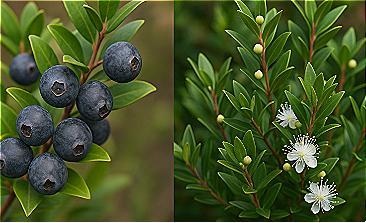
Common name: myrtle
Scientific name: Myrtus communis
Family: Myrtaceae
Genus: Myrtus
Origin: Mediterranean area (Southern Europe, North Africa, Asia Minor)
Growth habit: evergreen, aromatic shrub, dense and well-branched, usually 1–3 m tall
Cultivation and growing conditions
Climate
A typical Mediterranean species: prefers mild climates, with mild winters and hot, dry summers.
Tolerates short, light frosts (around –5 °C) but can be damaged by more intense or prolonged cold.
In colder regions it is better grown in a sheltered position or in large containers that can be protected in winter.
Exposure
Likes sunny positions or light partial shade.
In full sun it develops a compact crown and good flowering, with higher production of aromatic leaves.
In deep shade it tends to flower poorly and grow weakly.
Soil
Adapts to many soil types, but prefers well-drained, moderately fertile soils, from slightly acidic to neutral.
Tolerates poor, stony and calcareous soils typical of Mediterranean coasts, provided there is no waterlogging.
In pots, a good universal potting mix with added sand or pumice is recommended to improve drainage.
Irrigation
Once well established it is fairly drought tolerant.
During the first years after planting and in very hot summers, regular watering is useful, allowing the soil to dry slightly between waterings.
Avoid prolonged waterlogging, which can cause root rot.
Temperature
Optimal growth between 18 and 28 °C.
Not suitable for very harsh climates; in cold winters it is helpful to mulch the base and, if grown in pots, move it to a protected place.
Cold, dry winds can damage leaves and young shoots.
Fertilization
Moderate nutrient requirements.
In spring, apply mature organic fertilizer (compost, well-rotted manure) or a slow-release granular fertilizer for evergreen shrubs.
Heavy feeding is not necessary: excess nitrogen encourages soft growth that is more sensitive to cold and pests.
Cultivation care
Can be left in its natural form or pruned to create hedges and borders.
Major pruning is done after flowering or at the end of winter, shortening untidy branches and maintaining the desired shape.
Generally not very prone to pests; under stress it may be attacked by scale insects or aphids, which should be controlled promptly.
In very compact soils, shallow cultivation and periodic addition of organic matter are useful.
Harvest
Leaves can be harvested all year round, preferably from current-year shoots that are not too woody; they are used fresh or dried as a flavouring.
Flowers, white and fragrant, appear in late spring–early summer and can be harvested for ornamental or aromatic use.
Berries, blue–violet in colour, ripen in autumn–early winter and are picked when fully coloured for culinary use (liqueurs, flavourings) or for ornament.
Propagation
By semi-woody cuttings: the most common method; in summer or late summer, take cuttings from current-year shoots and root them in a light substrate (peat and sand) kept moist and in a sheltered place.
By seed: possible but slower; sow in spring after a light stratification, and be aware that young plants take several years to reach a good size.
By layering: less common but feasible, bending a flexible branch to the ground and burying part of it until roots form.
Indicative nutritional values per 100 g (fresh berries)
(Indicative values; in practice, myrtle berries are consumed in much smaller amounts.)
Energy: ~60–80 kcal
Water: ~70–80 g
Total carbohydrates: ~15–18 g
sugars: ~10–14 g
Total dietary fibre: ~5–8 g
Protein: ~1.5–3 g
Total fat: ~1–3 g
SFA (saturated fatty acids): minor fraction
MUFA (monounsaturated fatty acids): moderate (mainly oleic acid)
PUFA (polyunsaturated fatty acids): relevant share (mainly linoleic acid, n-6)
TFA (natural trans fatty acids): negligible
Vitamins: vitamin C, carotenoids (provitamin A), small amounts of B-group vitamins
Minerals: potassium, calcium, magnesium, iron, manganese
Other: organic acids (malic, citric, tartaric), tannins, anthocyanins (especially in dark berries)
Key constituents
Essential oil (leaves and berries, chemotype-dependent)
α-pinene
1,8-cineole (eucalyptol)
limonene
linalool
α-terpineol
myrtenyl acetate and other terpene esters
Phenolic compounds
gallic, caffeic, chlorogenic and other phenolic acids
ellagic acid derivatives and hydrolysable tannins
proanthocyanidins, especially in berries
Flavonoids and anthocyanins
quercetin, myricetin and their glycosides
anthocyanins responsible for blue–violet colour in dark berries
Lipid fraction (mainly in seeds)
linoleic acid (n-6), oleic acid, palmitic acid
Vitamins and minerals
vitamin C, carotenoids, potassium, calcium, magnesium, iron
Production process
Selection and harvesting of plant material (leaves, berries, sometimes flowers) according to intended use (food, herbal, cosmetic).
Manual or mechanical harvesting of ripe berries (often dark varieties) typically from late autumn to winter for liqueur production.
Cleaning and sorting to remove branches, damaged fruits, foreign matter and soil residues.
For liqueur production:
maceration of cleaned berries in food-grade ethanol for several weeks/months,
pressing/filtration of the macerate,
addition of sugar syrup (water + sugar, sometimes honey),
maturation, clarification and final filtration before bottling.
For extracts and essential oils:
gentle drying of leaves (and sometimes berries) for dry extracts,
steam distillation of leaves (or aerial parts) to obtain essential oil.
Storage and packaging:
dried leaves or berries in airtight containers, protected from light and moisture,
essential oil in well-filled dark glass bottles,
liqueur in glass bottles, stored preferably away from light and heat.
Physical properties
Evergreen shrub with dense, woody, bushy habit.
Fresh leaves: small, lanceolate, glossy, leathery, with numerous oil glands visible against the light.
Berries: spherical, about 5–8 mm in diameter, smooth skin, colour from blue–black to violet (dark forms) or whitish/yellow–waxy (white forms), with aromatic pulp and small seeds.
Essential oil: clear to pale yellow, low-viscosity liquid with high volatility and intense balsamic–resinous odour.
Myrtle liqueur: clear or slightly opalescent liquid; ruby–violet colour in “red” myrtle (from dark berries) or straw–yellow in “white” myrtle; moderate viscosity depending on sugar content.
Sensory and technological properties
Aroma: strongly aromatic, balsamic and resinous, with pine-, eucalyptus-, citrus- and spicy-like notes; leaves give more resinous, camphoraceous notes, berries more fruity and tannic notes.
Taste: berries are sweet–tart with perceptible tannins; liqueur is sweet, warm, aromatic and gently astringent, with a persistent balsamic aftertaste.
Colouring capability: berry extracts confer intense red–violet tones to liqueurs, syrups and other products thanks to anthocyanins.
Technological functionality:
natural colouring (berry extracts),
contribution to antioxidant and mild antimicrobial effects via phenolics and essential oils,
high aroma stability in hydroalcoholic matrices (liqueurs).
Food applications
Fresh or dried berries in:
traditional myrtle liqueurs (“red” and “white” myrtle),
syrups, aromatic reductions, sweet sauces,
flavouring of game dishes, lamb or pork, especially in regional Mediterranean cuisines.
Leaves in:
flavouring of roasted meats (also used as aromatic “bed” or wrapping),
brines, marinades and light smoking processes,
herbal infusions and teas, sometimes combined with other Mediterranean herbs.
Industrial derivatives:
natural flavours for beverages, bakery products, sauces and ice cream bases,
functional extracts for food supplements (where legally permitted).
Nutrition and health
Myrtle berries provide fibre, phenolics, anthocyanins and essential fatty acids (mainly linoleic), contributing to the overall antioxidant and functional profile of the diet when consumed in appropriate forms.
Experimental studies report antioxidant, antimicrobial and potential modulatory effects on glucose and lipid metabolism for berry and leaf extracts (mainly preclinical data).
Myrtle liqueur carries part of the berry phenolic content but is an alcoholic, sugary product; consumption should therefore remain moderate and compatible with a balanced dietary pattern.
Essential oil, rich in oxygenated monoterpenes such as α-pinene and 1,8-cineole, is used in balsamic and herbal preparations but must be handled with care and within controlled formulations and doses.
Portion note
Fresh or dried berries used as a culinary ingredient: typically a few grams per serving (e.g. 5–20 g in meat dishes or artisanal preparations).
Myrtle liqueur: commonly 20–40 mL as an after-meal drink, to be counted within daily alcohol and calorie intake.
Extracts and essential oil: only within formulated products (supplements, herbal preparations, functional products) following manufacturer instructions and professional advice.
Allergens and intolerances
Myrtle is not among the major regulated food allergens in EU legislation.
Individual sensitivities may occur to specific components of the essential oil or to tannins in susceptible individuals.
In composite products (liqueurs, industrial preparations), other allergens (e.g. sulphites, milk components in creams, nuts in confectionery) may be present; labels must be checked carefully.
Storage and shelf-life
Fresh berries: 2–5 days in the refrigerator, with progressive loss of firmness and aroma intensity.
Dried berries: up to ~12 months in hermetically sealed containers, protected from light, heat and moisture.
Dried leaves: indicative shelf-life 12–18 months under cool, dry, dark conditions.
Myrtle liqueur: relatively stable alcoholic product, with best-before dates usually of several years; colour and aroma can slowly evolve over time.
Essential oil: typical shelf-life 2–3 years in dark glass bottles, well closed and stored at moderate temperature; oxidation reduces sensory quality and may increase irritant potential.
Safety and regulatory
Cultivation, harvesting, processing and bottling must follow GMP and HACCP principles, with particular attention to water quality, equipment hygiene and traceability.
Use of myrtle essential oil in foods, supplements and cosmetics is subject to safety standards and specific guidance for essential oils (maximum levels, permitted categories, mode of use).
Myrtle liqueur is governed by general EU and national rules on liqueurs and spirits (minimum alcoholic strength, sugar content, labelling requirements) and, where applicable, by product specifications for typical/geo-indicated products.
Ingestion of pure essential oil is not recommended; special care is required in pregnancy, breastfeeding, in children and in individuals with liver or respiratory diseases.
Labelling
Raw botanical material (leaves, berries)
sales name (“myrtle leaves”, “myrtle berries”), origin, net weight, lot number, best-before date, storage instructions.
Myrtle liqueur
sales name (“myrtle liqueur” or equivalent), alcoholic strength, volume, full ingredient list (alcohol, berry macerate/infusion, sugar, other ingredients if present), lot number, best-before or expiry date if applicable, producer/bottler details.
Essential oil
botanical name Myrtus communis, plant part used (leaves, leaves and twigs), extraction method (steam distillation), country of origin, warnings and hazard statements where required.
Cosmetic products
INCI declaration (e.g. “Myrtus Communis Leaf Oil”, “Myrtus Communis Fruit Extract”) in the ingredient list.
Troubleshooting
Loss of aroma in dried leaves or berries
Causes: slow or high-temperature drying, exposure to light and air, permeable packaging.
Actions: optimise drying conditions, use opaque airtight containers, shorten storage times.
Marked browning of dried berries
Causes: oxidation of anthocyanins and tannins, high humidity, prolonged storage.
Actions: improve humidity control, reduce storage temperature and time.
Cloudy liqueur or sediment formation
Causes: insufficient filtration, precipitation of phenolics or sugars during maturation and temperature fluctuations.
Actions: finer filtration, cold stabilisation, consistent maturation conditions.
Colour variation between batches of liqueur
Causes: differences in ripeness, dark/white berry ratio, maceration time and temperature.
Actions: standardise raw material selection and process parameters.
Sustainability and supply chain
Myrtle is native to Mediterranean scrub and can be cultivated or harvested under controlled conditions with relatively low environmental impact when wild populations are not overexploited.
It can contribute to crop diversification in marginal and drought-prone areas, with lower water needs than many intensive crops.
Processing into liqueurs, extracts and essential oils generates by-products (pomace, distillation residues) that can be recovered as sources of polyphenols, functional ingredients or biomass for energy.
Proper management of distillation effluents and process water includes monitoring BOD and COD and adopting suitable treatment systems.
Short supply chains, territorial branding and quality schemes (e.g. organic certification, geographical indications) support both environmental and economic sustainability of myrtle-based products.
Main INCI functions (cosmetics)
fragrance / perfuming – provides balsamic, resinous and slightly citrus notes in skin care, hair care and oral care products.
skin conditioning – contributes to a perception of toned, fresh skin in gels, lotions and cleansers.
masking – helps mask unpleasant odours from other raw materials.
antioxidant – polyphenol-rich extracts can help protect the product and, to some extent, the skin from oxidative processes.
astringent – due to tannins; useful in toners and products for combination or oily skin.
purifying – used in formulations aimed at skin exposed to pollutants or with excess sebum/impurities.
Conclusion
Myrtus communis is a symbolic species of the Mediterranean landscape, combining gastronomic, cultural and phytotherapeutic value. Berries and leaves, rich in essential oil and phenolics, are widely used in traditional liqueurs, foods, herbal preparations, supplements and cosmetics, while the plant itself represents a key resource for high-value local supply chains. Sound agronomic management, appropriate processing and strict adherence to safety and regulatory requirements allow myrtle to be exploited sustainably, supporting both biodiversity and the identity of the territories where it has deep historical roots.
Mini-glossary
SFA – Saturated fatty acids: fatty acids without double bonds; excessive intake relative to unsaturated fats may be associated with increased cardiovascular risk.
MUFA – Monounsaturated fatty acids: fatty acids with one double bond; generally considered favourable when they replace saturated fats in the diet.
PUFA – Polyunsaturated fatty acids: fatty acids with two or more double bonds (n-6 and n-3 families); contribute to normal heart function as part of a balanced diet.
TFA – Trans fatty acids: fatty acids with at least one trans double bond; intake should be kept as low as possible, although myrtle itself contains at most natural traces.
GMP – Good manufacturing practices: manufacturing and hygiene rules that ensure product safety, quality and consistency.
HACCP – Hazard analysis and critical control points: preventive system for identifying and controlling hazards along food and related production chains.
BOD – Biological oxygen demand: indicator of biodegradable organic load in wastewater, expressed as the oxygen required by microorganisms to degrade organic matter.
COD – Chemical oxygen demand: indicator of the total amount of oxidisable substances in wastewater, expressed as the equivalent oxygen required for their chemical oxidation.

