



Shea butter glycerides: properties, uses, pros, cons, safety
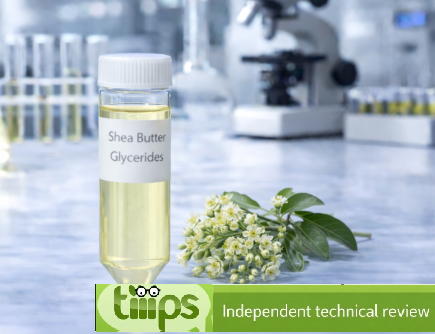
Shea butter glycerides are lipid derivatives obtained from shea butter (Butyrospermum parkii/Vitellaria paradoxa, family Sapotaceae). Technically, they are a fraction of glycerides (a mixture of mono-, di- and triglycerides) obtained through processing of shea butter, with the aim of delivering an ingredient that is more formulation-friendly than the raw butter while retaining an emollient signature and good compatibility with cosmetic systems (emulsions and cleansing products). In practice, their value is linked to rheology, sensoriality, and contribution to formula structure.
Definition
It is not a single molecule: it is a mixture of glycerides with acyl chains reflecting the lipid profile of shea butter (typically dominated by C18 and C16 fractions). Depending on process and supplier, the ingredient can be engineered to increase performance as a co-emulsifier, to improve emulsion stability, and/or to provide conditioning in skin and hair products. Real performance depends on the mono/di/tri-glyceride distribution and the fatty-acid profile.
Main uses
Food.
Not relevant: it is primarily intended for cosmetics/personal care (not a standardized food additive).
Cosmetics.
Broad use in creams, lotions, balms, body products, lip products, cleansers, and shampoos/conditioners, where it can contribute to creamy sensoriality, reduced post-cleansing dryness, and improved stability/texture.
INCI functions.
Surfactant - Emulsifying agent. Emulsions are thermodynamically unstable and are used to soothe or soften the skin and to emulsify, therefore they require a specific stabilizing ingredient. This ingredient forms a film, lowers surface tension, and makes two immiscible liquids miscible. A very important factor affecting emulsion stability is the amount of emulsifying agent. Emulsifiers reduce the oil/water or water/oil interfacial tension, improve emulsion stability, and can directly influence stability, sensorial properties, and the surface tension of sunscreen filters, modulating film-forming performance.
Emulsion stabilizer. Emulsions are thermodynamically unstable. Emulsion stabilizers improve the formation and stability of single and double emulsions as well as their shelf-life. It should be noted that, in the structure-function relationship, the molecular mass of the ingredient used plays an important role.
Hair conditioning agent. In shampoo formulations a relevant number of ingredients can coexist with specific and targeted purposes: detergents, conditioners, thickeners, opacifiers, chelating agents, fragrances, preservatives, special additives. However, indispensable ingredients are detergents and conditioners, as they are necessary and sufficient for hair cleansing and manageability. The others have accessory commercial functions and are not indispensable, such as: aesthetic appearance, fragrance, coloring, etc. Hair conditioning agents increase shine, manageability and volume, and reduce static electricity, especially after treatments such as coloring, straightening, perming, drying and brushing. In practice, they are dispersants that may contain cationic surfactants, thickeners, emollients, polymers. Types of hair conditioning agents include: intensive conditioners, instant conditioners, thickening conditioners, blow-drying conditioners. They can generally perform their role alongside other different ingredients.
Surfactant - Cleansing agent. Cosmetic products used to cleanse the skin use surfactant action that lowers the surface tension of the stratum corneum, facilitating removal of dirt and impurities.
Surfactant - Foam booster. It introduces gas bubbles into water and affects the cleansing process by helping to spread the cleanser. Since sebum inhibits bubbles, a second shampoo typically produces more foam.
Medicine.
Not an active substance. Any uses are technical/sensorial and depend on the finished form.
Pharmaceutical.
Possible use as an excipient/structuring agent in certain topicals, with assessment based on supplier specifications and the finished product dossier.
Industrial use.
Functional lipid raw material to provide structure and stability to emulsion or cleansing systems, with better repeatability than unmodified butter (given equivalent specifications).
Key constituents
The chemical core consists of glycerides with acyl chains typically attributable to common fatty acids found in shea butter (e.g., stearic, oleic, palmitic, linoleic). It is important to distinguish:
The glyceridic fraction (driver of structure, slip, and surfactant/co-emulsifier behavior).
The potential residual unsaponifiable fraction of shea butter (phytosterols and triterpenes), which may be present to variable extent depending on how the derivative is produced.
Technical note: “free glycerin” is not typically a main constituent when referring to “glycerides”; what matters is the esterified structure (glycerol + fatty acids), unless the supplier specification indicates otherwise.
Nutritional use note and bioactive compounds
It is not a food ingredient. In a cosmetic context, any residual unsaponifiables (phytosterols/triterpenes) can support a “skin comfort” positioning, but practical effect must be assessed on the finished product, without automatically transferring the profile of raw butter to the derivative.
Identification data and specifications
| Characteristic | Value |
|---|---|
| INCI name | Shea butter glycerides |
| Botanical source | Butyrospermum parkii/Vitellaria paradoxa (family Sapotaceae) |
| Type | mixture of mono-, di- and triglycerides (lipid derivative) |
| CAS number | 194043-92-0 |
| Molecular formula | not applicable (mixture) |
| Molecular weight | not applicable (mixture) |
| Variability note | depends on fatty-acid profile, mono/di/tri distribution, and residual unsaponifiable fraction |
Physico-chemical properties (indicative)
| Characteristic | Indicative value | Note |
|---|---|---|
| Physical state | semi-solid/creamy | depends on glyceride distribution |
| Color | white → pale yellow | batch and refining dependent |
| Odor | mild, typical lipid/nutty | depends on deodorization level |
| Water solubility | insoluble | lipid nature |
| Solubility in oils | good | compatible with oil phase |
| Emulsion compatibility | good | often useful as co-emulsifier/structurant |
| Sensorial effect | emollient, “creamy slip” | depends on dose and system |
Functional role and mechanism of action (practical)
Its main contribution is structural and sensorial:
In emulsions, it can help lower interfacial tension and support formation of more stable systems, affecting viscosity and cream “body”.
In cleansing products, it can modulate foam and post-rinse feel, reducing “stripping” and improving perceived softness.
On skin and hair, the lipid fraction forms a thin film that improves slip and reduces perceived TEWL, resulting in a conditioning effect.
Formulation compatibility
Generally good, but key practical drivers are:
balance with other emulsifiers/surfactants (synergies or interference on rheology),
process temperature (melting and crystallization behavior),
impact on opacity and sensoriality,
long-term stability (texture shifts due to lipid polymorphism if the system is not balanced).
Production process
The process depends on the manufacturer, but can be traced back to the following operational phases:
Selection and preparation of shea butter.
The butter is obtained from the kernels and then filtered/refined according to the required grade (deodorization and impurity reduction where necessary).
Modification/rearrangement of the glyceride fraction.
The butter is transformed to obtain a targeted distribution of mono-, di- and triglycerides. Depending on the technology, this can be achieved via controlled interesterification/transesterification or equivalent processes to “tune” melting point, texture, and performance in emulsions/cleansers.
Purification and removal of residues.
Removal of catalysts/process residues (if present) and treatment for stability and odor (filtration, deodorization, standardization).
Standardization.
Blending and controls to ensure consistent parameters: melting profile, viscosity/consistency, color/odor, and batch quality specifications.
Safety, regulation, and environment
It is generally considered suitable for cosmetic use at normal concentrations, with a typically good tolerability profile, especially when the grade is well controlled and low in impurities. Practical management focuses on batch quality (lipid oxidation, off-odor) and supply-chain hygiene.
Allergen.
Not typically classified as an allergen. In highly reactive subjects, as with many vegetable lipid derivatives, individual sensitivities are possible, rare, and dependent on the finished product.
Contraindications (brief).
Use caution on extremely sensitive skin if the formula also contains other potential irritants; assessment must be made on the finished product. In very rich leave-on products, consider the risk of “heavy” feel or perceived comedogenicity in some users.
Environment.
Sustainability depends on traceability and responsible sourcing/production practices for shea. Responsible supply chains and control of local impacts are the main drivers; compared with raw butter, the derivative can offer improved formulation efficiency (less variability and fewer reformulation losses).
Formulation troubleshooting
Cream “graining” or texture changes over time.
Action: rebalance the oil phase, optimize the cooling profile, evaluate co-structurants, and manage polymorphism.
Emulsion instability (separation).
Action: review the emulsifying system (HLB/co-emulsifiers), dose and addition order; verify shear and temperature.
Cleanser with low foam or too “film-forming” feel.
Action: optimize surfactant/foam-booster ratio, reduce dose or modulate the lipid fraction; verify compatibility with electrolytes.
Conclusion
Shea butter glycerides are a glyceridic derivative of shea butter designed to deliver emollience, structure, and improved formulation handling in emulsions and cleansing systems. Their technical value lies in the ability to modulate texture, stability, and sensoriality, with a generally favorable safety profile when the grade is controlled and consistent batch-to-batch.
Mini-glossary
Glycerides. Esters of glycerol with fatty acids (mono-, di-, triglycerides). Benefit: define structure and sensorial behavior of cosmetic lipids.
TEWL. Transepidermal water loss. Benefit: parameter related to skin barrier function.
HLB. Hydrophilic-lipophilic balance, a practical indicator to select emulsifiers. Benefit: supports the design of stable emulsions.
Lipid polymorphism. Ability of lipids to crystallize in different forms. Benefit: explains changes in consistency and “graining” over time.

