Hydrolyzed Verbascum Thapsus Flower: properties, uses, pros, cons, safety
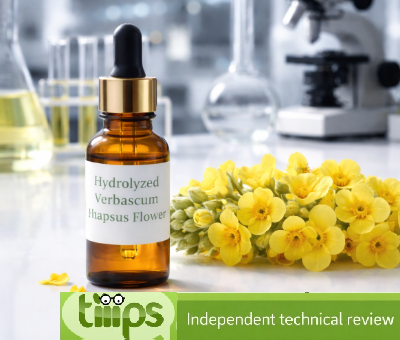
Hydrolyzed Verbascum Thapsus Flower is derived from the hydrolysis of the flowers of the Mullein plant (Verbascum thapsus L.), which belongs to the Scrophulariaceae family. This hydrolyzed extract is widely used in the cosmetic and personal care industry for its enhanced bioavailability and efficacy, offering soothing, anti-inflammatory, and moisturizing properties.
Chemical Composition and Structure
Hydrolyzed Verbascum Thapsus Flower contains a variety of bioactive compounds that contribute to its beneficial properties, including smaller molecular weight compounds resulting from the hydrolysis process:
Flavonoids: Known for their antioxidant and anti-inflammatory effects.
Saponins: Possess antimicrobial properties and aid in skin cleansing.
Mucilage: Provides soothing and emollient effects, helping to moisturize and protect the skin.
Tannins: Have astringent properties, which help to tighten and tone the skin.
Iridoids: Contribute to the anti-inflammatory and antimicrobial activities of the extract.
Hydrolyzed Proteins and Peptides: Smaller molecules that enhance skin penetration and bioactivity.
Physical Properties
Hydrolyzed Verbascum Thapsus Flower typically appears as a yellow to amber liquid. It is soluble in water, making it suitable for various cosmetic formulations. The hydrolyzed extract has a mild, characteristic herbal scent.
Cosmetic and Personal Care Applications
Soothing: Provides a calming effect on irritated and inflamed skin.
Anti-inflammatory: Helps to reduce redness, swelling, and discomfort associated with skin conditions.
Moisturizing: Enhances hydration by improving skin moisture retention.
Astringent: Tightens and tones the skin, making it appear firmer and smoother.
Enhanced Penetration: The hydrolyzed form allows for better absorption and efficacy of the bioactive compounds.
Cosmetics - INCI Functions
Antioxidant agent. Ingredient that counteracts oxidative stress and prevents cell damage. Free radicals, pathological inflammatory processes, reactive nitrogen species and reactive oxygen species are responsible for the ageing process and many diseases caused by oxidation.
Skin protectant. It creates a protective barrier on the skin to defend it from harmful substances, irritants,allergens, pathogens that can cause various inflammatory conditions. These products can also improve the natural skin barrier and in most cases more than one is needed to achieve an effective result.
Environmental and Safety Considerations
Hydrolyzed Verbascum Thapsus Flower is generally considered safe for use in cosmetic and personal care products when used within recommended concentrations. It is biodegradable and environmentally friendly. Sustainable harvesting practices are important to ensure the preservation of the Mullein plant and its natural habitats.
References__________________________________________________________________________
Zhang N, Baran A, Valioglu F, Teng L, Atalar MN, Keskin C, Wang XX, Hatipoğlu A, Baran MF, Abdelsalam AH, Arslan S, Necip A, Karadağ M, Alma MH, Eftekhari A, Beilerli A. Antioxidant, AChE inhibitory, and anticancer effects of Verbascum thapsus extract. Cell Mol Biol (Noisy-le-grand). 2023 Dec 20;69(14):211-216. doi: 10.14715/cmb/2023.69.14.35.
Abstract. Verbascum thapsus (VT) is a medicinal plant that is used in folk medicine to treat a variety of ailments. For this study, the biological functions of VT methanol extract were determined in vitro. The plant's methanol extract was created through the maceration process. The phytochemical composition of plant extracts was investigated using liquid chromatography-electrospray ionization tandem mass spectrometry (LC-ESI-MS/MS). The antioxidant capacity of the extract was determined using the DPPH (2,2-diphenyl-1-picrylhydrazil) and ABTS (2,2-azinobis (3-ethylbenzothiazoline-6-sulfonic acid) tests and its cytotoxicity was assessed using the MTT ((3-(4,5-dimethylthiazol-2-yl)-2,5-diphenyltetrazolium bromide, a tetrazole)) assay on the Caco-2 (human colorectal adenocarcinoma cells), LNCaP (Lymph Node Carcinoma of the Prostate), and HEK293 cell lines (Human embryonic kidney 293 cells) used to model colon, prostate, and non-cancerous cells. VT extract showed low DPPH and ABTS radical scavenging activities compared to standard antioxidants at 30 mg/ml concentration. In addition, it was determined that VT extract inhibited acetylcholinesterase enzyme.
Ali N, Ali Shah SW, Shah I, Ahmed G, Ghias M, Khan I, Ali W. Anthelmintic and relaxant activities of Verbascum Thapsus Mullein. BMC Complement Altern Med. 2012 Mar 30;12:29. doi: 10.1186/1472-6882-12-29.
Abstract. Background: Verbascum thapsus is used in tribal medicine as an antispasmodic, anti-tubercular agent and wormicide. In this study, we investigated the antispasmodic and anthelmintic activities of crude aqueous methanolic extract of the plant. Methods: V. thapsus extracts were tested against roundworms (Ascaridia galli) and tapeworms (Raillietina spiralis). Each species of worm was placed into a negative control group, an albendazole treatment group, or a V. thapsus treatment group, and the time taken for paralysis and death was determined. In addition, relaxation activity tests were performed on sections of rabbit's jejunum. Plant extracts were tested on KCl-induced contractions and the relaxation activities were quantified against atropine. V. thapsus calcium chloride curves were constructed to investigate the mode of action of the plant extracts. Results: We detected flavonoids, saponins, tannins, terpenoids, glycosides, carbohydrates, proteins, fats and fixed oils in V. thapsus. For both species of worm, paralysis occurred fastest at the highest concentration of extract. The relative index values for paralysis in A. galli were 4.58, 3.41 and 2.08, at concentrations of 10, 20 and 40 mg/ml of plant extract, respectively. The relative index for death in A. galli suggested that V. thapsus extract is wormicidal at high concentration. Similarly, the relative indexes for paralysis and death in R. spiralis suggested that the extract is a more potent wormicidal agent than albendazole. The mean EC(50) relaxation activity values for spontaneous and KCl induced contractions were 7.5 ± 1.4 mg/ml (6.57-8.01, n = 6) and 7.9 ± 0.41 mg/ml (7.44-8.46, n = 6), respectively. The relaxation activity of the extract was 11.42 ± 2, 17.0 ± 3, 28.5 ± 4, and 128.0 ± 7% of the maximum observed for atropine at corresponding concentrations. The calcium chloride curves showed that V. thapsus extracts (3 mg/ml), had a mean EC(50) (log molar [calcium]) value of -1.9 ± 0.06 (-1.87 - -1.98, n = 6) vs. control EC(50) = -2.5 ± 0.12 (-2.37 - -2.56, n = 6), whereas the verapamil (0.1 μM) EC(50) was -1.7 ± 0.1 (-1.6 - -1.8, n = 6) vs. control EC(50) = -2.4 ± 0.09 (-2.3 - -2.47, n = 5).
Calabrese G, Zappalà A, Dolcimascolo A, Acquaviva R, Parenti R, Malfa GA. Phytochemical Analysis and Anti-Inflammatory and Anti-Osteoarthritic Bioactive Potential of Verbascum thapsus L. (Scrophulariaceae) Leaf Extract Evaluated in Two In Vitro Models of Inflammation and Osteoarthritis. Molecules. 2021 Sep 5;26(17):5392. doi: 10.3390/molecules26175392.
Abstract. Osteoarthritis (OA) is a complex disease, source of pain and disability that affects millions of people worldwide. OA etiology is complex, multifactorial and joint-specific, with genetic, biological and biomechanical components. Recently, several studies have suggested a potential adjuvant role for natural extracts on OA progression, in terms of moderating chondrocyte inflammation and following cartilage injury, thus resulting in an overall improvement of joint pain. In this study, we first analyzed the phenylethanoid glycosides profile and the total amount of polyphenols present in a leaf aqueous extract of Verbascum thapsus L. We then investigated the anti-inflammatory and anti-osteoarthritic bioactive potential of the extract in murine monocyte/macrophage-like cells (RAW 264.7) and in human chondrocyte cells (HC), by gene expression analysis of specifics inflammatory cytokines, pro-inflammatory enzymes and metalloproteases. Six phenylethanoid glycosides were identified and the total phenolic content was 124.0 ± 0.7 mg gallic acid equivalent (GAE)/g of extract. The biological investigation showed that the extract is able to significantly decrease most of the cellular inflammatory markers, compared to both control cells and cells treated with Harpagophytum procumbens (Burch.) DC. ex Meisn, used as a positive control. Verbascum thapsus leaf aqueous extract has the potential to moderate the inflammatory response, representing an innovative possible approach for the inflammatory joint disease treatment.




