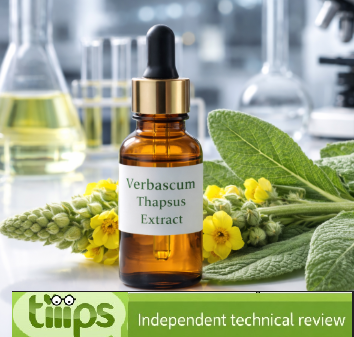
Verbascum Thapsus Extract è derivato dai fiori, dalle foglie e dai gambi della pianta di Verbasco (Verbascum thapsus L.), appartenente alla famiglia delle Scrophulariaceae. Questo estratto è ampiamente utilizzato nell'industria cosmetica e per la cura personale per le sue proprietà lenitive, antinfiammatorie e antimicrobiche, nonché per la sua capacità di condizionare e proteggere la pelle.
Composizione chimica e struttura
L'Estratto di Verbascum Thapsus contiene una varietà di composti bioattivi che contribuiscono alle sue proprietà benefiche:
Flavonoidi: Conosciuti per i loro effetti antiossidanti e antinfiammatori.
Saponine: Possiedono proprietà antimicrobiche e aiutano nella pulizia della pelle.
Mucillagine: Fornisce effetti lenitivi ed emollienti, aiutando a idratare e proteggere la pelle.
Tannini: Hanno proprietà astringenti, che aiutano a rassodare e tonificare la pelle.
Iridoidi: Contribuiscono alle attività antinfiammatorie e antimicrobiche dell'estratto.
Proprietà fisiche
L'Estratto di Verbascum Thapsus si presenta tipicamente come un liquido o una polvere di colore giallo o marrone. È solubile in acqua e alcol, rendendolo adatto a varie formulazioni cosmetiche. L'estratto ha un leggero profumo erbaceo caratteristico.
Applicazioni cosmetiche e per la cura personale
Lenitivo: Fornisce un effetto calmante sulla pelle irritata e infiammata.
Antinfiammatorio: Aiuta a ridurre il rossore, il gonfiore e il disagio associati a condizioni della pelle.
Antimicrobico: Protegge la pelle dai microrganismi nocivi e aiuta a prevenire le infezioni.
Astringente: Rassoda e tonifica la pelle, rendendola più compatta e liscia.
Idratante: Il contenuto di mucillagine aiuta a trattenere l'umidità nella pelle, fornendo idratazione e protezione.
Cosmetica - Funzioni INCI
Agente condizionante della pelle. Rappresenta il perno del trattamento topico della pelle in quanto ha la funzione di ripristinare, aumentare o migliorare la tolleranza cutanea a fattori esterni, compresa la tolleranza dei melanociti. La funzione più importante dell'agente condizionante è prevenire la disidratazione della pelle, ma il tema è piuttosto complesso e coinvolge emollienti ed umettanti che possono essere aggiunti nella formulazione.
CAS 90064-13-4 EC number 290-074-2
Smoothing. La funzione di questo componente è di rendere la superficie della pelle più uniforme, riducendo le rugosità e le irregolarità.
Considerazioni ambientali e di sicurezza
L'Estratto di Verbascum Thapsus è generalmente considerato sicuro per l'uso nei prodotti cosmetici e per la cura personale quando utilizzato nelle concentrazioni raccomandate. È biodegradabile e rispettoso dell'ambiente. Le pratiche di raccolta sostenibile sono importanti per garantire la preservazione della pianta di Verbasco e dei suoi habitat naturali.
Bibliografia__________________________________________________________________________
Zhang N, Baran A, Valioglu F, Teng L, Atalar MN, Keskin C, Wang XX, Hatipoğlu A, Baran MF, Abdelsalam AH, Arslan S, Necip A, Karadağ M, Alma MH, Eftekhari A, Beilerli A. Antioxidant, AChE inhibitory, and anticancer effects of Verbascum thapsus extract. Cell Mol Biol (Noisy-le-grand). 2023 Dec 20;69(14):211-216. doi: 10.14715/cmb/2023.69.14.35.
Abstract. Verbascum thapsus (VT) is a medicinal plant that is used in folk medicine to treat a variety of ailments. For this study, the biological functions of VT methanol extract were determined in vitro. The plant's methanol extract was created through the maceration process. The phytochemical composition of plant extracts was investigated using liquid chromatography-electrospray ionization tandem mass spectrometry (LC-ESI-MS/MS). The antioxidant capacity of the extract was determined using the DPPH (2,2-diphenyl-1-picrylhydrazil) and ABTS (2,2-azinobis (3-ethylbenzothiazoline-6-sulfonic acid) tests and its cytotoxicity was assessed using the MTT ((3-(4,5-dimethylthiazol-2-yl)-2,5-diphenyltetrazolium bromide, a tetrazole)) assay on the Caco-2 (human colorectal adenocarcinoma cells), LNCaP (Lymph Node Carcinoma of the Prostate), and HEK293 cell lines (Human embryonic kidney 293 cells) used to model colon, prostate, and non-cancerous cells. VT extract showed low DPPH and ABTS radical scavenging activities compared to standard antioxidants at 30 mg/ml concentration. In addition, it was determined that VT extract inhibited acetylcholinesterase enzyme.
Ali N, Ali Shah SW, Shah I, Ahmed G, Ghias M, Khan I, Ali W. Anthelmintic and relaxant activities of Verbascum Thapsus Mullein. BMC Complement Altern Med. 2012 Mar 30;12:29. doi: 10.1186/1472-6882-12-29.
Abstract. Background: Verbascum thapsus is used in tribal medicine as an antispasmodic, anti-tubercular agent and wormicide. In this study, we investigated the antispasmodic and anthelmintic activities of crude aqueous methanolic extract of the plant. Methods: V. thapsus extracts were tested against roundworms (Ascaridia galli) and tapeworms (Raillietina spiralis). Each species of worm was placed into a negative control group, an albendazole treatment group, or a V. thapsus treatment group, and the time taken for paralysis and death was determined. In addition, relaxation activity tests were performed on sections of rabbit's jejunum. Plant extracts were tested on KCl-induced contractions and the relaxation activities were quantified against atropine. V. thapsus calcium chloride curves were constructed to investigate the mode of action of the plant extracts. Results: We detected flavonoids, saponins, tannins, terpenoids, glycosides, carbohydrates, proteins, fats and fixed oils in V. thapsus. For both species of worm, paralysis occurred fastest at the highest concentration of extract. The relative index values for paralysis in A. galli were 4.58, 3.41 and 2.08, at concentrations of 10, 20 and 40 mg/ml of plant extract, respectively. The relative index for death in A. galli suggested that V. thapsus extract is wormicidal at high concentration. Similarly, the relative indexes for paralysis and death in R. spiralis suggested that the extract is a more potent wormicidal agent than albendazole. The mean EC(50) relaxation activity values for spontaneous and KCl induced contractions were 7.5 ± 1.4 mg/ml (6.57-8.01, n = 6) and 7.9 ± 0.41 mg/ml (7.44-8.46, n = 6), respectively. The relaxation activity of the extract was 11.42 ± 2, 17.0 ± 3, 28.5 ± 4, and 128.0 ± 7% of the maximum observed for atropine at corresponding concentrations. The calcium chloride curves showed that V. thapsus extracts (3 mg/ml), had a mean EC(50) (log molar [calcium]) value of -1.9 ± 0.06 (-1.87 - -1.98, n = 6) vs. control EC(50) = -2.5 ± 0.12 (-2.37 - -2.56, n = 6), whereas the verapamil (0.1 μM) EC(50) was -1.7 ± 0.1 (-1.6 - -1.8, n = 6) vs. control EC(50) = -2.4 ± 0.09 (-2.3 - -2.47, n = 5).
Calabrese G, Zappalà A, Dolcimascolo A, Acquaviva R, Parenti R, Malfa GA. Phytochemical Analysis and Anti-Inflammatory and Anti-Osteoarthritic Bioactive Potential of Verbascum thapsus L. (Scrophulariaceae) Leaf Extract Evaluated in Two In Vitro Models of Inflammation and Osteoarthritis. Molecules. 2021 Sep 5;26(17):5392. doi: 10.3390/molecules26175392.
Abstract. Osteoarthritis (OA) is a complex disease, source of pain and disability that affects millions of people worldwide. OA etiology is complex, multifactorial and joint-specific, with genetic, biological and biomechanical components. Recently, several studies have suggested a potential adjuvant role for natural extracts on OA progression, in terms of moderating chondrocyte inflammation and following cartilage injury, thus resulting in an overall improvement of joint pain. In this study, we first analyzed the phenylethanoid glycosides profile and the total amount of polyphenols present in a leaf aqueous extract of Verbascum thapsus L. We then investigated the anti-inflammatory and anti-osteoarthritic bioactive potential of the extract in murine monocyte/macrophage-like cells (RAW 264.7) and in human chondrocyte cells (HC), by gene expression analysis of specifics inflammatory cytokines, pro-inflammatory enzymes and metalloproteases. Six phenylethanoid glycosides were identified and the total phenolic content was 124.0 ± 0.7 mg gallic acid equivalent (GAE)/g of extract. The biological investigation showed that the extract is able to significantly decrease most of the cellular inflammatory markers, compared to both control cells and cells treated with Harpagophytum procumbens (Burch.) DC. ex Meisn, used as a positive control. Verbascum thapsus leaf aqueous extract has the potential to moderate the inflammatory response, representing an innovative possible approach for the inflammatory joint disease treatment.




