



Ceratonia Siliqua Fruit Extract – carob fruit extract, INCI functions, composition, cosmetic uses, and formulation notes
Ceratonia Siliqua Fruit Extract
Fruit extract of Ceratonia siliqua – family Fabaceae (syn. Leguminosae)
Synonyms: carob fruit extract, carob extract, locust bean fruit extract
INCI / functions: skin conditioning, masking (and, in some ingredient databases/INCI interpretations, also a fragrance contribution)
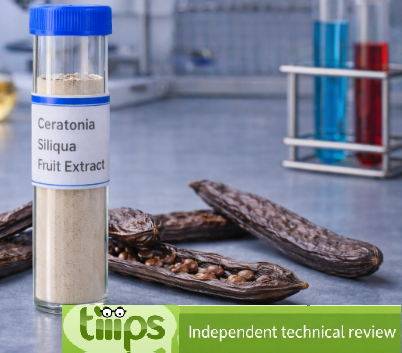
Definition
Ceratonia Siliqua Fruit Extract is an extract obtained from the fruit (pod/pulp) of the carob tree, Ceratonia siliqua (family Fabaceae). From a compositional standpoint, the ingredient is a complex mixture whose fingerprint depends on the solvent (water, hydro-glycolic mixtures, alcohol/water), the plant-to-solvent ratio, and any standardization: it typically contains sugars and carbohydrate fractions (characteristic of the pulp), phenolic components (polyphenols/tannins, grade-dependent), as well as minor plant constituents and trace minerals. In cosmetic formulation it is mainly used as a conditioning ingredient (supporting skin feel) and as a contributor to odor masking/olfactive nuance in selected systems, often associated with warm, sweet tonalities linked to carob.
Food: may be used as a carob extract for aromatic and technological purposes (grade- and category-dependent).
Cosmetics: skin conditioning and masking; potential sensorial/olfactive support in selected formulas.
Medicine: traditional/research interest in fruit fractions (not equivalent to clinical indications for the cosmetic ingredient).
Pharmaceutical: possible interest as a botanical extract in specific formulation contexts (grade and dossier are decisive).
Industrial use: botanical ingredient for technical and aromatic applications (sector-dependent).
Calories (energy value)
| Metric | Value |
|---|---|
| Energy value (100 g) | ~250–400 kcal (indicative range for carbohydrate-rich extracts/powders; depends on standardization) |
| Technical note | used at functional levels in cosmetics: energy impact on the finished product is negligible |
Identification data and specifications
| Identifier | Value |
|---|---|
| INCI name | Ceratonia Siliqua Fruit Extract |
| Botanical origin | Ceratonia siliqua – family Fabaceae |
| Preparation type (common) | extract (solvent extract) |
| CAS number | 84961-45-5 |
| EC number | 284-634-5 |
Key constituents
| Class | Typical components | Technical note |
|---|---|---|
| Carbohydrate fraction | sugars and soluble pulp components | impacts color, viscosity, and potential tack at higher use levels |
| Phenolic fraction (grade-dependent) | polyphenols / tannins | may contribute to oxidative stability and color (variable) |
| Minor constituents | trace minerals and minor plant compounds | batch variability: manage via supplier specifications |
Functional role in formulation
| Function | What it does in the formula | Operational notes |
|---|---|---|
| Skin conditioning | supports skin feel and conditioning positioning | depends on vehicle, concentration, and matrix |
| Masking / olfactive nuance | helps mask base odors or provide olfactive shading | more evident in formulas targeting warm/sweet profiles |
| Sensorial support | can contribute to a “softer” perception | monitor color and potential tack in leave-on products |
Formulation compatibility
In practical terms, Ceratonia Siliqua Fruit Extract is often supplied in aqueous or hydro-glycolic form; compatibility therefore depends both on the extract itself and on the carrier (e.g., glycerin/propanediol). In O/W emulsions, it typically incorporates without major issues into the water phase (or post-emulsification, depending on the supplier dossier), but it is advisable to verify: (i) impact on color (possible darkening or shifts in very light formulas), (ii) impact on viscosity and tack if the extract is rich in sugars, and (iii) olfactive stability over time.
In clear gels and “transparent” systems, the main risks are loss of clarity (haze) and viscosity changes due to interactions with polymers and system electrolytes; testing over 24–48 hours and under thermal cycling is recommended. From a microbiological standpoint, as a botanical material (often with dissolved solids), preservative compatibility is critical and must be validated with a finished-product challenge test.
Use guidelines (indicative)
| Application | Typical range | Technical note |
|---|---|---|
| Leave-on (creams/serums/lotions) | 0.2–2.0% | monitor color, tack, and odor stability |
| Rinse-off (cleansers/masks) | 0.5–5.0% | broader sensorial flexibility; verify preservative compatibility |
| Fragranced products | 0.2–1.5% | assess masking/fragrance contribution and fragrance interactions |
Typical applications
Creams and lotions targeting skin conditioning and a softer sensorial profile.
Products where masking is needed to reduce base notes from botanicals or other “challenging” raw materials.
Rinse-off products (cleansing/masks) where a more “comfort” profile is desired.
Quality, grades and specifications
| QC parameter | What to control |
|---|---|
| Identity | CAS/EC consistency and INCI match on SDS/CoA |
| Solids and carrier | % solids; solvent/carrier (water, glycols, etc.) |
| Sensorial profile | color, odor, changes under heat/light |
| Microbiology | counts and limits per application; essential for aqueous extracts |
| Batch repeatability | acceptance criteria for color/odor and solids range |
Safety, regulatory and environment
As a botanical extract used in cosmetics, Ceratonia Siliqua Fruit Extract is assessed within the safety evaluation of the finished product under EU practice and GMP (Good Manufacturing Practice: quality systems that help control process variability and contamination). The key operational points typically concern (i) microbiological management (especially for aqueous/high-solids extracts), (ii) potential individual sensitivity to complex botanical matrices (handled through finished-product safety assessment), and (iii) the presence of color- and oxidation-sensitive fractions that can influence odor and color over time.
From an environmental perspective, the ingredient is plant-derived and primarily contributes as organic load in process effluents; good practice is to minimize uncontrolled releases and manage wash waters and residues according to internal procedures and local regulation.
Formulation troubleshooting
| Issue | Likely cause | Corrective actions |
|---|---|---|
| Darkening or color shift | oxidation/phenolics, pH compatibility, light exposure | adjust pH target, evaluate compatible antioxidants, barrier packaging, reduce dose |
| Tackiness | high sugar fraction or high dose | reduce dose, balance with less-tacky humectants, optimize rheology |
| Haze in clear gels | polymer interaction or salinity | change polymer, reduce electrolytes, add in the correct phase, filter if applicable |
| Microbiological instability | bioburden and/or insufficient preservative compatibility | tighten raw material specs, optimize preservatives, run challenge testing |
Conclusion
Ceratonia Siliqua Fruit Extract is a Ceratonia siliqua fruit extract used mainly for skin conditioning and masking, with potential sensorial/olfactive support in selected formulas. Successful use depends on grade quality (carrier and solids), control of color and tack, and rigorous management of microbiology and long-term stability.
Mini-glossary
| Term | Meaning | Note |
|---|---|---|
| GMP | Good Manufacturing Practice | quality systems that reduce variability and contamination risk |
| Masking | odor-masking function | useful to reduce undesirable base notes |
| Challenge test | finished-product microbiological test | verifies preservative system effectiveness |
| Solids (extract) | non-volatile dissolved fraction | influences viscosity, tack, and color |

