Oleyl alcohol: what it is, cosmetic uses, safety
General description
Oleyl alcohol is a fatty alcohol widely used in the cosmetics and personal care industries. It can be obtained from natural sources (primarily vegetable-derived lipid fractions and, historically, also from certain animal-derived fractions). It is valued for its emollient and conditioning performance, for improving sensorial properties (slip, spreadability, after-feel), and for functional roles such as solvent and rheology/viscosity modifier in selected formulations.
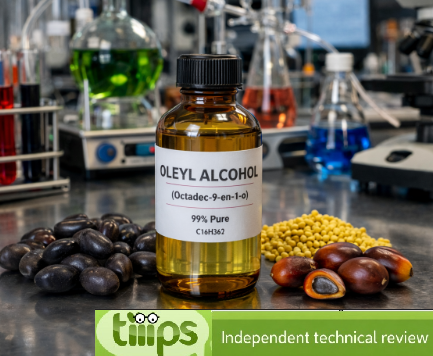
Chemical composition and structure
Oleyl alcohol (chemical name: octadecenol) is an unsaturated fatty alcohol with the chemical formula C18H36O. Its structure is characterized by:
C18 hydrocarbon chain (predominantly lipophilic portion): contributes to emollience, slip, and a softer “skin feel”.
Hydroxyl group (–OH) (polar portion): improves interaction with other formula components and can support the stability of dispersions and emulsions.
| Structural element | Feature | Functional implication |
|---|
| Unsaturated C18 chain | Lipophilic | Emollience, sensorial profile |
| –OH group | Polar | Formula compatibility, stability |
Oleyl alcohol production process
Oleyl alcohol is mainly produced via reduction (hydrogenation) of oleic acid or its esters.
Oleic acid is derived from vegetable oils (e.g., olive, rapeseed/canola, palm) through hydrolysis or transesterification of triglycerides.
Oleic acid (or the corresponding ester) is then subjected to catalytic hydrogenation (typically using nickel-based catalysts) to reduce the carboxylic group to a primary alcohol.
The final product is purified by vacuum distillation.
| Step | Objective | Output |
|---|
| Hydrolysis / transesterification | Obtain oleic acid / esters | Oleic fraction |
| Catalytic hydrogenation | Reduce to alcohol | Crude oleyl alcohol |
| Vacuum distillation | Increase purity | Purified oleyl alcohol |
Physical properties
Oleyl alcohol typically appears as a liquid ranging from colorless to pale yellow, odorless or slightly odorous. It is insoluble in water and soluble in oils and organic solvents, making it suitable for oil phases and many cosmetic bases.
| Parameter | Indicative value |
|---|
| Appearance | Liquid |
| Color | Colorless – pale yellow |
| Odor | None – slight |
| Water solubility | Insoluble |
| Solubility in oils/organic solvents | Good |
Cosmetic and personal care applications
In formulations, oleyl alcohol is used to:
Improve skin and hair feel, slip, and spreadability.
Support the oil phase and compatibility with fragrance oils and lipophilic actives.
Contribute to viscosity management and, in some systems, to the foam profile (in synergy with surfactants).
Typical application examples: creams, lotions, anhydrous or oily serums, balms, hair treatments, and fragranced products.
Cosmetics – INCI functions
Skin conditioning agent – emollient
Emollients support the skin barrier through exogenous lipids that remain on the surface, helping reduce transepidermal water loss and improving softness and comfort.
Fragrance
Improves, masks, or adds scent to the finished product, supporting sensory appeal and consumer perception.
Solvent
Promotes solubilization or dispersion of lipophilic components (oils, oil-soluble colorants, aromas, certain functional ingredients) within the formulation.
Surfactant – foam booster
In specific cleansing bases, it can contribute to the foam profile, supporting product distribution during use.
Perfume
A term associated with particularly pleasant fragrances, used in contexts related to perfumes and aromatic raw materials.
| Identifiers | Value |
|---|
| CAS | 143-28-2; 593-47-5 |
| EC number | 205-597-3; 209-791-9 |
Environmental and safety considerations
Oleyl alcohol is generally considered suitable for use in cosmetic and personal care products at commonly used concentrations. In practical terms:
Use safety: it is commonly described as well tolerated; as with all raw materials, compatibility depends on dose, formulation matrix, and individual sensitivity.
Environmental aspects: when sourced from vegetable supply chains, it can support more sustainable sourcing strategies, provided these are backed by responsible practices and appropriate management of disposal and the supply chain.
References__________________________________________________________________________
Orienti I, Zuccari G, Bergamante V, Fini A, Carosio R, Montaldo PG. Enhancement of oleyl alcohol anti tumor activity through complexation in polyvinylalcohol amphiphilic derivatives. Drug Deliv. 2007 Apr;14(4):209-17. doi: 10.1080/10717540601036898.
Abstract. Oleyl alcohol was complexed with new amphiphilic polyvinylalcohol derivatives with the aim of increasing its aqueous solubility, thus improving bioavailability and favoring its antitumor activity. Water-soluble amphiphilic polymers were prepared by polyvinyl alcohol (PVA) substitution with oleyl chains through a succinyl spacer at 2% and 3% substitution degree. The complexes were obtained by spray-drying hydroalcoholic solutions of the substituted polymers and free oleyl alcohol at different weight ratios (3:1; 5:1; 10:1 w/w). The main physicochemical characteristics of the complexes were analyzed and correlated to the cytotoxic activity of oleyl alcohol toward tumor cell lines. The complexes strongly increased the aqueous solubility of oleyl alcohol and provided oleyl alcohol release in the presence of extractive conditions (simulating in vivo absorption). The complexes obtained by 10:1 polymer:fatty alcohol weight ratio offered higher release rates than the 5:1 and 3:1 ratios, respectively. Complexation also increased oleyl alcohol cytotoxicity toward tumor cells due to increased availability of the active molecule in the aqueous phase. Pure polymers were found to be biocompatible and no toxic effect was detected up to the highest concentration used in the present study (500 mu g/ml). The complexation of oleyl alcohol with the polymers analyzed here efficiently increased the availability of the fatty alcohol in aqueous environment. The enhanced cytotoxicity toward tumor cells of the complexed oleyl alcohol and the polymer biocompatibility make these amphiphilic PVA derivatives interesting candidates for soluble pharmaceutical formulations containing hydrophobic drugs whose therapeutic potential is often underestimated due to unsuitable levels of their aqueous solubilization.
Kováčik A, Kopečná M, Hrdinová I, Opálka L, Boncheva Bettex M, Vávrová K. Time-Dependent Differences in the Effects of Oleic Acid and Oleyl Alcohol on the Human Skin Barrier. Mol Pharm. 2023 Dec 4;20(12):6237-6245. doi: 10.1021/acs.molpharmaceut.3c00648.
Abstract. Oleic acid and oleyl alcohol are commonly used permeation and penetration enhancers to facilitate topical drug delivery. Here, we aimed to better understand the mechanism of their enhancing effects in terms of their interactions with the human skin barrier using diclofenac diethylamine (DIC-DEA), a nonsteroidal anti-inflammatory drug for topical pain management. Oleic acid promoted DIC-DEA permeation through ex vivo human skin more rapidly than oleyl alcohol (both applied at 0.75%) due to fluidization of stratum corneum lipids as revealed by infrared spectroscopy. After 12 h, the effect of these enhancers on DIC-DEA permeation leveled off, fluidization was no longer evident, and skin permeabilization was mainly due to the formation of fluid enhancer-rich domains. Contrary to oleyl alcohol, oleic acid adversely affected two indicators of the skin barrier integrity, transepidermal water loss and skin electrical impedance. The content of oleyl alcohol in the stratum corneum was lower than that of oleic acid (even 12 h after the enhancers were removed from the skin surface), but it caused higher DIC-DEA retention in both epidermis and dermis compared to oleic acid. The effects of oleyl alcohol and oleic acid on DIC-DEA permeation and retention in the skin were similar after a single and repeated application (4 doses every 12 h). Thus, oleyl alcohol offers several advantages over oleic acid for topical drug delivery.
Murota K, Kawada T, Matsui N, Sakakibara M, Takahashi N, Fushiki T. Oleyl alcohol inhibits intestinal long-chain fatty acid absorption in rats. J Nutr Sci Vitaminol (Tokyo). 2000 Dec;46(6):302-8. doi: 10.3177/jnsv.46.302.
Abstract. Long-chain fatty acids are important nutrients, but obesity is the most common nutritional disorder in humans. In this study we investigated the effect of oleyl alcohol on the intestinal long-chain fatty acid absorption in rats. We administered [14C]oleic acid and oleyl alcohol as lipid emulsion intraduodenally in unanesthetized lymph-cannulated rats and measured the lymphatic output of oleic acid. Second, we orally administered lipid emulsion with a stomach tube and measured the luminal and mucosal oleic acid residues. Furthermore, rats were fed oleyl alcohol as a dietary component for 20 days, and fecal lipid and the weight of adipose tissues were measured. In lymph-cannulated rats, triglyceride and [14C]oleic acid output in the lymph were significantly lower in the presence of oleyl alcohol when compared with the absence of oleyl alcohol in a dose-dependent manner. The radioactivity remaining in the intestinal lumen was more strongly detected in rats that had been orally administered oleyl alcohol than in the controls. The feces of rats fed an oleyl-alcohol-added diet contained much higher amounts of lipids, and the weights of their adipose tissues were significantly lower than in the control group. These results suggest that oleyl alcohol inhibits the rat gastrointestinal absorption of long-chain fatty acids in vivo.
Tan BB, Noble AL, Roberts ME, Lear JT, English JS. Allergic contact dermatitis from oleyl alcohol in lipstick cross-reacting with ricinoleic acid in castor oil and lanolin. Contact Dermatitis. 1997 Jul;37(1):41-2. doi: 10.1111/j.1600-0536.1997.tb00380.x. PMID: 9255492.




