



Decapeptide-37: properties, uses, pros, cons, safety
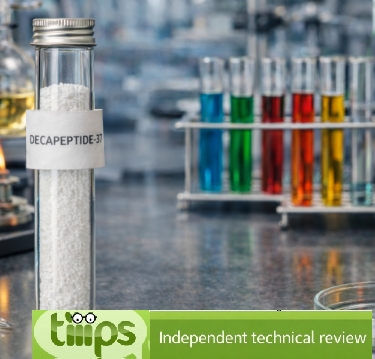
Decapeptide-37 is a synthetic peptide consisting of a chain of 10 amino acids (decapeptide), used in cosmetics as a functional ingredient primarily positioned as a skin conditioning agent.
Synonyms: decapeptide 37 (graphic variant); decapeptide (category).
Definition
Decapeptide-37 belongs to the family of cosmetic peptides, i.e., short amino-acid sequences used in skincare formulations to support the maintenance of good skin condition (alanine, cysteine, histidine, leucine, phenylalanine, proline, tryptophan, and tyrosine). From a chemical-regulatory standpoint, it should not be interpreted as a single universally standardized “molecule” in the literature: in industrial practice, identity is linked to the INCI name and to the manufacturer’s specifications (purity, impurity profile, supply form).
Operationally, cosmetic use is oriented toward supporting comfort and overall formula functionality, with particular attention to peptide stability within the system (pH, preservatives, electrolytes, thermal processing).
It is an abbreviated class of biomolecules and produced by chemical or enzymatic hydrolysis.
Peptides, natural and synthetic, have the ability to activate an immunomodulatory action by interacting with the cells of the immune system.
(Werner GH. Natural and synthetic peptides (other than neuropeptides) endowed with immunomodulating activities. Immunol Lett. 1987 Dec;16(3-4):363-70. doi: 10.1016/0165-2478(87)90170-2. )
For more information: Peptides
What it is used for and where
Cosmetics - INCI Functions
Skin conditioning agent. It is the mainstay of topical skin treatment as it has the function of restoring, increasing or improving skin tolerance to external factors, including melanocyte tolerance. The most important function of the conditioning agent is to prevent skin dehydration, but the subject is rather complex and involves emollients and humectants that can be added in the formulation.
Identification data and specifications
| Characteristic | Value |
|---|---|
| INCI name | Decapeptide-37 |
| synonyms (descriptive) | synthetic peptide with 10 amino acids |
| CAS number | Not uniquely reported in publicly accessible sources (INCI entry/ingredient) |
| EC/EINECS number | Not uniquely reported in publicly accessible sources (INCI entry/ingredient) |
| molecular formula | Not uniquely reported publicly; depends on the defined sequence and the supplied form (salt/counterions) declared by the manufacturer |
| molecular weight | Not uniquely reported publicly; available in the manufacturer’s SDS/CoA when sequence and supplied form are specified |
| typical commercial form | powder or solution, grade-dependent (vehicle/solvent and concentration defined by the supplier) |
| energy value (practical note) | Not applicable in cosmetics; not a labeling parameter for topical use |
Physico-chemical properties (indicative)
| Characteristic | Value | Note |
|---|---|---|
| chemical nature | peptide (oligopeptide) | chain of 10 amino-acid residues |
| solubility | typically good in suitable aqueous systems, grade-dependent | often supplied in a form that supports solubilization |
| pH stability | sensitive to extreme pH | optimal window defined by supplier specifications |
| process sensitivity | potentially sensitive to prolonged heat and oxidants | advisable to limit thermal stress and highly reactive agents |
| preservative compatibility | to be verified case by case | some preservative systems/solvents may affect integrity and performance |
Functional role and practical mechanism of action
In formulation, Decapeptide-37 is used as a peptide “signal/conditioning” type ingredient, with the practical goal of contributing to keeping the skin in good condition and supporting the product’s functional positioning. From a formulator’s standpoint, the determining factor is peptide stability over time: chemical integrity, absence of perceivable degradation (odor/color), and performance consistency across batches.
Formulation compatibility
Compatibility is generally favorable in leave-on systems, but should be verified depending on pH, solvents, preservatives, and electrolyte presence. Typical critical points include: perceived performance loss due to degradation, interactions with “aggressive” preservative systems or high ionic-strength matrices, and sensitivity to prolonged thermal processing. It is recommended to confirm stability through accelerated testing and real-packaging studies, especially for long shelf-life products.
Use guidelines (indicative)
Use is driven by the supplier’s technical documentation (use level, pH window, compatibility). Operationally, it is good practice to add the peptide under non-stressing processing conditions, control final pH, and verify finished-product stability on critical parameters (appearance, odor, pH, viscosity and, where applicable, analytical peptide assay).
Quality, grades, and specifications
Key quality elements include: assay/purity (typically declared on CoA), impurity profile and residual solvents, potential presence of salts/counterions, and batch-to-batch consistency. In many supply chains, quality control may include HPLC for purity and MS for identity/mass confirmation, per supplier standards.
Safety, regulatory, and environment
In cosmetics, safety is assessed on the finished product and on the quality of the raw material. For peptides, practical focus points are: impurity control, selection of a compatible preservative system, and chemical stability to limit degradation products. From a regulatory standpoint, the INCI name supports labeling; any specific restrictions depend on jurisdiction and product dossier.
Implementation of GMP (good manufacturing practice; benefit: reduces variability and contamination) is relevant to ensure repeatability and traceability, especially for high-value ingredients such as peptides.
Formulation troubleshooting
Stability loss (color/odor shift or reduced perceived performance).
Typical cause: thermal stress, out-of-window pH, or oxidation. Action: reduce process stress, return to the pH window, optimize packaging and protection from oxygen/light.
Instability in the presence of certain preservatives or salts.
Typical cause: chemical incompatibility or high ionic strength. Action: screen compatible preservatives, reduce electrolytes, confirm via accelerated testing and analytical control where available.
Conclusion
Decapeptide-37 is a cosmetic peptide with 10 residues used primarily as a skin conditioning ingredient in leave-on formulas. Technical management centers on grade quality (purity and specifications), compatibility with pH/preservatives, and stability over time. Robust supplier qualification and finished-product stability testing are the most decisive factors for repeatable outcomes.
Mini-glossary
Peptide: a short chain of amino acids linked by peptide bonds.
Oligopeptide: a peptide of limited length (typically a small number of residues).
HPLC: high-performance liquid chromatography; useful for purity control.
MS: mass spectrometry; useful for identity/mass confirmation.
GMP: good manufacturing practice; benefit: improves quality control and reduces contamination/variability.

