



Tetrapeptide-79: properties, uses, pros, cons, safety
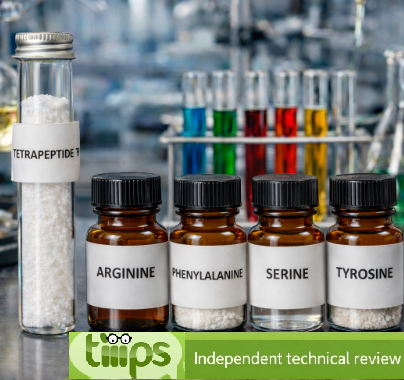
Tetrapeptide-79 (Tetrapeptide-79) – a synthetic peptide consisting of four amino acids (arginine, phenylalanine, serine, and tyrosine), used in cosmetics as a low-dose “active” for skin conditioning and, depending on the supplier concept, support of skin comfort/tolerability.
Synonyms: tetrapeptide composed of arginine/phenylalanine/serine/tyrosine (descriptive); Tetrapeptide-79 (EN)
INCI: Tetrapeptide-79
Definition
Tetrapeptide-79 is an oligopeptide (4 amino-acid units) obtained by synthesis, typically marketed as a cosmetic raw material either as a powder (dry peptide) or, more frequently, as a solution or blend in a hydrophilic vehicle (e.g., water, glycols, glycerin) to facilitate dosing and dispersion. From a “substance” standpoint, it is a short peptide chain whose identity is commonly described in public inventories as a tetrapeptide composed of arginine, phenylalanine, serine, and tyrosine; the exact sequence order and the presence of counterions/process-related species may depend on the manufacturer and grade specifications.
In terms of use, it is predominantly cosmetic. In food, medicine, and pharmaceutical contexts it is not a typical ingredient, while in industrial settings it may appear as a technical material or reference in R&D and QC activities related to cosmetic peptides/actives.
Peptides, natural and synthetic, have the ability to activate an immunomodulatory action by interacting with the cells of the immune system. For more information:
(Werner GH. Natural and synthetic peptides (other than neuropeptides) endowed with immunomodulating activities. Immunol Lett. 1987 Dec;16(3-4):363-70. doi: 10.1016/0165-2478(87)90170-2. )
Main uses
Cosmetics.
Used in skincare as a functional ingredient at low concentrations, positioned around skin conditioning and, at the claim level, concepts related to barrier/comfort support and skin “comfort.” In formulation, handling is similar to other peptides: attention to pH, processing temperature, and compatibility with highly ionic systems.
INCI functions.
Skin conditioning agent. It is the mainstay of topical skin treatment as it has the function of restoring, increasing or improving skin tolerance to external factors, including melanocyte tolerance. The most important function of the conditioning agent is to prevent skin dehydration, but the subject is rather complex and involves emollients and humectants that can be added in the formulation.
Identification data and specifications
Common name: Tetrapeptide-79
English name: Tetrapeptide-79
Chemical category: synthetic oligopeptide (4 amino acids)
Amino-acid composition (descriptive): arginine, phenylalanine, serine, tyrosine
Cosmetic inventory reference: present in public cosmetic inventories (a CosIng reference is reported in some secondary sources as “98977”)
CAS number / EC number: not always published in generalist databases for this entry; often managed via supplier documentation (SDS/CoA)
Typical commercial form: powder or solution in a hydrophilic vehicle, cosmetic grade depending on purity and microbiological specification
Physico-chemical properties (indicative)
| Characteristic | Value | Note |
|---|---|---|
| Molar mass (theoretical) | ~500–600 g/mol | If composed of Arg/Phe/Ser/Tyr without modification: approximately ~572 g/mol |
| Solubility | Generally good in water/hydrophilic vehicles | Depends on commercial form and any co-solvents |
| pH stability | Better within moderate ranges | Avoid pH extremes to minimize hydrolysis/degradation |
| Processing thermal stability | Sensitive to prolonged heat | Typically added during cool-down |
| Ionic sensitivity | Possible interactions with electrolytes/ionic polymers | Can affect clarity, viscosity, and peptide availability |
Functional role and practical mechanism of action
Skin conditioning: supports skin conditioning and the feel of comfort-oriented formulas.
Comfort/tolerability support: in “sensitive skin” products, it is often positioned as support for improved handling of external stressors, with a supplier-dependent formulation rationale.
Low-dose ingredient: like many cosmetic peptides, it is used at low concentrations and performance depends on raw material quality, vehicle, and in-formula stability.
Formulation compatibility
Tetrapeptide-79 behaves as a hydrophilic peptide: it is generally compatible with O/W emulsions, aqueous gels, and serums, but requires attention to the processing “window.” In practice, it is advisable to limit exposure to high temperatures and long heating times, maintain pH within a moderate interval, and evaluate interactions with strongly ionic polymers or high-salinity systems, which can affect solubility and product clarity.
If the raw material is supplied in solution, compatibility must also be assessed with respect to the vehicle (glycerin/glycols) and the preservative system of the finished product. In anhydrous systems, incorporation requires an appropriately compatible carrier form (e.g., a solution in a suitable solvent), because the peptide is generally not lipophilic.
Use guidelines (indicative)
Use level: typically ppm or fractions of a percent, per supplier specification and recommendation.
Addition point: preferably during cool-down or at low temperature.
Stability controls: monitor pH, viscosity, color/odor, microbial load (if supplied in solution), and peptide assay when available.
Quality, grades, and specifications
Identity: confirmation via analytical profile (e.g., HPLC/LC-MS) per supplier CoA.
Purity: control of related species (truncated peptides, synthesis-related impurities) and salts/counterions.
Process residues: solvents/reagent residues within limits applicable to cosmetic grade.
Microbiology: particularly relevant for aqueous-solution supplies.
Batch-to-batch consistency: critical for reproducible performance, especially in claim-driven products.
Safety, regulatory, and environment
Tetrapeptide-79 is managed as a cosmetic ingredient and, as with all ingredients, use should be supported by the safety assessment of the finished product under the applicable regulatory framework (in the EU: Regulation (EC) 1223/2009). For cosmetic peptides, systemic exposure is generally low because use levels are low and the route is topical; however, impurity control, microbiological quality (if in solution), and cutaneous compatibility of the complete formula remain central, particularly for sensitive-skin products.
At the manufacturing and quality level, adoption of GMP (good manufacturing practice; benefit: reduces variability and contamination) is a practical requirement to ensure repeatability and fitness for use of both the raw material and the finished product.
Formulation troubleshooting
Perceived efficacy loss: possible degradation due to thermal stress or non-optimal pH; intervene by reducing processing temperature/time and re-aligning pH to a moderate range.
Haze or visual instability: possible interaction with electrolytes or ionic polymers; intervene by reducing salinity, changing the thickening polymer, or adjusting the peptide vehicle.
Batch variability: differences in purity or commercial vehicle; intervene by qualifying the supplier, requesting complete CoAs, and defining minimum specifications (assay, impurities, microbiology).
Conclusion
Tetrapeptide-79 is a synthetic tetrapeptide used in cosmetics as a functional ingredient primarily oriented to skin conditioning and, in positioning terms, comfort and tolerability concepts. For formulators, the key points are: gentle processing (temperature and pH), verification of interactions with ionic matrices, and rigorous quality control of the raw material to ensure performance repeatability and finished-product stability.
Mini-glossary
Amino acid: the basic unit of proteins and peptides (e.g., arginine, phenylalanine, serine, tyrosine).
HPLC: high-performance liquid chromatography, an analytical technique used for identity and purity.
LC-MS: liquid chromatography coupled to mass spectrometry, used to confirm mass and peptide profile.
GMP: good manufacturing practice; benefit: improves quality control and reduces contamination.

