



Tetrapeptide-37: properties, uses, pros, cons, safety
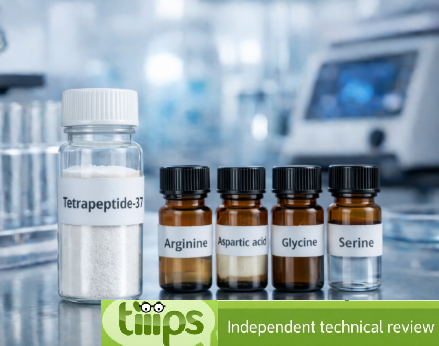
Tetrapeptide-37 is a synthetic peptide (tetrapeptide) made of four amino acids linked by peptide bonds. In the context you indicated, it is composed of arginine, aspartic acid, glycine, and serine. In cosmetic formulation it is used as a skin conditioning active, with positioning aimed at improving sensoriality and supporting a more even-looking skin surface, depending on dose, vehicle, and overall formula architecture.
Definition
Tetrapeptide-37 is a small oligopeptide, designed to be compatible with predominantly aqueous or hydro-glycolic cosmetic systems. By nature, tetrapeptides show a profile of surface interaction influenced by polarity, charge, and the formulation environment, with a potential contribution to skin conditioning and perceived comfort, especially in leave-on products.
Peptides, natural and synthetic, have the ability to activate an immunomodulatory action by interacting with the cells of the immune system. (Werner GH. Natural and synthetic peptides (other than neuropeptides) endowed with immunomodulating activities. Immunol Lett. 1987 Dec;16(3-4):363-70. doi: 10.1016/0165-2478(87)90170-2. )
Main uses
Cosmetics
Typical use in leave-on products (serums, gel-creams, light emulsions, eye contour) where a skin conditioning contribution and improved skin-surface sensoriality are desired. It can also be included in body lotions or emulsions when the formula is optimized for stability and compatibility with preservatives and polymers.
INCI functions
Skin conditioning agent. It is the mainstay of topical skin treatment as it has the function of restoring, increasing or improving skin tolerance to external factors, including melanocyte tolerance. The most important function of the conditioning agent is to prevent skin dehydration, but the subject is rather complex and involves emollients and humectants that can be added in the formulation.
Industrial use
Peptidic raw material for skin conditioning and “skin feel enhancement” lines, often combined with humectants, film formers, and barrier-support systems, where perceived outcome depends strongly on vehicle, pH, and electrolyte presence.
Identification data and specifications
| Characteristic | Value | Note |
|---|---|---|
| INCI name | Tetrapeptide-37 | Cosmetic denomination |
| Description | Synthetic peptide with 4 amino acids | Skin conditioning |
| Origin | Synthetic | Quality depends on supplier grade |
| Molecular formula | C15H27N6O8 | Calculated based on Arg + Asp + Gly + Ser (4 residues) |
| Molecular weight | ~419.4 g/mol | Indicative, linked to the stated composition |
| Commercial form | Powder or solution | Often in a hydro-glycolic carrier |
| Assay (title) | Variable | Depends on specification and purity |
| Impurity profile | Variable | Depends on synthesis, purification, and standardization |
Physicochemical properties and composition (indicative)
| Characteristic | Indicative value | Note |
|---|---|---|
| Physical state | Powder or solution | Depends on commercial grade |
| Color | White/off-white | Varies with purity and carrier |
| Odor | Mild or neutral | Often driven by the carrier |
| Water solubility | Moderate to good | Improves with compatible co-solvents |
| Stability | Good under controlled conditions | Sensitive to extreme pH and oxidative stress |
| Electrolyte compatibility | To be verified | Possible haze at high ionic strength |
| Main component | Tetrapeptide-37 | Functional active |
| Typical relevant impurities | Truncated peptides, salts/inorganics, trace solvents | Controlled to specification and by batch |
Functional role and mechanism of action
In practical formulation terms, Tetrapeptide-37 is used for its skin conditioning contribution, with a rationale centered on improving sensoriality and supporting a more “well-cared-for” skin feel. Practical performance depends primarily on dose, vehicle system, and synergies with humectants, film formers, and sensorial polymers. As with many peptides, results are strongly influenced by peptide stability within the matrix and the ability of the formula to keep it solubilized without undesired interactions.
Formulation compatibility
In general, it is compatible with O/W emulsions and aqueous or hydro-glycolic systems, provided the formula is designed to minimize incompatibilities related to charge and salts. It is advisable to keep pH in a non-extreme range and verify stability in the presence of anionic or cationic polymers, which may affect clarity and viscosity. In high ionic-strength systems, it is appropriate to test the risk of haze or precipitation and evaluate co-solvents or an alternative commercial grade.
Pros and cons
Pros
Small molecular size supports integration into many leave-on bases oriented to skin feel and conditioning.
Clear INCI positioning as skin conditioning, easy to place within sensorial and cosmetic-support claims.
Good formulation flexibility when carrier, pH, and preservatives are well selected.
Cons
Performance and reproducibility may depend significantly on supplier grade, carrier, assay, and impurity profile.
Potential sensitivity to extreme pH and to formulas with high ionic strength or reactive polymers, with a risk of haze.
Need for clear specifications on purity and impurities (truncated peptides, salts, solvents) to control batch-to-batch variability.
Safety, regulatory, and environment
Allergen
Not a typical fragrance allergen. In general, cosmetic peptides show a relatively low intrinsic allergenic risk, but tolerability should be assessed on the finished product as a function of concentration, vehicle, and impurities.
Contraindications
Use caution on very reactive or compromised skin, especially in high-dose leave-on products. If the formula shows instability (haze or precipitation), the matrix should be corrected because instability can worsen comfort and potential irritation.
Regulatory/claim note
The skin conditioning function is coherent with cosmetic use; any additional claims should be supported by an appropriate technical dossier (stability, compatibility, performance testing) consistent with the commercial specification and the product matrix. The safety assessment of the finished cosmetic product remains decisive under the applicable regulatory framework.
Formulation troubleshooting
Haze in aqueous systems: increase a compatible co-solvent, optimize pH, reduce electrolytes, revise order of addition.
Quality loss over time: run stress tests (temperature and light), evaluate more barrier packaging, verify peptide stability within the preservative system.
Polymer incompatibility: reformulate using less interactive polymers or modulate ionic strength, verifying viscosity and clarity.
Conclusion
Tetrapeptide-37 is a synthetic four–amino acid peptide with INCI function skin conditioning, mainly used in leave-on products to support sensoriality, comfort, and perceived quality of the skin surface. From a formulation-development standpoint, the most critical factors to achieve stable and reproducible results are selecting the appropriate commercial grade (assay and impurity profile), integrating the carrier properly into the matrix, and controlling compatibility parameters (pH, electrolytes, polymers, and the preservative system). Final evaluation should always be performed on the finished product, verifying stability (clarity/precipitation), perceived performance, and tolerability as a function of concentration and vehicle.

